



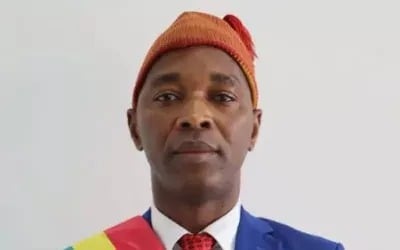

Nigeria has moved to provide asylum and protection to Fernando Dias da Costa, Guinea-Bissau’s opposition presidential candidate, following reported threats to his life after last week’s military coup, The Cable reported on Monday.
The coup was announced by military officers on Wednesday, just days after Guinea-Bissau’s presidential election in which both incumbent President Umaro Embaló and his main challenger, da Costa, claimed victory before official results were released.
Former President Goodluck Jonathan, who led ECOWAS observer team to the poll, questioned the genuineness of the coup, hinting that it was staged by President Embaló.
Nigeria condemned the takeover and urged an immediate return to constitutional order.
In a letter to the President of the Economic Community of West African States Commission, Omar Touray dated November 30, the Foreign Affairs Minister, Yusuf Tuggar, said President Bola Tinubu had approved asylum and protection for da Costa inside the Nigerian embassy in Bissau.
Tuggar wrote that the decision was made in response to threats made against da Costa’s life.
“I write to inform you that His Excellency, President Bola Ahmed Tinubu, GCON, has graciously approved the provision of protection and security in the premises of the Nigerian Embassy in the Republic of Guinea-Bissau, for Mr. Fernando Dia Da Costa. Mr. President’s decision is a proactive measure to ensure the safety of Mr. Da Costa, in response to imminent threats to his life.
“The decision to accommodate Mr. Da Costa within the Nigerian premises, underscores our firm commitment to safeguarding the democratic aspirations and the sovereign will of the good people of the Republic of Guinea-Bissau.
“In this regard, it would be appreciated if you would kindly mandate the ECOWAS Stabilization Support Mission in Guinea-Bissau to provide him protection and security while in the premises of the Nigerian Embassy.
“Please, accept Dear President, the assurances of my highest consideration,” the letter read.
The special assistant on media and communications strategy to the foreign minister, Alkasim Abdulkadir, confirmed the letter’s authenticity to The Cable.
He said, “The decision of the Federal Government of Nigeria to grant asylum and provide protection to Fernando Dia Da Costa falls squarely within Nigeria’s sovereign responsibility and longstanding commitment to regional peace, stability, and democratic governance.”
He added that Nigeria acted “in the broader interest of de-escalation,” saying the government had exercised its discretion “to prevent further deterioration of tensions and to promote social cohesion in Guinea-Bissau and the wider West African sub-region.”
According to Abdulkadir, the intervention aligns with ECOWAS principles and reflects Nigeria’s role as a stabilising force in West Africa.
Following the coup, ECOWAS held an emergency virtual summit of heads of state and subsequently suspended Guinea-Bissau from the regional bloc until constitutional order is restored.
Meanwhile, ECOWAS Chairman and Sierra Leonean President, Julius Bio, said he has held talks with the military leadership of Guinea-Bissau, as regional efforts intensify to restore constitutional rule in the troubled West African nation.
In a statement posted on his X account on Monday, Bio said the engagement followed resolutions reached at an extraordinary session of the ECOWAS Mediation and Security Council.
“Pursuant to the communiqué of the Extraordinary Session of the ECOWAS Mediation and Security Council, I engaged in a constructive discussion with the military leadership of Guinea-Bissau,” he wrote.
Bio added that the regional bloc remains firm in its push to ensure democratic governance is reinstated in the country.
“As Chairperson of the Authority of Heads of State and Government, I reaffirmed ECOWAS’s unwavering commitment to restore constitutional order,” he said.
ECOWAS intervention in Guinea-Bissau comes against a background of deep-rooted political instability and a history of military coups in the country.
Since gaining independence in 1974, Guinea-Bissau has suffered repeated disruptions to democratic governance, with frequent military interventions.
The current crisis erupted following national elections held on 23 November 2025. Both the incumbent president, Umaro Embaló, and the main opposition candidate, Fernando Dias da Costa, claimed victory which triggered tensions.
On 26 November, soldiers moved on the country’s key government sites, announcing they had “taken total control,” suspending the electoral process and sealing off all land, air and sea borders while imposing an overnight curfew.
By 27 November, the ruling junta, the High Military Command for the Restoration of National Security and Public Order, had appointed Horta Nta Na Man as transitional president for one year. Shortly after assuming power, the junta reversed its decision to keep the country sealed: the borders were reopened to ease economic pressure and mitigate humanitarian concerns.











Leave a comment