




In mineral-rich communities across Nigeria, a cycle of deaths has been unleashed on families whose loved ones are dying in illegal artisanal gold mines where crude tools, unstable pits and toxic chemicals have yielded a harvest of environmental damage unchecked, writes VICTOR AYENI
T he steady scrape of Jamal Abubakar’s shovel echoed as he cleared the overgrown weeds at the front of a client’s building.
Abubakar had been working with a building construction company within an estate in Magboro, Ogun State, when another client paid him to clear their front lawn.
The 28-year-old moved to the state just over three years ago, leaving behind Kebbi State, where he had spent much of his early adult life.
In Kebbi, he toiled as an artisanal miner, navigating the dusty, uneven terrain of one of the numerous mines dotting the outskirts of the bustling town.
Each day in the mine was a test of endurance, with the sun beating down on open pits and the echo of pickaxes striking stone filling the air.
“The job no easy,” he said in Pidgin English. “I dey work there from morning reach night. They pay me N4,000.” He described the artisans he worked with as a small group who mined for minerals using basic, low-tech methods, often as a subsistence livelihood.
Ideally, these miners are meant to operate with permits and be affiliated with large companies, but Abubakar noted that they worked independently, and admitted there was a shared understanding that the activities were often illegal.
According to him, they extracted minerals from the ground using rudimentary tools, transported them to the surface and processed them.
“We have superiors who also report to other senior people, and when we are done at a site, they may call us to go to another site. Both men and women work there, but they prefer young men who can endure the work, and there are also young boys who collect the sand as we dig.
“The work is not easy, but we do it because they pay daily. It’s still better than stealing or committing other crimes. But one has to be careful all the time; we have to be on the lookout even though some of our superiors hire security, because anybody can attack us and take the minerals,” Abubakar told Sunday PUNCH.
Although Abubakar said he never witnessed a mine-pit collapse or any major accident during his years in illegal mining, he recalled one incident that still lingers in his memory, unsettling him to this day.
“Nasir was one of my close friends. His mother is from my home state, Borno. His brother told me he had gone to work at a mining site when the pit collapsed. Nasir died there with others before help could reach them. He was just 24. He died for nothing,” Abubakar said, shaking his head slowly.
Bloody gold rush
Sunday PUNCH gathered that illegal mining is prevalent in states such as Kaduna, Katsina, Kebbi, Kogi, Nasarawa, Niger, Plateau, Zamfara, among others.
An estimated 80 per cent of mining in these areas is conducted illegally on an artisanal basis, involving over two million people who depend on it for survival, according to African Business.
It was learned that of all illegally mined minerals in Nigeria, gold tops the list, primarily due to its high value, relative ease of mining, and convertibility, which makes it easy to smuggle.
Illegal gold mining is widespread in the North West, North Central, and South Western regions and has been linked to organised criminal networks, involving both local and foreign actors.
Artisanal gold mining, a major source of income in mineral-rich states across Nigeria, has gained new visibility in recent months due to mine-pit incidents that have occurred.
Reports from mining artisans indicate that these mining pits are typically excavated without any geomechanical engineering or protective supports for walls and ceilings, exposing miners and passersby to risks of subsidence and collapse.
Consequently, experts, federal and state authorities, and security agencies have warned that the industry’s rapid and largely unregulated growth has contributed to environmental degradation, loss of revenue, and insecurity.
‘Many deaths are covered up’
An artisan who had worked at such mining sites in two states, who gave his name simply as Jubril, disclosed that the casualties that occur during the work are often covered up.
“There are many incidents that are not known to the public. You just see a pit collapse, and our colleagues die. Those who survive are the fortunate ones. There are sites that hire us from neighbouring states, and they tend to pay more. So once a person dies there, that is all,” he said with a sigh.
Jubril added that even when someone reports to the police, “it doesn’t go beyond that. The people are dead, so what can anyone do? The best is to tell their families if they can contact them, and work continues.”
He further disclosed that in most of the sites he worked at, there were no records or logbooks of artisans, many of whom he admitted could not read or write.
“They are brought there by friends. And most of this work is done from evening till dawn, so anything can happen to you while you are working. We rely on God for protection,” Jubril added.
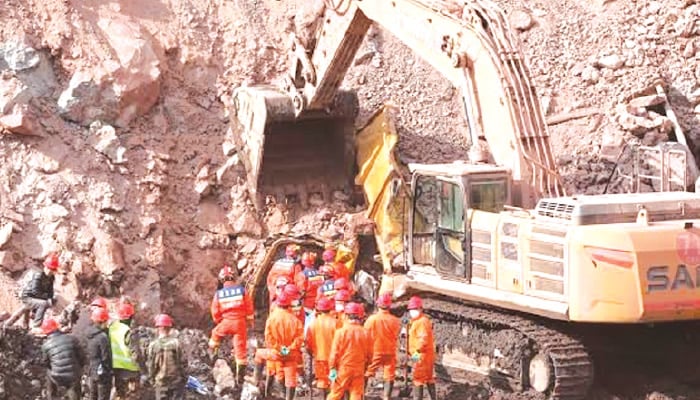
On September 27, Sunday PUNCH reported that at least 13 bodies were recovered, while many others were still trapped following the collapse of a mining site in Kadauri village, in the Maru Local Government Area of Zamfara State.
An eyewitness who narrowly escaped death, Sani Hassan, told Sunday PUNCH that he was among those fortunate to survive the incident.
According to him, he was digging for gold in the pit on Thursday when he suddenly stepped out to drink water.
“Just a few minutes after I came out of the mining pit, it suddenly collapsed and buried some of my colleagues. There were more than 30 people inside. Eleven dead bodies were evacuated, while several others are still there,” he said.
A resident involved in rescue efforts, Sanusi Auwal, told Reuters that no fewer than 13 bodies had been retrieved from the rubble, including that of his cousin.
In a statement issued by Segun Tomori, the Special Assistant on Media to the Minister of Solid Minerals, Dele Alake, he said the collapse was caused by heavy rainfall and worsened by the unsafe practices of illegal miners. It trapped at least 15 itinerant workers.
Alake described the incident as “tragic and entirely preventable,” noting that illegal miners had descended on the site using crude tools after discovering gold, with little regard for environmental or safety standards.
Mines turning to graves
Within a year alone, there have been many incidents of mine-pit collapse that have thrown many families into mourning and turned mining sites into graveyards for many young people.
In August 2025, tragedy struck at the Ajirija lead-mining site in Ihietutu Community, Ishiagu, Ivo Local Government Area of Ebonyi State.
According to eyewitnesses, the incident occurred at the site when the mine pit collapsed, leaving two persons dead and three others critically injured.
The site was allegedly parcelled out and sublet to unlicensed petty miners who operated without professional supervision. An indigene of the community told the News Agency of Nigeria, on condition of anonymity, that the incident was one in a series of unreported tragedies at the site.
He recalled that a similar incident had occurred earlier in the year and had also claimed two lives and left several others injured, yet no sanctions were imposed on the site owner or the illegal operators.
That same month, at least five women died after an illegal mining pit collapsed in the Paikoro Local Government Area of Niger State.
According to sources who spoke to Zagazola Makama, the women who lost their lives were identified as Tani Abubakar (who was pregnant), Farida Mustapha, Farida Sule, Khadijat Abdullahi, and Zainab Usman — all from Budu and Panbi villages.
“Security operatives visited the scene, where the victims were exhumed and rushed to the General Hospital, Paiko. Sadly, they were confirmed dead on arrival. Their corpses have been deposited at the hospital for autopsy,” the sources said.
Similarly, in April, two suspected illegal miners — identified as Buhari and Mallam Tasiu from Kano State — died following the collapse of a mining pit located in Farin-Doki, Shiroro Local Government Area of Niger State.
In the same Niger State in June 2024, dozens of gold miners died when a pit collapsed after heavy rainfall.
Niger state emergency service agency spokesman Hussaini Ibrahim told the BBC that one person has been confirmed dead, but they believe that over 30 people were trapped in the rubble.
He said that four excavators and rescue workers were at the scene trying to help those trapped.
Alake said that officials of the Mines Inspectorate visited the mining site in Galadima Kogo.
“Rest assured, we will investigate the causes of the disaster to prevent a recurrence and ensure the safety of all Nigerians,” he said in a statement.
In 2023, mining activities were banned in the Shiroro area, where the mine collapsed, along with neighbouring districts, due to insecurity and safety concerns.
A vicious cycle
Findings by Sunday PUNCH showed that in almost every site where a mine-pit collapse occurs, there is often a cycle of artisans returning to the site to continue extracting gold.
“There is a lot of greed involved. If security operatives raid an illegal mining site and order the people to leave, give it a month or two, and you will find them back there again. Even when a mine-pit incident occurs, after a while, you find that they are back.
“So, it’s not shocking to find that incidents keep happening in the same place. This year, the pit will trap 10 people; next year or in the next two years, 13 people. It’s as if the earth keeps devouring those exploiting its resources, but greed is in action,” an engineer, Leke Atobiloye, said.
He added that there is also a lot of infighting and external violence involved in illegal mining, and that is why it is such a sensitive subject to discuss.
“There are also some community rulers who are paid by some foreigners behind these illegal activities to look away, while the negative effects of illegal mining ravage their environments. It’s a bad situation,” Atobiloye added.
For instance, in March, at least five miners were confirmed dead following the collapse of a mining pit at an illegal mining site within the Gashaka-Gumti National Park.
The Chairman of Toungo LGA, Suleiman Toungo, revealed that the exact number of miners buried beneath the rubble could not be determined.
He explained that the illegal mining activities were frequently conducted at night in the Kogin Bama District of Tila village, despite being located inside a national game reserve protected by the Nigeria Security and Civil Defence Corps.
The miners were reportedly digging for gold in the Buffa zone of the Gashaka-Gumti National Park — an area known for its rich mineral deposits and history of unregulated mining — when the incident occurred.
‘An outcome of negligence’
Reacting to the Zamfara mine-pit collapse that claimed 13 lives in September, the Federation of Nigerian Mining Host Communities, in a statement jointly signed by its co-chairs, Temitope Olaifa and Alhaji Abubakar Wushishi, decried the weak regulatory oversight in the country’s mining sector.
The FNMHC emphasised that the disaster highlights the daily dangers faced by residents of mineral-rich host communities across Nigeria.
“This preventable incident is yet another outcome of negligence, poor oversight, and the failure to apply proper safety measures,” the federation said. “These lapses continue to put lives at risk and must no longer be tolerated.”
An associate professor of Disaster Risk Management and Development at the Federal University Wukari, Taraba State, Dr Odudu-Abasi Inyang, told Sunday PUNCH that Nigeria started experiencing mine-pit disasters as a result of the increase in largely illegal solid-mineral mining across the country.
“Mine collapses can be caused by many factors, but mostly natural events like heavy downpour (rain) that could result in the ground becoming heavily soaked and thereby breaking in, as well as unprofessional ways of constructing the mine in the first place.
What needs to be done to prevent or reduce mine collapse is proper regulation. Illegal mining has to stop in the first place. Mining activities should be properly documented and monitored by the government.
“Mine pits should be constructed by qualified professionals who will consider soil properties, and modern equipment, such as underground tracking and safety gear, should always be used. This will reduce the number of mine-pit collapses and limit casualties,” Inyang explained.
Billions in lost revenue
With the growth of illegal gold mining has come mounting economic losses.
Trillions of naira have been lost to unlicensed mining operations, according to the Nigerian government.
Recently, the Federal Executive Council approved N2.5 billion for the procurement of satellite surveillance and remote-sensing technology to monitor mining sites in real time — to track ongoing extraction, truck movements, and other security challenges.
In August, the immediate past Commissioner of Police for the Federal Capital Territory, Ajao Adewale, warned that unlicensed mining cartels are likely exacerbating wider economic and security challenges by diverting resources to banditry, terrorism, and other organised crimes.
According to an estimate, state security officials claim that Nigeria may be losing N13.7 trillion annually to illicit mining and smuggling activities.
Last year, the Chairman of the House of Representatives Committee on Solid Minerals, Jonathan Gbefwi, disclosed that illegal mining activities in Nigeria cost the country about US$9 billion annually.
The lawmaker lamented that only three per cent of royalties gets paid into government coffers by the few miners legally licensed to operate.
To this end, mining marshals — a special enforcement unit established by the federal government in collaboration with the Ministry of Solid Minerals Development and the NSCDC — said they have arrested more than 320 suspected illegal miners and closed down almost 98 illegal mining sites in the first 12 months of operations.
Scientific insights on biogeochemical impacts
Providing new scientific insight on the effects of artisanal and small-scale gold mining, a team of Nigerian researchers noted that the future of gold mining hinges not only on extraction but also on sustainability.
Checks by Sunday PUNCH showed that informal processing of gold ore typically involves mercury and cyanide — both known to have serious health and environmental impacts.
Toxic chemicals like mercury and cyanide used in ASGM seep into the soil and nearby water bodies, contaminate rivers and groundwater, and make them unsafe for drinking, farming, and aquatic life.
When these illegal miners use liquid forms of heavy metals to extract gold without proper technology, it results in the deposition of toxic compounds into the environment.
These chemicals find their way into fish, which are in turn consumed by humans, thus leading to health hazards.
Studies have shown that these pollutants from illegal mining sites can enter waterways and soils and become concentrated in food crops, leading to long-term health issues for local populations.
A recently published chapter from the book Soil Microbiomes in Green Technology Sustainability by Olaniyi Popoola, Olusola Ogundele, Abayomi Ladapo, and Samson Senbore took a look at how gold mining impacts soil health.
The authors argued that ASGM activities in Nigeria disrupt biogeochemical cycles and affect key microbial processes vital for soil fertility.
Mercury and cyanide used in ASGM pollute air, soil, and water bodies; being highly mobile, they persist in the environment, leading to accumulation and potential contamination.
The authors concluded, “Our findings underscore the need for stringent regulations, including mandatory environmental impact assessments before mining activities, government oversight, community engagement, and site remediation to safeguard environmental and public health.”
In another recent study published in Environmental Science and Pollution Research, researchers showed that well-planned soil cleanup strategies can successfully reduce dangerous heavy metals in land affected by mining.
The work took place in the Oronogo–Duenweg area of southwestern Missouri, a US Environmental Protection Agency Superfund site.
For decades, mining and smelting released large amounts of lead, cadmium, and zinc into the soil, leaving the land unsafe and difficult for plants to grow.
Although earlier cleanup efforts removed the most heavily contaminated layers, exposing deeper, nutrient-poor layers that still contained high levels of cadmium and zinc, hampered the natural regrowth of vegetation.
Egondu Umeobi, one of the Nigerian researchers currently at The Ohio State University, said the team wanted to see whether applying compost at different rates could help restore damaged soil.
“Heavy metals tend to stay in the soil for a very long time,” Umeobi said. “But in our study, the soils treated with compost showed overall health similar to the native prairie and far better than the untreated site.”
The findings also point to encouraging results for food-chain safety. “Lead, cadmium, and zinc levels in plant tissues were all well below the limits considered safe for livestock,” she added.
Calls for reforms
Experts and stakeholders have faulted government action as inconsistent, partly due to “political, social and cultural” sensitivities around strictly enforcing licensing requirements and penalising illicit miners, especially in hard-to-govern parts of the country.
At a ministerial press briefing in July, Alake said, “The North West and North Central zones have become the base for illegal miners in the country.
“For states to conduct business the way they like, it can only happen with political support from the federal level. If the Federal Government is not ready to support or work with them, states may not be very supportive.”
Highlighting measures to curb mine incidents, a geologist and lecturer at Kogi State Polytechnic, Lokoja, Dr Seyi Mepaiyeda, said there should be proper mine valuation to determine the best mining method, whether surface or underground mining.
“Mine pits should be developed with quality materials that are strong and resistant to collapse. Furthermore, adequate health and safety structures should be put in place, such as personal protective equipment and modern tools,” he said.
For Abubakar, however, despite the tragedy he had seen from an illegal mining collapse, he still believes that whatever will happen has been predetermined by God; hence, he might return to his old work.
“I knew how much I made daily there in Kebbi. If I still find the opportunity here, I will do it again. I have people who can help me find another place where there are plenty of minerals, and I can join them to work,” he told Sunday PUNCH.















Leave a comment