



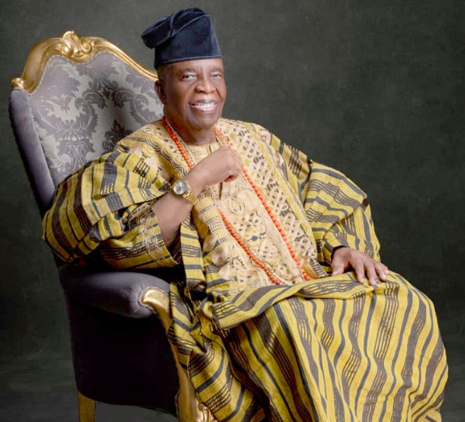
Few lives leave chroniclers in lasting awe, but that of the founder of the Doyin Group of Companies, Prince Samuel Adedoyin’s does. As Adebayo Adeoye reveals, his story is stitched with grit and grace.
The saying “When life gives you lemons, make lemonade” rings especially true in the life of Prince Samuel Adedoyin, founder of the Doyin Group of Companies. Stories of people who rise above adversity are not uncommon, but Adedoyin’s journey stands apart. It is a life so unlikely and compelling that it continues to intrigue even the most seasoned chroniclers.
Born on December 4, 1935, into the humblest of beginnings, Adedoyin’s story is stitched with grit and grace. His parents, Solomon Adedoyin Olaosebikan and Rachel Oni, were peasant farmers, good-hearted, hardworking, but poor.
His childhood was framed not by toys or comfort but by scarcity: shoes were a rarity, and hunger was a constant companion.
“I didn’t wear shoes until Standard Two. And in those days, only the first son was allowed to go to school,” he recounted in a recent encounter.
Although he was born in Lagos State, he was later taken back to his hometown, Agbamu in Kwara State, where he started his primary school education. However, he only made it to Primary Four before poverty closed the doors.
While many children were still shielded by love and innocence, young Samuel was already working—taking menial jobs after school to support his family and, at times, to survive. Farming, the dominant occupation in Agbamu, never excited him.
“If I wanted to further my education, I would have had to go to Offa to complete elementary school before proceeding to college,” he revealed. “That was the dream of many of us, but it only remained a dream. Offa Grammar School was very popular then, and it was the school people went to before proceeding to the university.”
The billionaire businessman and philanthropist did not hide his disgust for the early exposure to farming foisted on him by fate. In his account, it was a boring life that revolved around using hoes and cutlasses and going to the farm without shoes. Though he admitted that farming was his community’s occupation, he desperately needed a break from it.
“From the beginning, I knew I wasn’t going to do it for too long. I was considered by many as a lazy boy because I showed little or no interest in farming. I was a fragile boy. Again, we hardly fed from the little proceeds we derived from this peasant farming. My father was a polygamist and had several children. I was underfed because my father was poor. The situation wasn’t palatable at all.”
Those who crossed his path easily knew that he was restless and ambitious. He was always hankering after an opportunity to rewrite his story and turn his misfortune inside out. So what did he do?
His father’s divorce from his mother became the final push. Deeply attached to her, he knew he could not continue living under his father’s roof. A wild idea soon took hold of him: he wanted to escape. He resolved not to go to another town but England!
That thought became the genesis of the most audacious episodes of his life.
He slipped onto a ship as a stowaway, hoping to smuggle himself to the United Kingdom. But the dream collapsed in Takoradi, Ghana, where he was arrested.
Out of desperation, he begged an immigration officer named Mr. Koffi to save him. Miraculously, the officer took him in as a steward.
Asked why he made such an impulsive decision, he revealed that he feared his no-nonsense father would do the worst to him, hence he took his destiny into his own hands.
A few months later, the weight of working as a steward began to take a toll on him, so he again begged his boss to set him free. Luckily, Koffi obliged his humble request and handed him a princely sum of £2.
With it, he began selling padlocks and door hinges on the streets. Fate soon introduced him to a vendor of the Ashanti Pioneer, and that encounter opened doors: accommodation, a job, and a network. Slowly, survival began to look like progress.
When he eventually returned to Nigeria, it was with renewed purpose. In 1949, with a £46 loan from Standard Bank (now First Bank), he founded his first business: Jekoyemikale Oluwa and Brothers—translated as “Let me enjoy God’s blessings till the end of my life.” It was a name that would prove prophetic.
Adedoyin took a giant leap of faith. From a small corner on Dosunmu Street, Lagos, he traded umbrellas, imported bags, ballpoint pens—anything honest that could bring profit. Within a few years, he bought the shop he once rented, then more properties, then even more. His rise was swift but never reckless.
By 1968, he launched the conglomerate that would define his legacy: Doyin Group of Companies, now an industrial empire with subsidiaries spanning automobiles, manufacturing, property, and retail.
But like all other successful businessmen, he is not insulated from the vagaries of business. The respected industrialist became somewhat emotional when he recounted the liquidation of his bank, City Express Bank, by the Nigeria Deposit Insurance Corporation (NDIC). He intoned, “I regret investing in banking. But in life, there cannot be success all round.”
Through all the highs and lows, Adedoyin’s spirit remained unbroken. If anything, adversity only refined his humanity. He became one of Nigeria’s most committed philanthropists—funding scholarships, building institutions, and transforming countless lives across Kwara State and beyond. As fate would have it, many of his beneficiaries have risen to national prominence today.
Recently, he donated a state-of-the-art ICT building to Lagos State University, a testament to his belief that education changes destinies.
When asked to share the secret of his rise to fame despite the daunting challenges of his early years, he responded with a broad smile, “God has been kind to me. I have gone through some personal learning, practices, and experiences. So when I put all my situations into a text, or think back, I have to thank God for what He has done in my life. No matter who you are in life, you will experience some ups and downs.
“There was a time I could not eat or feed. You are here interviewing me at 90, without any defects. So, what complaint do I have to give to God? If I summarise everything, all I have is to thank God for the overall blessings and where I have reached.
“If you are a Christian, you will know that nothing is difficult for God to do. People said times were hard then, too, but God Almighty, who knows everything from everything, made some of us very successful, and it is still happening. No matter what you do in life, without His grace, it is nothing. I think life is by luck, God’s guidance, and blessings.
“God has been so kind to me in life. I feel highly privileged. The only way I can show my gratitude to Him is to use my resources to support the underprivileged. This I intend to do for the rest of my life.”
He sermonised that trusting and believing in God is the surest way to a fulfilled life, adding that “one should be closer to God. Some people don’t believe in the power of God and His supremacy over our lives. God has allowed me to believe in Him right from the beginning, which I still do. I think this is the backbone of my success. I think everybody should put God first in everything he or she want to do. And if one believes absolutely in Him, there will be no going back.”
Even though he is 90, Adedoyin is as sharp as ever. He attends long business meetings, signs cheques without glasses, and carries himself with the agility and clarity of a man decades younger.
When asked how he maintains such vitality, he fixed his gaze on the interviewer and offered a philosophy as simple as it is profound:
“Drink right, eat right, and do everything in the right way!”
But is this all there is to his good looks?
“Before, it was God who helped me. But now, I eat according to medical directives. I wouldn’t say that was all that saved my life. It’s God who saved my life. But I know it is good to eat right, drink right, and do everything right.”
Adedoyin’s journey is a testament to resilience, faith, and an unyielding belief that one’s beginning does not determine one’s end. From a barefoot boy in Agbamu to a business titan shaping lives and industries, his story is, in every sense, the Nigerian dream lived, survived, and mastered.













Leave a comment