



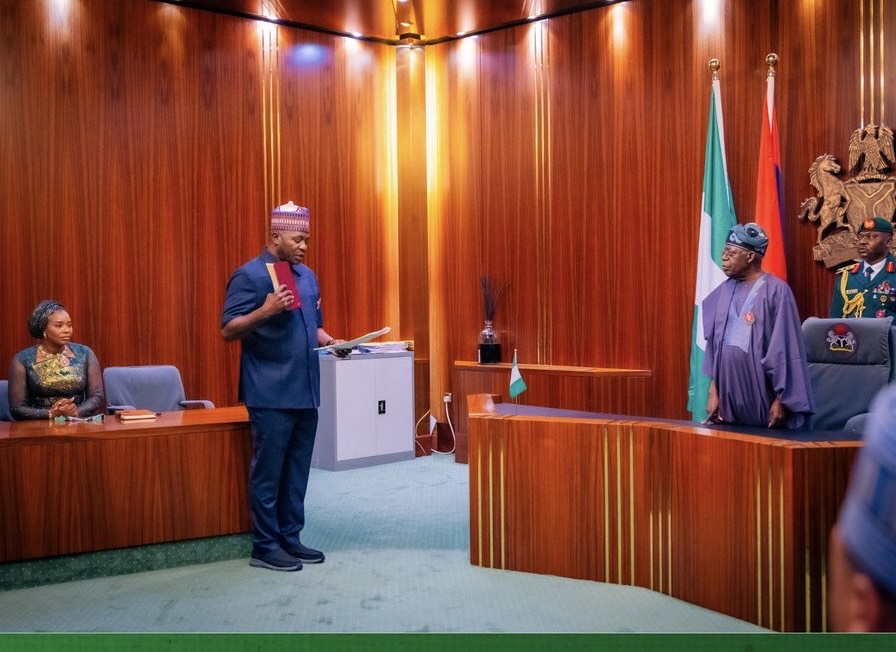
General Christopher Gwabin Musa (Rtd) stepped into his new role as Minister of Defence with a solemn oath that now shapes the expectations of a nation in need of firm, credible security leadership. His pledge to “preserve, protect and defend” the Constitution comes at a time when Nigeria faces a volatile mix of terrorism, banditry, separatist violence and economic sabotage. With Nigerians and the Federal Government looking to him for stronger coordination, improved troop welfare and a smarter, intelligence-driven approach, Chiemelie Ezeobi writes that General Musa carries the hopes of a country yearning for stability, one he must steer with courage, discipline and integrity
When General Christopher Gwabin Musa (Rtd) stepped forward to accept his appointment and be sworn in as Nigeria’s Minister of Defence last week, he did not begin with policy statements, political assurances, or broad promises.
Instead, he anchored his very first public commitment in the solemnity of the oath he swore, a declaration of allegiance and duty that now frames the expectations of a nation grappling with complex security challenges.
His appointment by President Bola Ahmed Tinubu was one that was heralded with joy by majority of Nigerians, who felt the lacuna in the security sector had given room for rising cases of insecurity across the nation.
A Minister’s Oath
Speaking with clarity and composure, the newly appointed minister delivered the constitutional oath of office, affirming that “I will be faithful and bear true allegiance to the Federal Republic of Nigeria, and that I will preserve, protect, and defend the Constitution of the Federal Republic of Nigeria, so help me God.
“That as Minister of the Government of the Federation, I will discharge my duties to the best of my ability, faithfully and in accordance with the Constitution and the law, and always in the interest of the sovereignty, integrity, and solidarity of the Federal Republic of Nigeria.
“That I will strive to preserve the fundamental objectives and directive principles of state policy contained in the Constitution; that I will not allow my personal interests to influence my official conduct or decisions; that I will abide by the Code of Conduct in the Fifth Schedule of the Constitution.
“That in all circumstances, I will do right to all manner of people, according to the law, without fear or favour; and that I will not directly or indirectly communicate or reveal to any person any matter brought under my consideration as Minister of the Government of the Federation, except as required for my duties. So help me God.”
With this declaration, General Musa not only signalled his entry into office; he laid down the moral and constitutional framework by which he wishes to be judged.
Nigeria’s Security Realities
General Musa assumes responsibility at one of the most volatile moments in Nigeria’s contemporary security history. The country faces what is arguably its most complex mix of threats since the return to democracy in 1999, a layered conflict landscape with multiple, evolving dimensions.
Terrorism remains a persistent challenge, despite significant gains by the military. Boko Haram and Islamic State West Africa Province (ISWAP) continue to stage attacks in Borno and Yobe, while splinter cells and sleeper elements disrupt vulnerable communities. Though major territories have been reclaimed, the ideological and asymmetric nature of these groups means the conflict endures.
Banditry and kidnappings have transformed from isolated incidents into an organised criminal economy across the North-West and North-Central regions. Entire communities in Zamfara, Kaduna, Niger, and Katsina live under the constant threat of raids, abductions, and forced displacement. These criminal networks now possess sophisticated weapons, communications tools, and financial channels that rival formal structures.
The South-East faces the recurring cycle of violent agitations, with unknown gunmen, separatist-linked attacks, and targeted assaults on security personnel and public facilities. The region’s insecurity carries economic and political consequences that ripple across the federation.
Oil theft and maritime crimes in the Niger Delta continue to drain billions of dollars annually from Nigeria’s revenue stream. Despite increased operations by the Navy and joint task forces, illegal refining sites, pipeline vandalism, and sea piracy persist, undermining national economic stability.
Across board, other forms insecurity including cultism, armed robbery, cyber-enabled crime, and drug-related violence, has further complicated the national outlook, threatening public confidence in security institutions.
This is the landscape General Musa inherits: a nation confronting threats on every axis, with an urgent need for strategic coordination across the Armed Forces, the intelligence community, law enforcement agencies, and local authorities.
A Nation’s Expectations
With General Musa’s decorated military record and his experience as Chief of Defence Staff, expectations from Nigerians and the Federal Government are undeniably high.
First, there is a demand for results-driven leadership. Nigerians want a Defence Minister who will not only articulate policy but drive coordinated action, one who understands the terrain, the enemy, and the psychology of conflict.
Second, there is a growing call for inter-agency synergy. For years, gaps between the military, police, intelligence services, and paramilitary agencies have hindered operations. Musa is expected to leverage his background to unify these structures, ensuring information-sharing, joint planning, and a coherent national security strategy.
Third, citizens want improved protection for communities, particularly in rural areas where government presence is often minimal. Farmers want to return to their fields; children need to return to school without fear; markets and roads should no longer be battlegrounds.
Fourth, there is hope for a defence sector that is transparent, accountable, and free from waste. As global and local pressures push for responsible public spending, Musa is expected to drive reforms that improve procurement processes, enhance welfare for service personnel, and strengthen oversight.
Fifth, the military family, serving and retired, expects better welfare, equipment, and morale for troops. Decades of fighting have taken a toll, and the operational strength of the Armed Forces depends heavily on the well-being of those serving at the frontlines.
Finally, from the Federal Government, the expectation is simple but significant: deliver measurable improvement in security across all regions, restore confidence in Nigeria’s defence architecture, and provide the leadership required to translate policy into peace.
The Road Ahead for General Musa
As General Christopher Musa begins this new and weighty chapter, several guiding principles may serve him well because he must lead with firm resolve but also with humility, recognising that modern security management requires partnership, with communities, governors, civil society, and international allies.
Essentially, he must insist on discipline and professionalism, ensuring that the military remains a respected institution anchored in law, ethics, and service to the nation.
He must prioritise intelligence-driven operations, technological modernisation, and the restructuring of response units to match the unconventional threats Nigeria faces, just as he must also guard against political distractions, remain guided by the Constitution he has sworn to defend, and remember that the true measure of his leadership will be the safety of the millions of Nigerians who look to the government for protection.
Above all, he must stay rooted in the solemn vow he made on the day of his appointment, a promise not only to the state but to every citizen whose security, dignity, and hope depend on the strength of Nigeria’s defence leadership.
If he keeps that promise, history will record him not merely as a Defence Minister that was loved by Nigerians, but also as a leader who helped steer Nigeria toward a safer, more united future.














Leave a comment