



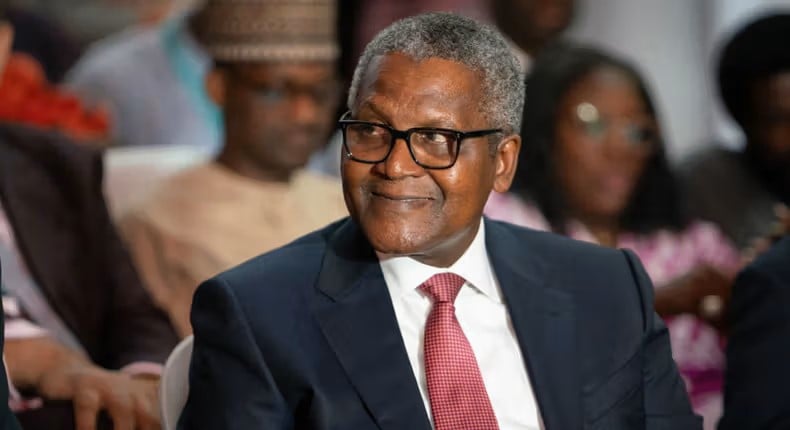

The Economic Community of West African States has announced plans to collaborate with Africa’s business mogul, Aliko Dangote and other private sectors, to strengthen financial stability and economic resilience across the region.
The initiative was unveiled by the President of the ECOWAS Commission, Omar Touray, at the 95th Ordinary session of the ECOWAS Council of Ministers in Abuja on Wednesday.
Touray revealed that Dangote has been chosen as the pioneer Chairperson of the ECOWAS Business Council, a new platform designed to mobilise private sector investment and support regional economic integration.
“We are moving forward with the operationalisation of the ECOWAS Business Council. We have identified Alhaji Aliko Dangote to be the pioneer Chairperson of the Council in view of his vast experience doing business within our subregion and across Africa.
“Through the Council, we hope to bring the private sector actors around the table as we discuss economic integration and development of our region.
“The Business Council will facilitate dialogue and partnership between the private sector, governments, and ECOWAS institutions,” he said.
The ECOWAS commission is seeking to reduce the region’s reliance on foreign investment by encouraging intra-regional capital flow.
“This appetite for intra-regional investment underscores the need to mobilise capital within our region to build our Community rather than wait for precarious foreign investments.
“I am confident that with the kind of investments we have seen from the likes of Alhaji Dangote, our regional private sector actors can lead the way in the development of our Community, if given the right incentives and opportunity,” Touray said.
Financial stability remains a central concern for the regional bloc.
Touray highlighted the challenges facing the West African Power Pool, describing it as “our flagship regional electricity market platform that is currently facing challenges on account of debts owed by national electricity companies.”
He called on member states to support efforts to recover these debts as part of broader measures to strengthen the regional economy.
In addition to private sector mobilisation, Touray’s speech addressed ECOWAS’s wider agenda, including regional resilience, monetary integration, and the activation of a regional force to counter terrorism.
Updates on the annual work programme, budget, and audits of ECOWAS institutions were also presented for consideration.
“It is our hope that your deliberations on the various items on the agenda will pave the way for a region that is self-sufficient, free from external control and vulnerability to external economic shocks,” he said.
In his remarks, Sierra Leone’s Foreign Affairs Minister and Chairperson of the ECOWAS Council of Ministers, Timothy Kabba, urged West African nations to strengthen cooperation in addressing regional security, economic, and democratic challenges.
Opening the session, Kabba said, “This meeting reaffirms our steadfast dedication to regional cooperation, guided by our collective vision of an integrated and prosperous West Africa.”
The minister noted that over the course of the two-day session, ministers would review reports and memoranda aimed at improving the community’s economic and political integration.
Marking the 50th anniversary of the Treaty of Lagos, the founding document of ECOWAS, Kabba emphasised the importance of economic integration.
“We must persist in our effort to foster an environment conducive to the growth of the private sector, the principal catalyst of the economic integration agenda,” he said.
He called for greater intra-regional trade, improved transport and energy connectivity, and full utilisation of the African Continental Free Trade Agreement to advance regional development.
The chairperson also addressed pressing security concerns across West Africa, including terrorism, violent extremism, organised crime, and unconstitutional changes of government.
He stressed, “It is self-evident that no single nation can confront these challenges independently. They can only be resolved through enhanced cooperation and mutual understanding among our member states.”
He called for investment in peace and security initiatives, joint intelligence efforts, and activation of the ECOWAS Standby Force.
Kabba condemned recent coups in the region, saying, “Our community must uphold a policy of zero tolerance towards military coups or any breaches of constitutional governance.”
He expressed concern over recent events in the Republic of Guinea-Bissau and the attempted coup in the Republic of Benin, stating, “These acts strike at the heart of constitutional order, democratic governance, and the collective values that bind us as a community.”
He also praised ECOWAS’ swift response to political challenges in Guinea-Bissau, noting, “Our swift and coordinated response, aimed at holding frank, open, and sincere discussions, is a clear testament to our collective and unwavering commitment to addressing the current political stirrings and restoring stability and constitutional order.”
Concluding his address, Kabba encouraged members to approach the session with determination and optimism.
In her welcoming remarks, the Minister of State for Foreign Affairs, Ambassador Bianca Odumegwu-Ojukwu, also cautioned against challenges facing the region.
“Recent years have witnessed political instability and lack of inclusivity, including forceful unconstitutional changes of government, deliberate prolonged transitions, and governance uncertainties and deficits in several Member States.
“These situations challenge not only the democratic values to which we have all subscribed, but also threaten hard-won development gains.
“They undermine citizen confidence and weaken the regional cohesion that has defined ECOWAS for half a century,” she noted.
The Nigerian minister stressed the importance of defending constitutional order and fostering inclusive political dialogue.
“We must therefore remain steadfast in defending constitutional order, promoting inclusive political dialogue, and supporting credible transitions that reinforce stability. Our unity and collective resolve are essential to navigating these periods of uncertainty,” she added.
Turning to economic integration, Ambassador Odumegwu-Ojukwu underscored the need for deeper intra-regional trade and opportunities for the youth.
“Our region’s future depends on deepening intra-regional trade, strengthening value chains, facilitating investments, and creating opportunities for the over 400 million people, especially the young people of 25 years and below, who constitute about 65 per cent of the population. They no doubt rely on ECOWAS to chart a path toward progress,” she said.
The minister highlighted the critical role of the council in shaping policy.
“The dossiers before you speak to crucial issues of governance, economic integration, humanitarian response, peace and security, agriculture and institutional effectiveness.
“As Ministers entrusted with steering the Community’s course, your insights and decisions will be instrumental in shaping the recommendations to be submitted to the Authority of Heads of State and Government,” she stated.
Concluding her remarks, Odumegwu-Ojukwu urged delegates to approach their deliberations with purpose and optimism.
West Africa is facing escalating political instability and security challenges, with several ECOWAS member states experiencing coups, attempted coups, and fragile political transitions.
Mali, Niger, and Burkina Faso remain under military-led administrations, while Guinea-Bissau recently joined this group following a military intervention. On Sunday, an attempted coup in the Benin Republic was foiled, further highlighting the fragility of democratic governance across the region.
These events underscore the erosion of constitutional norms, growing electoral tensions, and the rising influence of armed groups and criminal networks that threaten regional stability.
The situation is compounded by worsening humanitarian conditions, with millions of people displaced across Mali, Niger, Nigeria, and Burkina Faso.







Leave a comment