



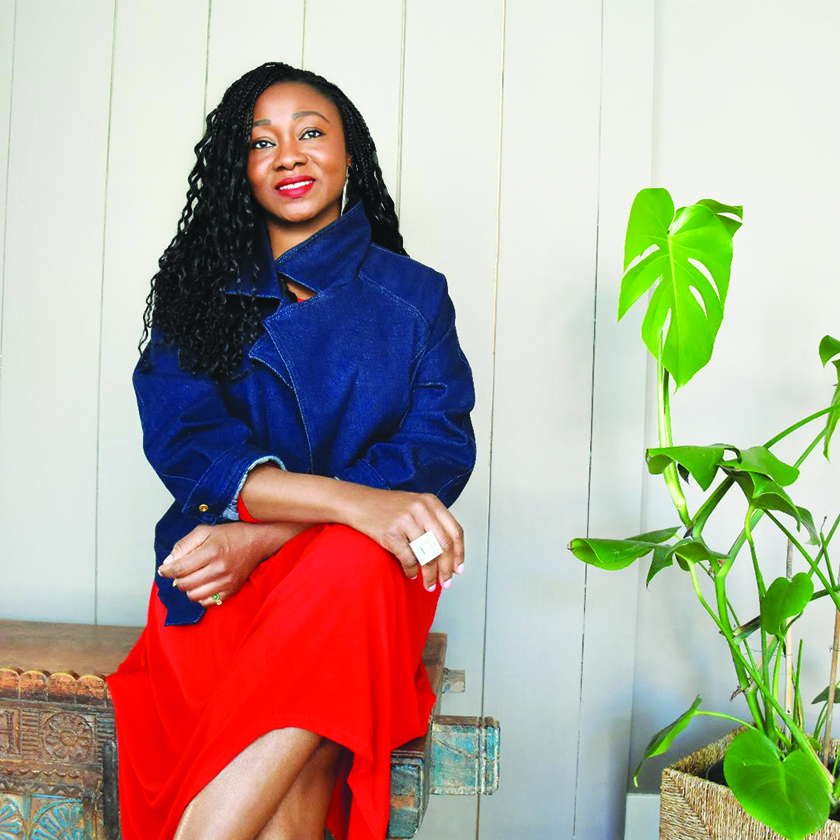
Bukola Oyebode moves across continents and exhibitions with a restless curiosity, always chasing stories that refuse to stay buried. Okechukwu Uwaezuoke writes
Stepping into the Central Museum of Textiles in the Polish town of Łódź that autumn, Bukola Oyebode must have struggled not to look like someone running on four hours of sleep. Perhaps—who knows?—she actually was. It would hardly have been surprising, given the packed schedule that had her hopping between continents, trying to keep her ideas in order, digging up histories she didn’t want to lose track of, and lugging around the stubborn weight of artistic memory. Still, beneath her calm exterior flickered the familiar restlessness of a mind circling back to unfinished notes and half-formed thoughts.
Her journey to this moment—co-curating the 18th International Triennial of Textile—didn’t begin with grand pitches or glossy presentations; it began quietly, almost casually, without the usual fanfare. It began, quite simply, with someone noticing. “I didn’t realise I was being observed prior to the invitation,” she says, still perhaps faintly flustered at the serendipity of being seen by the right eyes at precisely the right time. Those eyes, as it turned out, belonged to Marta Kowalewska, the museum’s chief curator and the seasoned helmswoman of the last two editions.
Earlier, Kowalewska—convinced that the Triennial’s future could use a little less monochromatic approach—had pitched to the Programme Council a curatorial expansion. And this meant more voices, wider horizons, fewer Eurocentric filters. “Their focus was expanding its curatorial process, reflecting the dynamics of the art world,” Oyebode recalls. In that desire for expansion, she found herself drawn into the day-to-day machinery of a European institution trying, in its own way, to rethink itself.
The work began in early 2024, and what awaited her was the kind of inbox shock that makes one pause and mutter, how did I end up here?: 1,600 portfolios from nearly 40 countries. Yet even amid the chaos, there was an almost anthropological thrill. The resulting exhibition, Deconstruction/Reconstruction, brought together 70 artists weaving meaning from textile, memory, and the very real political tensions shaping their worlds. “It became a space to rethink the current state of the world,” she says, with the clarity of someone who has seen what artists can dredge up when institutions finally place opportunities on a silver platter.
As if that weren’t enough to provoke a brief how-did-I-end-up-here? moment, destiny handed Oyebode an unexpected challenge. She was still knee-deep in the main show when she was asked—casually, as though tacking on a minor aside—to curate a collateral exhibition as well. Rhizomatic Portals: Ways of Knowing quickly became a broad, intergenerational gathering of African women artists, each contributing a story woven from heritage, intuition, and the deeper dimensions of cloth. She curated it with the kind of careful attention one reserves for something easily lost or mishandled, and with the precision of someone fully aware that African women cannot be neatly categorised. “I placed emphasis on weaving together self-stories and emotions,” she says, possibly a veiled warning to any visitor expecting a tidy, linear exhibition. The show, deliberately nonlinear, is a rich and improvisational weave of narratives: spiritual cosmologies, land regeneration, intergenerational memory, the tactile intimacy of textile practices, and the long shadow of colonial rearrangements. The statement could serve as a manifesto for her entire practice—an insistence that African art, like the lives it mirrors, resists simplification.
Artists like the Senegalese-French Aissa Dione, the Moroccan Amina Agueznay, and the Nigerian-born but US-based Peju Layiwola stand alongside younger practitioners not as contrasts but as continuities. Yet what sets Oyebode apart is the way she tenaciously holds on to historical detail, never letting a name or earlier contribution slip past unnoticed. “I try my best not to erase precious history,” she says, explaining her archival dig that unearthed Madame Zo, the late Malagasy artist whose presence in the 2007 Triennial deserved a return to the spotlight. Through an homage within the exhibition, Oyebode resurrected that legacy, quietly resisting the fashionable tendency to brand every contemporary African participation as a “first.”
Most people would have called it a day at that point. But Oyebode, by disposition averse to the run-of-the-mill, kept plodding on. While stitching together two exhibitions in Poland, she was simultaneously organising a satellite programme in Lagos for The Listening Biennial, a decentered global project where sound becomes a form of collective engagement. “This year has been exceptionally busy for me but also fulfilling,” she admits, carrying the weariness of someone who has finally paused long enough to take stock.
The Lagos exhibition, titled Wind Chimes, Gongs and Bells. For Whom Is This Call?, unfolded at the newly reopened Centre for Contemporary Art (CCA) Lagos—an institution intricately threaded into her own artistic story. Artists from Nigeria, Sudan, Switzerland, the Netherlands, and Cameroon converged, treating Lagos not as a brief stopover but as a place where global concerns and local rhythms could bump against each other. The Lagos Sound Artists’ Collective added a live sonic performance that felt like a communal exhale. At the emotional centre of this chapter was her return itself. “Returning to Lagos was a major highlight of my year,” she says. The journey wasn’t merely a flight home; it was a pilgrimage to the place where the late curator Bisi Silva had once taken her under wing. Being back at CCA Lagos, now helmed by Oyindamola Fakeye, felt like life looping back in a way she hadn’t fully anticipated.
Before all this continental shuttling and curatorial shape-shifting, there was TSA Art Magazine—the publication she founded and edited with a kind of devotion that felt more like a long-developed habit than a grand plan. The Nigerian art scene has always been vibrant, yet under-documented. “I consider my work in publishing a conscious archiving practice,” she says, as if archiving weren’t a herculean task but merely diligent stewardship. Through TSA, she collected stories, held space, and built a semblance of infrastructure where none existed.
Even when the magazine ended, the impulse did not. Its spirit reincarnated into TSA Ideas Lab, a laboratory for ideas that refuses tidy categorisation or labels. From there emerged new publications—the hybrid magazine/book Artists & Cities, the monograph Tracings of Time and Place on Nigerian-German artist Ngozi Ajah Schommers, Omonblanks’ Kids from the River, and the Momentum 12 publication Together As To Gather. Each felt like a quiet refusal to let important work fade into silence.
Speaking of Schommers’ monograph, she notes, “In an ideal ecosystem, she would have had one or two critical publications. Working on this was an act of recognising that gap and filling it.” On Kids from the River, she is equally emphatic, pointing to its refusal of neat categorisation and the challenge of finding a platform for such work. These choices reveal a through-line in Oyebode’s practice: a refusal to allow silence where documentation ought to exist.
Now, somewhere between China—her newest home—Poland, Nigeria, and The Netherlands, she is quietly plotting her next act. “I am in the early phase of preparing a publication bringing together some amazing women artists,” she reveals, though the slow pace of funding tempers the timeline. She is also nudging open the door to Asia, where future collaborations shimmer at the edge of possibility. Her career, it seems, doesn’t follow a neat, step-by-step path; it spreads out in unexpected directions, sometimes messy, sometimes brilliant, always in motion.
Oyebode’s story is not one of arrival but of continuous motion, of a curator, editor, and archivist whose work shifts depending on where she is and what she’s wrestling with. She is, in many ways, a listener—attuned to archives, to artists, to histories that resist forgetting. Yet she is equally a builder, reconstructing narrative linkages where institutions have left gaps. If the world is, as she says, in a state that requires rethinking, then her work—quietly insistent, meticulously layered—does not offer answers so much as ways of working through things: a method for knowing, a method for remembering, a method for stitching the world back together.








Leave a comment