



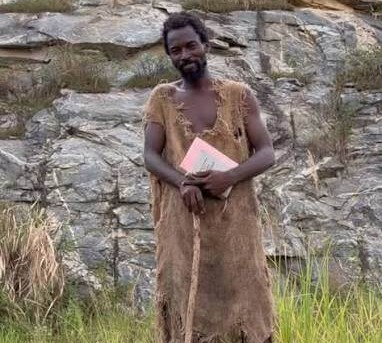

A Ghanaian man known online as Ebo Noah has drawn national and international attention for constructing wooden vessels he described as modern-day “Noah’s Arks,” claiming that God revealed to him a vision of a catastrophic global flood. Ebo Noah, sometimes called Ebo Jesus or Prophet Ebo, began sharing his mission earlier in 2025, posting videos and messages online in which he described a vision of relentless rain beginning on Christmas Day, December 25, 2025, and lasting for years. In these videos, he urged people to prepare for the deluge and join him on the arks he was building to survive the coming catastrophe.
The wooden structures were built in Kumasi and across the Ashanti Region, with footage showing large timber frames being assembled and groups of followers listening intently to his instructions. In his posts, Ebo often emphasised that multiple arks were under construction, some reports suggesting as many as 10. Each vessel, he claimed, was designed to accommodate both humans and animals, mirroring the biblical story of Noah. He framed the project as a divine mission, stating that the survival of the faithful depended on heeding God’s warning and preparing for the impending flood.
The story quickly gained traction across West Africa, with social media platforms buzzing with both support and criticism. Supporters praised Ebo Noah’s dedication and warned of the flood themselves, sharing his videos widely. Skeptics, however, questioned the practicality of building multiple large arks with local materials and noted that some of the vessels resembled fishing boats rather than massive ships capable of withstanding a global deluge. Religious scholars and commentators cited biblical passages, stating that God had promised never again to destroy the earth by flood, suggesting that Ebo Noah’s claims were inconsistent with the scripture. Nevertheless, he maintained that his instructions came directly from God, independent of conventional religious texts.
Thousands of people reportedly traveled to the ark sites in Kumasi and the Ashanti Region, camping nearby for days and selling personal belongings in anticipation of the predicted flood. Witnesses and videos described long lines of followers gathering around the wooden vessels, listening intently to Ebo Noah’s instructions, and preparing to board. The sheer scale of the crowds underscored the significant influence of his prophecy, drawing attention not only from local communities but also from social media users and international observers.
As his prominence grew, controversies quickly followed. Authorities detained Ebo Noah for 72 hours prior to December 25 amid concerns that his warnings were causing public panic. The arrest, widely reported in Ghanaian media, drew attention both locally and internationally. Officials later released him, acknowledging that religious prophecy is not a criminal offence, but the detention intensified scrutiny of his activities.
At about the time of the police scrutiny, reports emerged that Ebo Noah had acquired a luxury Mercedes Benz valued at $100,000.


This raised questions about whether donations from followers, originally intended for ark construction, had been diverted for personal gain. He, however, went around in sack clothing, defending himself that the funds were properly used for the project. But the timing of the purchase fueled skepticism and further criticism. Observers also questioned the size and authenticity of the arks themselves, suggesting that the structures might not be capable of withstanding a catastrophic flood. These controversies, combined with his growing online influence, created a storm of public debate.
Also Read:
Despite the intense attention, December 25 passed without the predicted flood. In response, Ebo Noah released additional videos asserting that the disaster had been postponed by divine instruction, urging followers to continue preparing and building additional arks. He framed the delay as part of a divine plan, claiming that God had granted more time to perfect the vessels and ensure the survival of the faithful.
In the wake of the failed prophecy, tensions escalated, with reports that some members of the public, angered or frustrated, attempted to set his vessels on fire. Authorities intervened and took Ebo Noah into custody for his own safety, preventing further attacks and stabilising the situation.
Critics, however, interpreted this adjustment as a pattern typical of failed prophecy movements in which predicted events are postponed rather than acknowledged as incorrect.
The movement surrounding Ebo Noah had tangible real-world effects. Followers traveled from across Ghana and neighbouring countries to visit the ark sites, with at least one international visitor from Liberia reportedly left stranded after the prophecy did not materialise. Many supporters reportedly sold personal belongings or made significant life changes in anticipation of the flood, reflecting the profound influence of his messages on his audience. Interviews with locals at the ark sites described long lines of curious onlookers and believers, some camping nearby for days to witness the construction firsthand.
Social media amplified the debate, with hashtags about Ebo Noah trending across multiple platforms. While some users defended his mission as genuine and divinely inspired, others criticised him for misleading followers and questioned his financial transparency. Videos showing him touring the arks, delivering sermons, and interacting with followers circulated widely, drawing both fascination and ridicule. Analysts pointed to the situation as a case study in how religious prophecy, viral social media content, and charismatic personalities can converge to produce both devotion and controversy in the digital age.
Follow The Eagle Online Channel on WhatsApp
[wpadcenter_ad id=’745970′ align=’none’]












Leave a comment