



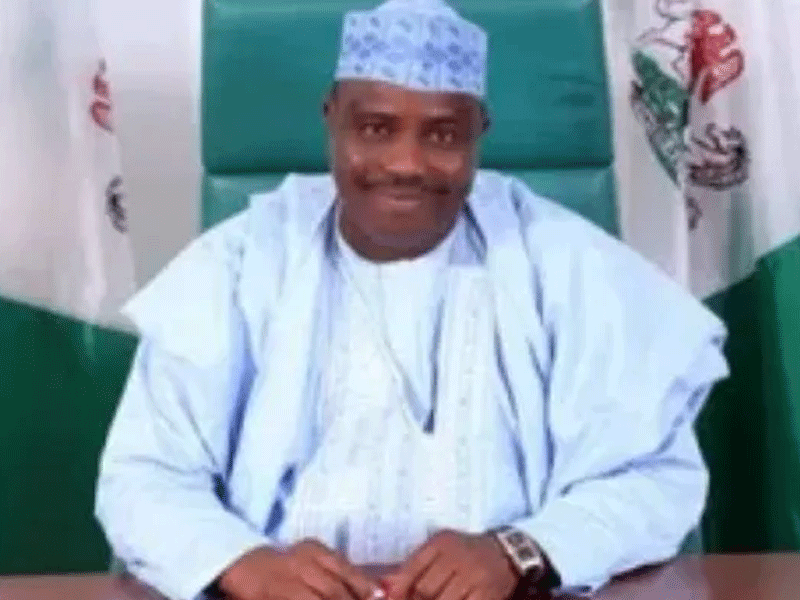
ADE EBIMOMI pays tribute to Tambuwal, politician and former Speaker of the House of Representatives, at 60
In 2011, Aminu Waziri Tambuwal happened upon our national consciousness when he won, against all compounding and confounding odds, the seat of the Speaker of the House of Representatives in the 10th Assembly. And for four years, Tambuwal fought for and achieved what an ideal separation of power is—as intended by the framers of our Constitution. When he picked the Sokoto State gubernatorial form in 2015, not a few national political observers believed he had more than a very good chance at winning the election, and that he would perform well in office. And he did. His eight years in Sokoto State remains a reference point for the people. As Tambuwal therefore clocks 60 this coming Saturday, many events are being lined up by friends and associates for the big occasion both in Sokoto and Abuja where he is back to the legislature as a Senator.
Born on 10th January 1966 and a lawyer by profession, Tambuwal started working at the National Assembly from the inception of the current democratic dispensation in 1999 when he was employed as a Special Assistant on Legislative Matters to then Senate Leader, Abdullahi Wali. Those four years (1999 to 2003) proved to be a solid foundation for Tambuwal’s later political career. The experience exposed him to the nuances of leadership as exemplified in his ability to work with men and women across political and religious divides while also teaching him how important it was for leaders to jettison their differences for the common good.
In 2003, Tambuwal contested and won a seat in the House of Representatives. As a lawmaker, Tambuwal brought his prior experiences as a teacher, lawyer and legislative assistant to bear on lawmaking. Even though he was not a household name at this point, Tambuwal was quietly working and achieving quite a range of legislative successes, which led to being elected by his peers as the Minority Leader of the House in 2005 and Deputy Chief Whip in 2007. He was also a member of various House Committees, including the Rules and Business, Communications, Judiciary, Inter-Parliamentary, and Water Resources.
Tambuwal’s ability to bring competing groups to work together earned him the sobriquet, ‘the Consensus Builder’. This attribute would come in handy when he contested the Speakership during his third term in the House in 2011. He defeated, rather convincingly, the candidate anointed by both his party and presidency, Hon. Mulikat Akande-Adeola, with 252 votes to 90. And throughout his tenure as Speaker, his integrity, knowledge of parliamentary procedures, and ability to build consensus made him an asset to the House and garnered for him the support needed to succeed. But this success wasn’t without its pitfalls and challenges. Several efforts were made to impeach Speaker Tambuwal but the respect he had earned across party lines, his knowledge of the inner workings of legislative processes and well-known ability to build bridges across political divides, helped him to survive all these moves.
Tambuwal’s ability to navigate the many traps and obstacles put on his way to serve his full term as House Speaker derived mainly from, and gave credence to, the premium he placed on national interest over partisanship conviction. The landmark successes he recorded during his Speakership were largely the results of his strength of character, a trait that helped align his vision with the will of his fellow legislators rather than party directives. His period of leadership remains, even up till this day, the only time in the Fourth Republic that the House of Representatives was able to remain truly independent of the Executive branch—just as the framers of our Constitution intended it. Tambuwal’s House was never at any time a rubberstamp to the Executive, an achievement that not too many other presiding officers can lay claim to under the current dispensation.
As governor of Sokoto between 2015 and 2023, Tambuwal made positive impacts on the lives of the people of his state. For eight years, he prioritized healthcare, infrastructure and education, particularly girl-child education while increasing school enrolment by over 100,000 pupils between 2016 and 2020. His integrity and transparency earned his administration several commendations and financial grants from the World Bank under the State Fiscal Transparency, Accountability and Sustainability (SFTAS) programme. Tambuwal was also committed to the welfare of the poor and the needy, bringing his renowned empathy and compassion to play.
Between 2015 and 2023, the administration’s economic reforms focused on boosting agriculture, empowering local enterprises, and improving the business environment. Some of the reforms and key initiatives Tambuwal embarked upon included support for MSMEs which led to the establishment of Sokoto Small and Medium Enterprises Development Agency (SSMEDA). The administration provided a N2 billion matching fund with the Bank of Industry (BoI), and a N1 billion in non-interest soft loans to traders and artisans. Other key initiatives of the administration included the creation of an ‘Ease of Doing Business’ structure to provide a conducive environment for commerce to thrive, reforms in the agricultural sector, including cooperation with private firms such as OCP Africa for a fertilizer blending plant, and Dangote for a rice mill, human capital investment, significant infrastructure investment, and fiscal transparency.
However, Tambuwal’s administration didn’t start and end with introducing key economic reforms and embarking on wide-ranging development initiatives. Shortly after he was inaugurated, he actually sought to streamline government processes and protocols and to recover lost and/ or stolen government properties including monies, in order to set the state back on the right foot. He also launched the exercise to rid the Sokoto State civil service of ghost workers. His investments in infrastructure in critical sectors of the state were the bedrock of his administration’s success.
Within the first five years, 250 primary healthcare centers were either constructed, renovated, upgraded and fully equipped across the rural communities. The Sokoto State University Teaching Hospital, Kasarawa and the Premier Hospital in Tambuwal Local Government Area were not left out. The Tambuwal administration also constructed a General Hospital in each of the three Senatorial zones and an advanced medical diagnostic and imaging center in Farufaru, Wamako Local Government Area.
Aminu Tambuwal has always demonstrated his love of country, championing national interest over parochial ones, constitutional reform, good governance, and national security. He has used every opportunity to remind national leaders to prioritize the welfare of the people and the wellbeing of the country. As he joins the Club of ‘Senior Citizens’ this coming Saturday, Tambuwal’s political journey presents a worthy example of how present and potential leaders would do great by prioritizing national development over sectional or parochial interests.
Although he has twice contested the presidential ticket of his party and failed, albeit narrowly on each occasion, Tambuwal has also demonstrated that seeking political offices needs not be a do-or-die affair. That perhaps explains why he was always willing to sacrifice his ambition for the greater good of the people. When he sat in the centre of the circle surrounded by his peers back at the 26th National Economics Summit in 2020 and declared that, for the country to progress, leaders must, by necessity, listen to the people, Tambuwal was only reiterating the conviction that has guided and shaped his life as a leader—the sort of leadership that our political firmament currently lacks but sorely needs.
As Tambuwal clocks 60, one can only wish him long life good health and many more years of active service to Nigeria.
Ebimomi is an Abuja-based public affairs commentator














Leave a comment