



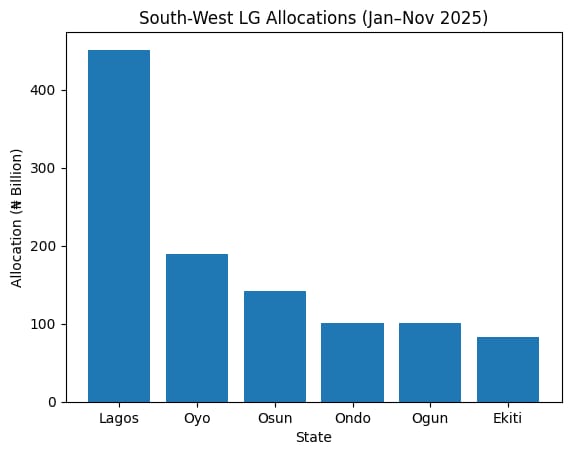
No fewer than 133 of the 137 local government areas in the South-West shared at least ₦965.29bn between January and November 2025, PLATFORM TIMES can report, even as millions of residents battle worsening insecurity, unemployment, inflation, poor infrastructure and climate-related disasters.
The figures, obtained from the BudgIT portal, which tracks federal allocations to all 774 local governments in Nigeria, cover councils in Ekiti, Osun, Ondo, Oyo, Lagos and Ogun states.
However, allocation data for four councils were not captured during the period under review — Gbonyin in Ekiti; Sagamu and Odeda in Ogun; and two local governments in Oyo State.
Despite the huge inflows to the grassroots, living conditions across the region continue to deteriorate, raising concerns about transparency, governance and the effectiveness of local councils in addressing pressing socio-economic challenges.
Ekiti: ₦83.1bn To 16 LGs Amid unemployment, Weak Infrastructure
Ekiti State, which has 17 LGs, recorded allocation data for 16 councils, excluding Gbonyin. The councils received a combined ₦83.10bn in 11 months.
Ado-Ekiti led with ₦6.87bn, followed by Ijero (₦5.98bn), Ekiti West (₦5.52bn), Ido-Osi (₦5.44bn) and Ekiti South-West (₦5.39bn). Ilejemeje received the least with ₦3.99bn.
The funds came amid high unemployment, decaying roads, poor healthcare facilities and heavy dependence on low-productivity agriculture. Notably, Ikole LG had no allocation recorded for March.
Osun: 30 LGs Share ₦141.35bn
All 30 local governments in Osun State shared ₦141.35bn within the period. Ife East (₦5.67bn), Iwo (₦5.57bn), Odo-Otin (₦5.49bn) and Ife Central (₦5.17bn) topped the chart, while Ifedayo received ₦3.79bn, the lowest.
Yet, communities continue to struggle with youth unemployment, failing schools, poor rural roads and overstretched primary healthcare centres.
Ondo: ₦100.97bn To 18 LGs As Insecurity Spreads
Although Ondo has 20 LGs, data were available for only 18 councils, which shared ₦100.97bn. Akure South received the highest allocation with ₦7.44bn, while Ose got ₦3.67bn.
The state faces rising cases of kidnapping, armed robbery and farmer–herder conflicts, especially in forested areas such as Owo, Akoko and parts of Ose. Poor road networks, weak healthcare systems and teacher shortages continue to undermine development in rural communities.
Oyo: 31 LGs Get ₦188.79bn Amid Banditry, Economic Strain
In Oyo State, 31 of the 33 LGs captured in the analysis shared ₦188.79bn, as allocation data for two councils were unavailable.
Ibadan North-East (₦7.78bn), Ifedapo (₦7.24bn), Egbeda (₦7.17bn) and Iseyin (₦7.16bn) were among the top beneficiaries.
Despite this, the state grapples with widespread insecurity, farmer & herder conflicts, environmental degradation, ineffective waste management and declining agricultural support, even as inflation and poor infrastructure squeeze households and businesses.
Lagos: 20 LGs Receive ₦451.07bn Under Megacity Pressure
All 20 local governments in Lagos received allocations totalling ₦451.07bn, the highest in the South-West. Alimosho alone got ₦31.20bn, while Ajeromi-Ifelodun received ₦24.77bn.
However, unemployment, high living costs, overstretched healthcare facilities, informal settlements vulnerable to disease outbreaks, and perennial flooding caused by poor drainage and climate change continue to expose governance gaps in Nigeria’s economic capital.
…₦100.7bn Flows To 18 Ogun LGs In 11 Months Amid Poor Roads, Joblessness
Local government councils in Ogun State received a combined ₦100.7bn in statutory allocations within 11 months in 2025, despite persistent complaints of poor infrastructure, unemployment and mounting pressure on social services across the state.
The figure covers 18 out of Ogun’s 20 local governments, as data for two councils were unavailable. Analysis of the allocations shows that Ado-Odo/Ota LG, one of the state’s most industrialised and populous areas, received the highest share at ₦9.22bn, followed by Remo North (₦7.02bn) and Ifo (₦6.74bn).
Other major recipients include Abeokuta South (₦6.12bn), Ijebu East (₦5.99bn), Yewa North (₦5.76bn) and Abeokuta North (₦5.76bn). At the lower end of the table were Ewekoro (₦4.14bn) and Ogun Waterside (₦4.26bn).
Despite the scale of funds flowing to the councils, many communities across Ogun continue to grapple with bad roads, rapid and poorly managed urbanisation, unemployment and overstretched health and education facilities, particularly in border towns and fast-growing industrial corridors.
Residents in peri-urban areas such as Ado-Odo/Ota, Ifo and Obafemi-Owode complain that infrastructure has failed to keep pace with population growth, while rural communities in Yewa and Ogun Waterside lament neglect, limited economic opportunities and poor access to basic services.
 ‘
‘ ‘
‘Do you want to share a story with us? Do you want to advertise with us? Do you need publicity for a product, service, or event? Contact us on WhatsApp +2348183319097 Email: platformtimes@gmail.com
We are committed to impactful investigative journalism for human interest and social justice. Your donation will help us tell more stories. Kindly donate any amount HERE











Leave a comment