



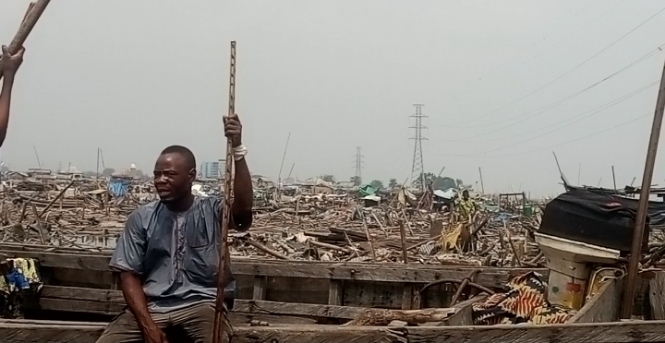
Makoko, one of Lagos’ oldest waterfront settlements, is once again at the centre of a contentious urban renewal drive that has seen homes demolished and families displaced. Officially justified as a safety measure around high-tension power lines, the exercise has revived long-standing concerns about the human, environmental and economic consequences of rapid urbanisation in Nigeria’s commercial capital, and the fate of vulnerable communities caught in its path. Esther Oluku reports
Something is happening along a section of Lagos’ coastline, gradually sweeping away what has variously been described as the Venice of Lagos, in a move to transform the area into a high-stakes waterfront residential zone in keeping with megacities around the world. If the ambition of the state is followed through as planned, thousands of men, women and children will be permanently displaced, thus bringing to the fore the environmental, human and economic costs of urbanisation.
Residents who spoke to journalists on Tuesday, January 14, 2026, said the demolition of the shanties began about three days before Christmas Day 2025, as excavators pulled down stilts which officials claimed were built too close to a set of power lines running across the lagoon.
Seventy-five-year-old Evangelist Isaac said: “Just days to the end of the year, the Lagos State Government came and destroyed the houses on the water which were close to the power lines. They said they were too close and demanded that we remove the structures within 30 metres of the power lines, which we agreed to.
“Later, after they had removed the structures within the 30-metre mark, they said they would extend the demolition to 100 metres. Again, we accepted. As we speak, they have destroyed structures within 200 metres of the power lines.
“We went to Alausa on Monday (January 13) to meet with the Permanent Secretary, Office of Urban Development, Gbolahan Oki, but he did not meet us. He told us that the governor himself would come to the land.
“Many people would have come to this meeting today, but they cannot leave their houses. One woman died on the occasion when policemen began throwing tear gas. A man also died, as well as three children, the youngest of whom was five days old. We are calling on the world to save us from the Lagos State Government.
“They don’t give us any notice. They may come tomorrow or the next day and start removing people from their homes.”
Another resident, Ayinde Roderick, stated that since the demolition exercise began, no child in Makoko has been to school. “All schools have been closed. People have not been going to church. There is fear on people’s faces. People who lost their houses are sleeping on boats.”
On his part, youth leader and school owner Idowu Israel said: “I pulled down my school on Sunday because I spent a lot of money building it. I had to remove it myself because when the caterpillar comes, it will destroy everything.”
A brief history of Makoko
Makoko is located along Lagos’ waterways. The settlement is bordered by Adekunle on one side and the Lagos Lagoon on the other, with its waterfront overlooking the Third Mainland Bridge. With the majority of its settlers living on stilts, the settlement dates back to the 19th century. Makoko houses six villages, four of which are on water and two on land.
In 2012, the Lagos State Government, alarmed by the steep environmental degradation of the community, plagued by black water, indiscriminate disposal of sewage and refuse, limited healthcare access, and the expansion of the floating slum beyond a set of power lines hanging across the lagoon, ordered the removal of stilts beyond the power line. The directive was enforced within 72 hours, costing 3,000 residents their homes.
Demolition and urban renewal have been recurrent themes for the settlement between 2005, 2012 and late 2025 into early 2026. As megacities spring up with renewed affinity for waterfront residences, government ambition, academic discussions, engagement with consultants and town planners have once again been drawn to Makoko’s urban renewal.
The Permanent Secretary, Office of Urban Development, Gbolahan Oki, speaking with the media earlier this year, explained that the state’s engagement with community leaders was not aimed at demolishing the entire settlement, but at providing a safety buffer for residents from the power lines.
He noted that there are lethal risks associated with living underneath and around the power line, which could culminate in serious indictment of the government should there be a cut in any of the power cables.
The 100-metre distance from the power line, he said, is aimed at ensuring residents’ safety while conforming with the state’s drive towards attaining megacity status.
However, residents note that while the stance of the state government seems harmless, land reclamation and sales are already ongoing just beside Makoko, raising fears and questions about the long-term intent of government for the settlement.
Makoko is mostly known as a fishing community floating on black water, indiscriminate refuse heaps and lack of proper sewage management, prompting concerns over the health and safety risks faced by residents.
With limited access to clean water, many residents depend on the black water for daily needs. This, critics argue, may breed healthcare epidemics such as malaria, typhoid and cholera, among others.
These, in addition to the extension of the settlement beyond a set of high-power lines, present lethal risks for residents who depend on the water for daily subsistence and for children who use the water for leisure swimming.
Between displacement and resettlement
While the environmental concerns are real, other issues, such as the high cost of housing in Lagos, present another challenge. If the government insists that current residents living close to the power lines vacate the area, is there provision to resettle them?
While the destruction of the stilts would necessitate the relocation of residents, respondents say the state government has not assured them of any concrete resettlement plan.
According to PropertyPro.ng, the cost of renting a one-room self-contained apartment, alternatively regarded as a studio apartment, ranges between ₦390,000 and ₦3.5 million per annum, depending on the area. The cost of relocating 50,000 families would therefore vary between ₦19.5 billion and ₦175 billion respectively.
What Makoko’s rehabilitation may mean for Lagos State
With Lagos leading the pace in urbanisation and land reclamation gaining traction among developers and urban planners, waterfront residences have come to occupy a high-stakes property investment space beyond the reach of the common man. A listing by PropertyPro.ng shows that waterfront residences just across Makoko in the Ikoyi area of Lagos cost about ₦2.4 million per square metre, making a 500-square-metre plot cost as much as ₦1.2 billion. With Makoko stretching over 50 hectares in land mass, reclamation holds enormous economic potential.
However, physical geographer and researcher, Dr Dhritiraj Sengupta, in a 2022 publication on Sandstories.org, harped on the environmental impact of altering the delicate balance of the ecosystem, noting that these structures, referred to in modern times as prestige constructions, mainly serve the interests of the rich.
He added that although land reclamation promotes economic growth, its long-term environmental impact includes flooding resulting from rising sea levels, land subsidence, and shifts in the marine ecosystem.
“The investment (land reclamation and waterfront residences) comes at a cost, so it is not for common people or the middle class to purchase. It is targeted at the elite to have the sea view. As we know, coastal regions are at the frontline of any changes that come from the seas, so all reclaimed land is already susceptible to sea-level rise, coastal flooding and land subsidence.
“Reclamation impacts the coastal ecosystem and usually happens at the expense of coastal wetlands which support the region’s biodiversity.”
Meanwhile, a report on StoryMap.ArcGIS, authored by Felix Odhiambo, notes that some benefits of reclamation include expanded urban spaces, development of new tourist destinations and eco-friendly designs, job creation, innovation in engineering, and promotion of climate change resilience.
Civil society organisations react
Civil society organisations have condemned the demolition of parts of the Makoko waterfront community in Lagos, describing the exercise as a violation of human rights and calling on the Lagos State Government to halt further evictions and engage affected residents.
This came during a stakeholders’ engagement themed “Community Eviction Halting Dialogue”, organised by the Health of Mother Earth Foundation (HOMEF) in collaboration with Corporate Accountability and Public Participation Africa (CAPPA) and the Centre for Children’s Health Education, Orientation and Protection (CEE-HOPE Nigeria).
Speaking at the event, the Executive Director of HOMEF, Nnimmo Bassey, urged the government to adopt a more humane approach to urban development, warning that demolitions without resettlement plans amounted to collective punishment.
“What government has to do is support these communities, not destroy them,” Bassey said. “Destroying communities is never a solution. In the case of Makoko, destroying the place with no options given and no discussion about where the people are moving to is like sentencing them to death. This is reprehensible and unacceptable.”
He added that civil society groups were monitoring developments closely and would continue to draw national and international attention to what he described as impunity in the handling of waterfront communities.
On her part, the Executive Director of CEE-HOPE Nigeria, Betty Abah, said government interventions in a vulnerable settlement such as Makoko should focus on protection and social support, rather than displacement.
Abah cited the reported death of a newborn baby during the demolition exercise as evidence of the human cost of the operation.
“The first child of a couple lost his life just five days after birth in the course of the demolition exercise, for being born in a marginalised community,” she said.
“This community deserves the very best of protection from the government, but it is unfortunate that the same government facilitated his death barely five days after he was born.”
Abah, who has spent over 13 years working in Makoko and other informal settlements, alleged that demolitions across Lagos were often carried out without notice, consultation or adherence to legal procedures.
The way forward
The demolition of parts of the Makoko waterfront community in Lagos has reignited debate about the environmental, human and economic costs of rapid urbanisation. While the Lagos State Government says the exercise is aimed at creating a safety buffer around high-tension power lines, residents describe sudden demolitions that have displaced families, shut schools and livelihoods, and created fear and uncertainty, with no clear resettlement plan, as unjust.
Civil society groups have condemned the demolitions, calling them violations of human rights and urging the government to halt evictions, engage affected communities and adopt a more humane, inclusive approach to urban renewal that prioritises protection, rehabilitation and resettlement over displacement.
















Leave a comment