



By Emeka Oparah
For 72 hours, the fragile equilibrium of the Middle East has given way to the terrifying choreography of missiles, drones, sirens and counterstrikes. What began as coordinated strikes by Israel and the United States on Iran quickly spiralled into retaliatory barrages across Israel and US interests in the Gulf. The escalation was swift. The consequences, immediate.
From where I live in the United Arab Emirates, this is not an abstract geopolitical chess game. It is lived reality.
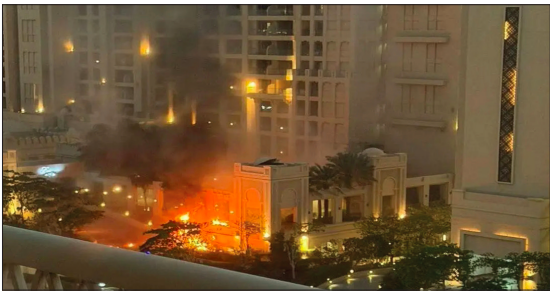
The UAE has absorbed a significant share of Iran’s retaliatory fire. Dubai, Abu Dhabi, Sharjah, Ras Al Khaimah and Al Ain have all witnessed either direct strikes or debris from intercepted projectiles. The country’s air defence architecture — the Terminal High Altitude Area Defense (THAAD) system — has functioned with remarkable efficiency, intercepting ballistic and cruise missiles and neutralising hundreds of drones. Official updates from the Ministry of Defense detail a technically impressive record of detection and interception.
But even the most sophisticated missile shield cannot intercept fear.
Dubai, arguably the Gulf’s most cosmopolitan hub, has felt the strain acutely. Strategic infrastructure — including Dubai International Airport and Jebel Ali Port — became early targets. Residential districts have not been spared from falling debris. While authorities have maintained disciplined communication and operational control, the psychological toll is palpable.
Emergency alerts flash across mobile phones. Residents are urged to seek shelter. Moments later, the sky erupts with loud booms — interceptions, we are told. Necessary reassurances. Yet each explosion is a reminder that steel and fire are arcing overhead.
Beyond the fear lies paralysis.
Airspace closures have grounded flights across the region. Thousands are stranded. Supply chains are wobbling. If hostilities persist beyond days into weeks, the effects will cascade: food logistics, medical supplies, fuel distribution. Global markets will not remain insulated. The Gulf is too central to energy and trade flows for the world to pretend otherwise.
War does not merely destroy buildings. It suspends normalcy.
Businesses have shifted to remote operations. Streets are quieter. Families calculate movements. Parents rehearse evacuation drills with children. Freedom — the mundane freedom to step outside, to drive, to gather — suddenly feels conditional. Government’s asurances of adequate food security are exactly what they are-assurances-because if the ensuing disruption of supply chains persist, then it will be a matter of time before hunger will be added to the equation.
And then there is the human ledger.
Casualties mount across Iran, Israel, the United States and parts of the Gulf. Lebanon has been dragged in. Lives have been cut short. Service personnel, civilians, bystanders — missiles do not discriminate. No defence system guarantees perfection. The mathematics of war always includes loss.
Compounding the crisis is a secondary contagion: AI-amplified misinformation. Fabricated memos, recycled videos, digitally manipulated footage — all circulating at velocity. In an age where synthetic media can manufacture panic, the information battlespace is as volatile as the physical one. Governments must fight on two fronts: intercepting projectiles and intercepting falsehoods.
Yet beneath the noise lies an uncomfortable truth: escalation is easier than restraint.
The assassination of leadership figures, retaliatory doctrine, alliance obligations — each side frames its actions as strategic necessity. But history is littered with conflicts that began as limited operations and metastasised into generational disasters.
Winston Churchill — hardly naïve about war — observed in 1954: “To jaw-jaw is better than to war-war.” It was a call for diplomatic engagement at the height of Cold War tension. The principle endures. Dialogue is slower, messier and politically inconvenient. But it is infinitely cheaper than reconstruction and burial.
The Middle East does not need another prolonged theatre of destruction. The global economy, already strained by supply shocks, regional wars and health crises, cannot easily absorb another protracted conflict. Nor can ordinary citizens — in Tehran, Tel Aviv, Dubai or beyond — afford the psychological and economic attrition of sustained hostilities.
War romanticised from afar is easy. War experienced from within is clarifying.
When sirens pierce the night and families descend into basements, abstractions disappear. What remains is a simple hierarchy of needs: safety, stability, survival.
Freedom, we are reminded, is not theoretical. It is the ability to move without calculating missile trajectories. It is the absence of emergency alerts at 2 a.m. It is the quiet assumption that tomorrow will resemble today.
Seventy-two hours have already altered that assumption.
The question now is not who can launch more missiles or intercept more drones. The question is who will summon the strategic courage to de-escalate. Who will choose jaw-jaw over war-war.
Because in the end, no missile defence system can shield a region — or a world — from the cumulative consequences of pride, miscalculation and prolonged conflict.
War is not good. It never has been. It never will be. Let no one deceive you otherwise, whether in the Middle East or South East Nigeria or South Sudan or war-weary Ukraine!
And 72 hours are more than enough to prove it.
•Oparah, a public affairs analyst, sent this piece from the UAE.













Leave a comment