



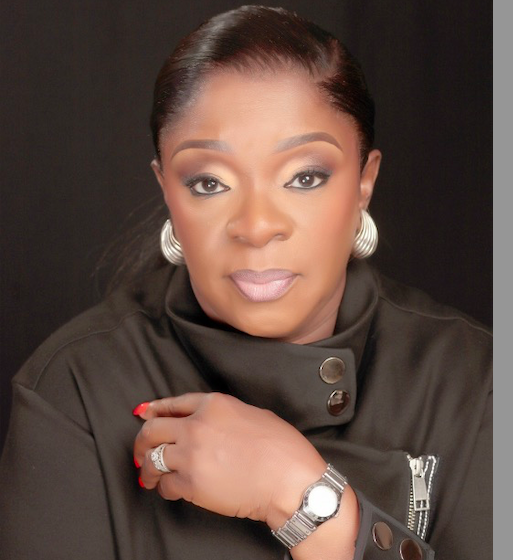
Beneath her famous family name, Adeola Azeez is a woman who has carved out her own path in banking, mentorship, and public service. In this conversation with
Vanessa Obioha, she reflects on building networks, mentoring the next generation of women and advocating greater female participation in leadership and politics.
Until her father’s passing last year, many within her corporate circle had no idea she was the daughter of the revered lawyer and politician, Ayo Adebanjo. To them, she was simply Adeola Azeez, the seasoned banker and advocate of gender and financial inclusion. Some suspected she came from a notable background but could not quite place it. It was only when she shared the news of her father’s death on social media that the pieces began to fall into place.
Soon, the comments followed. “No wonder she is like this,” some wrote. Others observed that “the apple doesn’t fall far from the tree.”
Pa Adebanjo, an elder statesman, was widely respected in Nigeria’s political landscape for his courage, bluntness and discipline. Azeez inherited much of that spirit — the fiery passion and conviction that defined her father. She, however, expresses herself differently. More strategic in approach and inclined to lead with empathy, she nonetheless remains unmistakably her father’s daughter.
More so, her aura is infectious. When we met at her home office, she greeted me with a warm, firm embrace, as though welcoming an old friend. Making people feel comfortable appears to come naturally to her. As she would later explain, networking is her “bank deposit.”
“It is second nature to me to network, to know people of value who could turn lives, change events or could be the answer to people’s problems. It is my money in the bank.”
Networking, she emphasised, is a fundamental skill to learn. Hardly a week passes without her adding a new contact to her phone. When saving these contacts, she also includes where she met them or who facilitated the introduction.
“Just to keep track of when I met them,” she explained.
Mrs. Azeez spent about 31 years in the banking industry before retiring in 2020, just as the COVID-19 pandemic was unfolding.
Her banking career began at Bankers Trust Company in 1989, where she worked as a customer service officer. She later joined the German financial institution Deutsche Bank, rising to the top echelon as Director and Deputy Country Representative. During her tenure there, she played a pioneering role in correspondent banking in Nigeria.
She studied Philosophy at the University of Lagos before going on to earn a law degree from the University of Warwick in the United Kingdom. Today, she is a partner at Sigma Risk, an international financial crime risk consultancy headquartered in the UK, where she represents the firm in West Africa.
She also has a knack for philanthropy. As she puts it, she likes to make people smile. Through the Adeola Azeez Community Care Foundation, she supports youths and other vulnerable groups. Earlier this year, through a partnership with TeachForNigeria, the foundation’s Tech Hub moved into a physical space to serve pupils in Italupe, Ijebu-Ode.
She is equally passionate about socioeconomic development, particularly concerning women. Mrs. Azeez is one of the co-founders of Women in Management, Business and Public Service (WIMBIZ) and previously served as its chairperson. It is not uncommon to find her mentoring women and encouraging them to push beyond perceived limits.
Guided by her mantra — “Keep moving, keep pushing; you only get out of life what you put into it” — she urges women to break barriers.
“When I see women thriving, making an impact, doing things that they say it’s uncommon to see a woman do, or say that because I was in a WIMBIZ room that I’m able to do this, or because I had a mentor at WIMBIZ, I was able to do it, it feels like there’s a party in my stomach.”
In her view, today’s generation of Nigerian women is more willing to challenge the status quo and venture into sectors that were once male-dominated.
“Did we have female managing directors before? Did we have female chairmen then? Maybe one or two. But by the time we formed WIMBIZ in 2002, those women among us were shattering ceilings and beginning to build ladders for other women to climb. But we needed to move faster.”
Although more women now occupy managerial and executive positions, Mrs. Azeez believes progress remains insufficient.
“We need to build more women, give them more capacity, expose them more, and identify the quick ones that you put on a fast trajectory. There has to be intentionality from corporate organisations. When you have a balanced organisation where there are equal numbers of men and women, it becomes a natural phenomenon.”
According to her, the benefits of gender balance in the workplace are numerous. From improved profitability to stronger collaboration.
“Everybody plays to their strengths. There is teamwork,” she added.
She, however, acknowledged that women still face toxic environments that can impede their climb up the corporate ladder.
“You hear some women say it’s lonely at the top,” she noted. “But I also like to ask: while they were rising to the top, were they also ensuring that other women were rising too?”
She also encourages women to embrace constructive criticism and continuous learning.
For Mrs. Azeez, mentorship is not static but evolves with life’s stages.
“At every turn in your life, you need different mentors for different aspects,” she explained. “You need mentorship for your career journey and how you rise in life. You need mentorship as you plan to retire, during retirement, and even in post-retirement. You need mentorship when you’re newly married and when you have challenges in marriage. You’d probably need mentorship when you’re going through menopause.”
Mentorship, she added, can mean different things but for her, it is an opportunity.
“You don’t want to have missed opportunities in life, because opportunity forces growth.”
Mentors too can be mentored by their mentee. As she pointed out, in this age of AI, she relies on younger people to teach her how to navigate the new digital world. Her relationship with her younger friends, she said, is mutual. She is not shy about conceding when their arguments are stronger.
Life after retirement can be daunting, if not confusing. Mrs Azeez found herself at an unexpected crossroads when she left banking.
“I was very restless and obviously wasn’t tired,” she recalled.
The idea of simply settling into retirement — perhaps focusing solely on philanthropy or family life — did not appeal to her. Instead, she began to consider how she could channel her decades of experience in business governance, negotiation, risk management and financial crime compliance back into society.
Growing up in the household of a father who regularly hosted political meetings and mentored many political figures also shaped her outlook. Still, she was aware that her father’s reputation — admired by many but considered controversial by some — could invite scrutiny if she ventured into politics.
Nevertheless, her long-standing passion for greater female representation in politics continued to grow. She recalled how, as a young woman observing some of her father’s political gatherings, the number of women present was often minimal.
Determined to change that narrative, she enrolled in the School of Politics, Policy and Governance in 2021. The institution is an offshoot of Fix Politics, of which she is a founding member. She is also a co-founder of Women in Politics.
That same commitment led her to contest for a seat in the House of Representatives during the last general election, representing Ijebu Central Federal Constituency in Ogun State. Preparing for the race, she said, required a major personal adjustment.
“And I realised that in wanting to do that, I needed to move in a manner that I’ve never done before. One of the first things I needed to do was move. Politics is local. I can’t contest for the people and live in Lagos, so I relocated to Ogun State.”
Throughout the campaign period, she lived among the people, returning to Lagos only occasionally to change clothes.
“I thoroughly adapted and enjoyed it. It was like going back to school — relating, engaging and living with the people: the poor, the elderly, the illiterate, the women, the youth — many of whom felt they had no one to listen to their problems.”
The experience, she said, allowed her to better understand their realities and think more deeply about transformative solutions.
Although she did not win the election, her political aspirations remain alive. She is already considering another run in the 2027 elections.
Her father’s death, however, temporarily slowed some of her plans. As the eldest daughter of her mother, she assumed significant responsibility for organising his burial and ensuring that his final wishes, particularly his desire that no one be excluded, were respected.
His death also delayed another project close to her heart: a book about her political journey. “I was supposed to have completed a book about my political experience,” she said. “The idea was to motivate more women to get into politics. For them to say, ‘If Adeola can do it, then I too can.’ I want it to be a resource book, something inspirational.”
But it’s not all about strategy sessions, mentoring circles and political conversations for the business leader. She finds joy on the dance floor and in her fitness routines. For someone whose mantra is to always be in constant motion, the rhythm of dance and exercise seems a fitting metaphor for a life that refuses to slow down.
















Leave a comment