



Vanessa Obioha
Despite generating an estimated $6.6 billion annually and being largely driven by women, Nigeria’s beauty and fashion sector ranks among the lowest for gender equity in leadership, according to the 2025–2026 Reykjavík Index for Leadership.
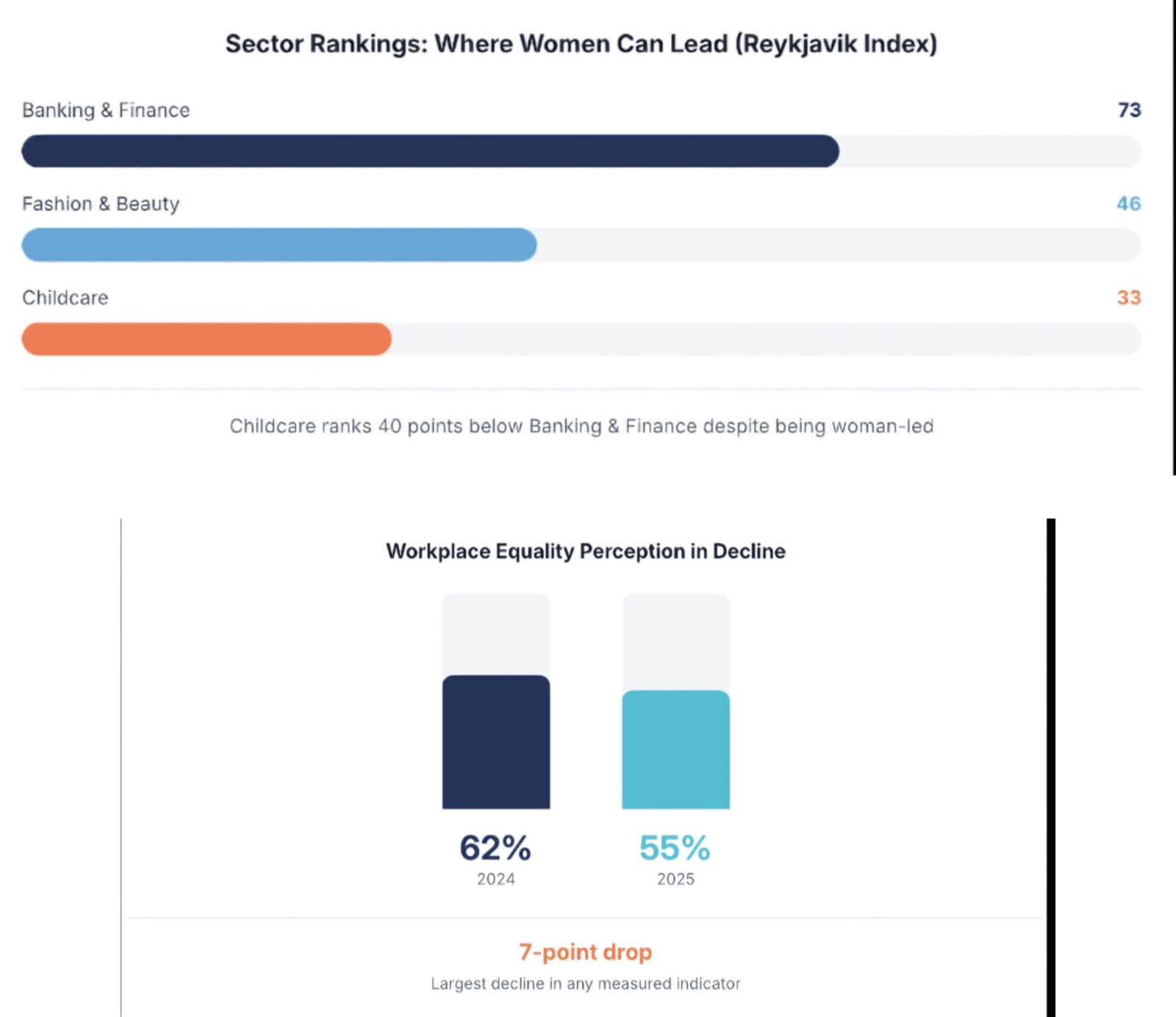
The sector scored 46 points on the index, placing it just 13 points above the lowest-ranked sector, childcare, which scored 33.
By contrast, banking and finance ranked highest with a score of 73, followed by education (72) and pharmaceutical and medical research (70).
Notably, some of the biggest improvements in gender equity perceptions this year were recorded in traditionally male-dominated industries such as aerospace (+9) and automotive manufacturing (+6).
Reacting to the findings, Omowunmi Akingbohungbe of WIMBIZ said Nigeria must deliberately support sectors where women already play leading roles.
“Nigeria must properly support sectors powered by women. This can unlock jobs, strengthen the creative economy, and add billions to national economic output.”
Similarly, Ekemini Akpakpan, Executive Secretary of Women in Successful Careers (WISCAR), said sectors with the strongest gender equity scores demonstrate the impact of intentional policies.
“Banking, finance, education, and medical research rank highest for gender equity, demonstrating that intentional policies, such as the Central Bank of Nigeria’s quota for women in leadership, can drive measurable progress.”
One of the report’s major findings is that nine in 10 Nigerians believe women are capable of leading in various sectors, including business, politics, and other critical areas. This perception raised Nigeria’s overall index score to 59 out of 100, a two-point increase from 57 in 2024.
However, the score remains below the G7 average of 68 and far behind Iceland, which leads the global ranking with 86 points.
Nigeria now sits just below Germany (60) but ahead of Kenya (56).
According to the report, the improvement in Nigeria’s score is largely driven by more progressive attitudes among men.
The data shows that 89% of Nigerians are comfortable with a woman serving as CEO, while 77% support a woman as Head of Government.
It also marks the first time since Nigeria joined the index that men’s perceptions have shifted significantly toward supporting women in leadership.
Women’s scores remained at 61, while men’s scores rose from 53 to 56, narrowing the gender perception gap from eight points to five.
The most notable shift occurred among older men aged 45–65, historically considered the most conservative demographic.
When asked what shapes their views on women in leadership, 30% of Nigerians cited family and upbringing, 18% education, 16% personal experience, while media and religion accounted for 9% each. The report found no significant differences between men and women in these responses.
Despite these positive attitudes, the report notes that structural barriers still limit women’s representation in leadership roles.
“While most Nigerians are comfortable with a woman leading, women occupy only 12% of CEO roles and 4% of National Assembly seats,” said Shirley Ewang, Advocacy Lead at Gatefield. “This highlights a stark disparity between comfort levels and actual representation.”
“Society is ready, but the system must follow,” added Rachel Pindar of the NGF. “The real barrier is no longer public opinion, but the policies and structures that determine who gets into positions of power.”
The report also found that perceptions that gender equality has been achieved in the workplace declined sharply, dropping from 62% in 2024 to 55% in 2025.
The Reykjavík Index for Leadership is the first international measure of societal perceptions of women’s suitability for leadership across 23 sectors. The 2025 Nigeria survey polled 1,082 working-age adults aged 18–65 and was statistically weighted to reflect national demographics.














Leave a comment