



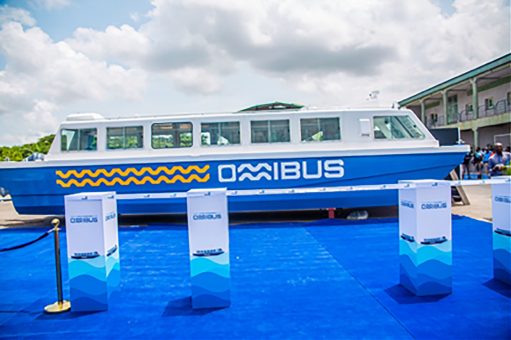
Caverton Marine, a subsidiary of Caverton Offshore Support Group, has sealed a major deal with ExploMar to accelerate the shift to electric-powered marine transport across Sub-Saharan Africa.
The move is designed to redefine mobility in coastal cities like Lagos.
The agreement, formalised on March 29, 2026, at the Shanghai Boat Show, includes confirmed orders for 20 electric engines and battery systems, alongside plans to roll out supporting onshore charging infrastructure, laying the foundation for a new clean-energy water transport ecosystem.
Chief Executive Officer of Caverton Offshore Support Group, Olabode Makanjuola, described the deal as a turning point for urban mobility across Africa’s water-rich cities. He said the collaboration will focus on developing a standardised electric ferry platform tailored to the unique operational challenges of African waterways.
“The future of Nigeria’s waterways is electric.
“Cities like Lagos are defined by water, yet millions of residents remain trapped in road congestion while vast waterway networks lie underutilised. Conventional petrol and diesel-powered ferries are costly to operate and increasingly difficult to justify in dense urban environments. This partnership sets out to validate an entirely new operating model under real-world conditions, beginning with pilot operations in Lagos, one of Africa’s most demanding and complex environments”, he said.
At the heart of the partnership is the next-generation OMIBUS EV 2.0 ferry, an upgraded electric vessel designed to deliver both performance and efficiency at scale. The new platform features dual 300-horsepower electric engines, producing a combined output of 600hp, powered by four 90kWh battery units with a total capacity of 360kWh. This represents a major leap from earlier configurations, which delivered significantly lower output and storage capacity.
Beyond technical improvements, the OMIBUS EV 2.0 signals a transition from experimental deployment to commercially viable operations. The vessels are engineered to tackle rising fuel costs while offering zero-emission transport, an increasingly critical factor for densely populated urban centres facing environmental and infrastructure pressures.
The collaboration combines Caverton Marine’s deep operational knowledge of African waterways with ExploMar’s expertise in electric propulsion and control systems. Makanjuola noted that China’s strength in large-scale manufacturing and systems integration will play a crucial role in delivering cost-effective solutions suited to emerging markets.
The partners aim to build a replicable model in which vessels and charging infrastructure are designed as a unified system. This integrated approach is expected to improve efficiency, reduce downtime, and create a scalable framework that can be deployed across multiple African cities beyond Lagos.
Chief Executive Officer of ExploMar, Alex Dong, said the initiative reflects a broader mission to extend the global electric maritime transition into underserved regions.
“We are proud to stand alongside Caverton as a committed partner in this transformative initiative.
“At ExploMar, we have long believed that the electric maritime revolution must extend beyond developed markets. Africa’s waterways represent one of the most significant and underserved opportunities in global sustainable transport. Our collaboration with Caverton is not simply a commercial arrangement; it is a shared mission to engineer solutions that are robust, affordable, and purpose-fit for the realities of African operations”, Dong said.
He added that the OMIBUS EV 2.0 platform is the product of months of technical collaboration and is expected to “set a new benchmark for electric ferry performance in emerging markets,” with plans to expand from Lagos to other parts of the continent.
Implementation is already underway, with pilot operations progressing in Lagos. Caverton confirmed it is working closely with key regulators, including the National Inland Waterways Authority and the Lagos State Waterways Authority, to ensure seamless integration of the electric vessels into the existing transport network.
“This is no longer distant. The pilot is running, the platform is being built and implementation has begun. We are building something Lagos and Africa can be proud of”, Makanjuola added.
The partnership is one of the most ambitious pushes yet to unlock the economic and environmental potential of Africa’s inland waterways, transforming them from underutilised assets into engines of sustainable urban mobility.













Leave a comment