



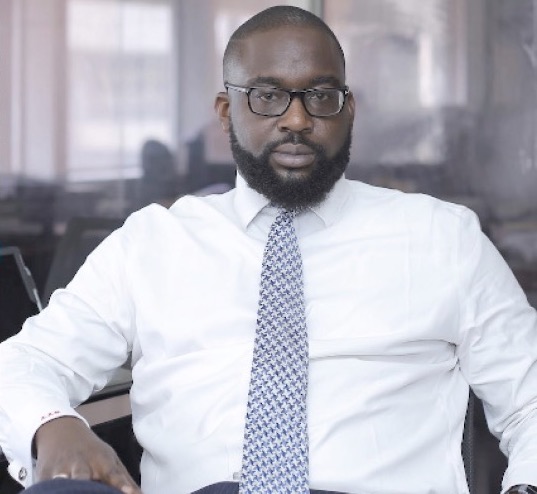
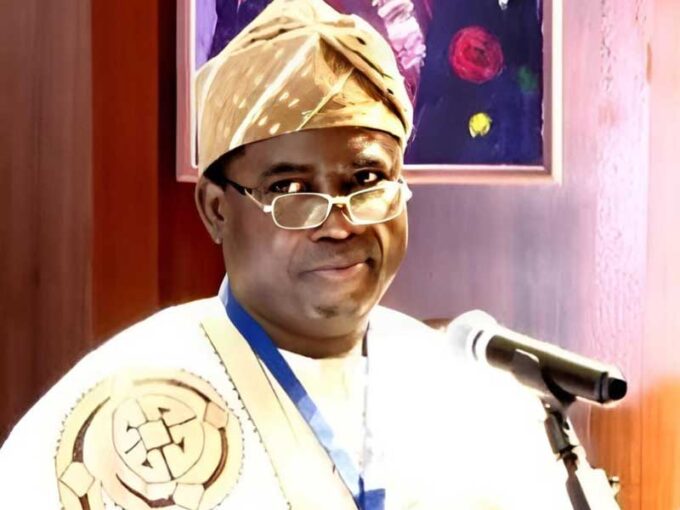
Inside a building older than many of its occupants on Broad Street, Lagos, a young silk’s son sits beneath the weight of a formidable name. Abiodun Adesanya is a lawyer of pedigree, determined not merely to preserve a legacy, but to transcend it. Adedayo Adejobi writes…
At the famous Bookshop House on Broad Street, the air carries the faint weight of history. The building, completed in 1973 by Godwin and Hopwood Architects, rises with modernist confidence above Lagos Island. It houses the venerable CMS Bookshop, the oldest in Nigeria, and for decades has served as a commercial nerve centre in the old business district. Within its concrete frame, lawyers, traders, clergy, and civil servants have climbed the same staircases in pursuit of ideas, contracts, and sometimes absolution.
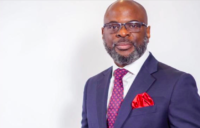
Behind a modest office door sits Dr. Abiodun Adesanya, steward of a second-generation law firm founded by the late Professor Safiriyu Abiodun Adesanya, SAN. The son sits in the same professional circuit as the father, yet with a distinct gravitational pull of his own.
On the surface, the inheritance seems almost inevitable. “In all fairness, there are only two things I have ever considered,” he says with a smile. “One was being a lawyer, and the other was being a pilot. Those were the only two options I ever had in mind. I eventually opted for being a lawyer.”
It sounds romantic, almost cinematic, until he adds, “I thought perhaps a bit more prestigious. But I always said to myself at the same time that I would still want to follow the passion of aviation as well.”
He still trains in flying schools, aiming for a private pilot’s licence. Aviation, he insists, remains “a hobby. But my career lies in law as of today.”
Law, in truth, was less a choice than an atmosphere. “I grew up in a household of lawyers. Law was the atmosphere, not just a career option,” he recalls. His father was a Professor and Senior Advocate of Nigeria. His mother, Hon Justice Y.A Adesanya was first an academic before going to the bench. Dinner table conversations were likely to drift towards jurisprudence rather than gossip.
Yet the mythology of his father’s stature did not fully dawn on him until adulthood. With an educational background that spans English boarding schools and a highly ranked British university, he returned to Nigeria for law school and encountered an unexpected moment of revelation.
“One of the lecturers starts talking about how one of her professors was Professor Adesanya. And half of the class looks in my direction.”
Around that time, the landmark decision in First Bank of Nigeria Plc v Longe was circulating as a locus classicus in company law. “Everyone would always refer to First Bank vs Longe. How one Professor Adesanya argued this and that. I think at that point in time, I started to appreciate my father’s stature in the profession.”
Appreciation, however, is a gentle word. The more accurate term might be pressure.
When Professor Adesanya died, his son was only four years at the Bar and midway through a PhD in England. “I suspended my PhD and returned home to take responsibility for the practice,” he says.
“I won’t lie; there were moments I doubted myself. There were moments I needed guidance from some of my seniors.”
The early years were defined by the invisible test that greets many heirs to professional empires. In court, the surname arrived before the argument. “The moment I announce my appearance, some judges would deliberately put me on the spot, simply to test the depth of my own competence. I still experienced this at the Supreme Court a few weeks ago.”
He recalls a judge of the Court of Appeal who remarked, “I had a professor at Ife who was my lecturer, a very brilliant man. Are you related to him?” When he answered yes, the judge added, “I hope you’re as brilliant as he is.” His reply was characteristically understated. “Well, My Lord, we are trying our best; with time, we will get there.”
He is careful, though, to distinguish inheritance from imitation. “I also have to be cognisant of the fact that I am not trying to be my father. We might be in the same profession. I am also trying to be my own person.”
The ambition is not replication but transcendence. “I honour his legacy, but I am building my own. The hope is to surpass him, not to imitate him.”
That distinction has shaped the firm’s evolution. Historically known as a litigation powerhouse, the chambers were once synonymous with courtroom combat. Today, while litigation remains “one of our strongest suits,” the portfolio has broadened. “We have deliberately evolved with the times, expanding beyond the firm’s traditional litigation strength into broader corporate and regulatory practice.”

As a Fellow of the Chartered Institute of Arbitrators, Abiodun has positioned the firm within that shift.
His own academic interests have also nudged the firm into new terrain. While his father was a towering authority in family law and authored a leading text on matrimonial causes, the son’s doctoral and academic focus on telecommunications law has drawn new instructions in telecoms and regulatory work, alongside expanded tax practice. Today, the firm’s work extends to operators and regulators such as Globacom Limited and the Nigerian Communications Commission (NCC), reflecting its growing engagement in the technology and communications sector.
The firm is currently representing the Nigerian Communications Commission (NCC) in a public-interest suit filed by the Socio-Economic Rights and Accountability Project (SERAP), challenging the recently approved 50 per cent increase in telecom tariffs. The case, initiated by human rights lawyer Ebun Olu Adegboruwa, SAN, underscores a growing regulatory dispute over pricing in the telecommunications sector.
Beyond this, the firm has handled several high-profile tax and constitutional matters. It represented the Federal Inland Revenue Service (FIRS) in a dispute with Shell Petroleum Development Company, which ended in a $9.48 million settlement after courts ruled against Shell’s tax deductions on gas flaring payments. The firm also secured key victories for the Office of the Senate President in cases involving the 2023 budget process and the Petroleum Industry Act, with courts affirming legislative authority and upholding the constitutionality of the Act’s Host Community Development Trust provisions.
For a lawyer who inherited a firm once wary of government briefs, this marks a philosophical pivot. His father, he notes, “used to refuse to do work for politically exposed persons or any Abiodun, the son, is candid about the divergence. “If he walked into this office today, my father would question the fact that we do work for certain government entities. That much I know he would have an issue with. But I’ll tell him that times have changed.”
Times have also tested the myth that sole proprietorship law firms must die with their founders. “There’s always been this norm, especially with the old school firms, that once the owner of the law firm dies, that firm essentially dies off,” he says. Succession, or the lack of it, has indeed felled many chambers. In his case, continuity has required both preservation and reinvention.
It took years to step out of the shadow. “For the first few years in practice, I was always known as Professor Adesanya’s son,” he reflects.
“I still occasionally get that. But I think I have also built my reputation as Dr. Adesanya now.” He marks the turning point at roughly six or seven years into leadership, around the completion of his PhD. “The judges know me for me. And know me for the cases I have argued or won before them.”
The client base tells its own story. While a handful of legacy clients remain, “75 per cent of our clientele today are new clients that have come in while I’ve been in charge of this law firm.” The revenue mix has shifted accordingly. Continuity without stagnation has become the operating principle.
Beneath the professional discipline lies a more human inheritance. “I grew up in a home where excellence was the baseline,” he says.
Academic excellence was assumed, not applauded. As a teenager, he admits, he was content to do “just enough to get by.” With maturity came recalibration. “I realised that mediocrity was not an option.”
Legacy, to him, is beyond parading articles of history like a museum. “Preserving my father’s name is important, but so is taking it to the next level.” He frames it as an intergenerational prayer. If his own children enter the profession, he would wish them greater success than his own. The continuity he speaks of is already evident; his younger sister, Bukola, entered the profession a few years ago, becoming the latest lawyer in the Adesanya family.
The most poignant preparation for leadership came not in formal instruction but in casual conversation. His father often spoke about death with disarming directness, even specifying his desired burial spot. At the time, the son did not grasp the subtext. In hindsight, he sees those moments as quiet rehearsals for responsibility.
When asked how he would like his own chapter in the Adesanya story to read, he pauses. “I am still writing that chapter,” he says. Yet he offers a sketch. He hopes to be seen as someone who “had a privileged start, maximised every opportunity, and advanced the legacy he inherited.” Above all, he wants to be recognised not merely as a son, but as a name. Outside the courtroom, the figure in the wig and gown recedes.
“I’m still very much a geek at heart,” he says of himself.
He enjoys football, supports Manchester United, practises archery, rides horses, plays Fortnite with his kids and still dreams of the cockpit. Law may have chosen him, as he puts it, but he has not surrendered the rest of his curiosities.








Leave a comment