



Okechukwu Uwaezuoke
There are moments when a painting compels a viewer to pause—much like the grey-bearded mariner in Coleridge’s “The Rime of the Ancient Mariner”, waylaying a wedding guest to unburden his tale. The pause is neither wholly admiration nor recognition; it settles into a liminal space, uneasy and searching. Against this backdrop, Wilson Imini’s The Red Crown, which opened on Thursday, April 2, at Thought Pyramid Art Centre in Abuja, lingers within that same in-betweenness. Here, the exhibition offers no easy reassurance, turning instead toward the slow shaping of self under pressure, where identity emerges cautiously, shaped as much by expectation as by desire.
Across the canvases, figures are set within spaces that feel at once intimate and tentative. They lean, sit, glance, hesitate. Their bodies suggest composure, yet their expressions betray an undercurrent of unrest. Imini’s palette—vivid, unyielding—pushes against the usual association of gravity with gloom. Even when the subjects verge on discomfort, the colours hold their intensity, as if vitality itself were a quiet act of defiance.
In “Butterflies Are Not in My Belly”, the familiar tropes of romantic anticipation are quietly subverted. The painting resists the soft-focus optimism its title might suggest, offering instead a scene of closeness tempered by hesitation. The figures lean toward one another, yet something intervenes—a self-consciousness shaped by experience, perhaps even fatigue. Attraction here is measured, reconsidered, stripped of mythic spontaneity. The absence of “butterflies” feels less like loss than a recalibration of what intimacy can be.
A similar restraint shapes “The Right Angle”, in which connection is rendered with near-geometric precision. The figures are embedded in a space that feels meticulously measured, as if emotional alignment could be reached through calculation. A dry wit is at play, yet there is also a quiet recognition of how contemporary encounters are often structured—deliberate, cautious, sometimes overthought. The painting captures the subtle tension between openness and self-protection, where each gesture is offered and withheld in equal measure.
Elsewhere, the mood becomes more taut. “The Shitty Shot” and “Cheese for Cheeks” turn their focus to the mechanics of modern dating, where sincerity and performance are often inseparable. Smiles feel rehearsed, gestures carry a subtle transactional charge. Yet Imini avoids easy moralising. These scenes read less as condemnations than as careful observations—studies in adaptation, tracing individuals navigating a terrain that demands both authenticity and its careful simulation.
The emotional tone deepens in “What To Do” and “The First Settings”. These works pivot on recognition: the moment when unease becomes legible, when intuition begins to articulate itself. The language of “red flags” is translated into atmosphere rather than iconography. Figures appear suspended between awareness and action, caught in the difficult interval where knowledge has yet to harden into decision. Imini renders this hesitation with notable sensitivity, allowing tension to accumulate without forcing resolution.
Beyond the terrain of romantic relationships, The Red Crown extends into the more enduring structures of kinship and responsibility. “My Sister” offers a meditation on familial proximity that never dissolves into sentimentality. The figures share an emotional landscape shaped as much by distance as by affection. Reconciliation, if it occurs, is partial—suggested rather than declared. The painting holds space for ambiguity, acknowledging that closeness can coexist with fracture.
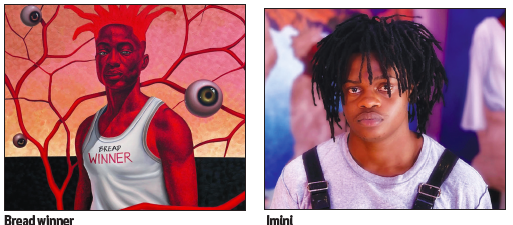
In “The Bread Winner”, the exhibition reaches one of its most resonant moments. Here, the red crown carries a tangible weight, inflected by the pressures of economic expectation. The central figure registers responsibility—not abstractly, but in posture and presence. There is a visible awareness of obligation, of the role one must inhabit within a broader familial structure.
Yet, as throughout the exhibition, this burden is expressed in colour rather than shadow. The luminosity does not erase the pressure; it complicates it, suggesting a resilience that is neither simple nor entirely voluntary.
Imini’s practice is rooted in attentiveness—to stories, gestures, and the textures of everyday interaction. This attentiveness is evident in the way his paintings resist grand narrative in favour of accumulation. Each work functions as a fragment, a scene drawn from lived experience and distilled without excess dramatisation. The emphasis falls on relation: how people meet, misread, accommodate, withdraw.
What emerges from The Red Crown is not a singular thesis but a field of recognitions. The exhibition does not seek to resolve the tensions it depicts. Instead, it renders them visible, allowing contradictions to remain intact. Love appears alongside calculation; confidence alongside doubt; obligation alongside the desire for self-definition. The red crown persists throughout, a quiet reminder that awareness is both a burden and a beginning.
In this sense, Imini’s work aligns with a broader current in contemporary Nigerian painting that values immediacy over spectacle. There is no attempt here to monumentalise experience. The scale remains human, the focus attentive to the small negotiations that shape daily life. Yet within this modesty lies a quiet insistence: that these negotiations matter, that they accumulate into something like identity.
By the time the exhibition closes, the red crown has shed any lingering association with grandeur. It settles instead into something more intimate, more precarious. It marks not arrival but process—the ongoing, often uneven effort to understand oneself in relation to others. In Imini’s hands, that effort is neither romanticised nor diminished. It is simply observed, rendered in colour and form, and left open for recognition.














Leave a comment