Home Lifestyle Art Breathes While a Nation Gasps – THISDAYLIVE
Lifestyle

Art Breathes While a Nation Gasps – THISDAYLIVE

Share
Share


Okechukwu Uwaezuoke

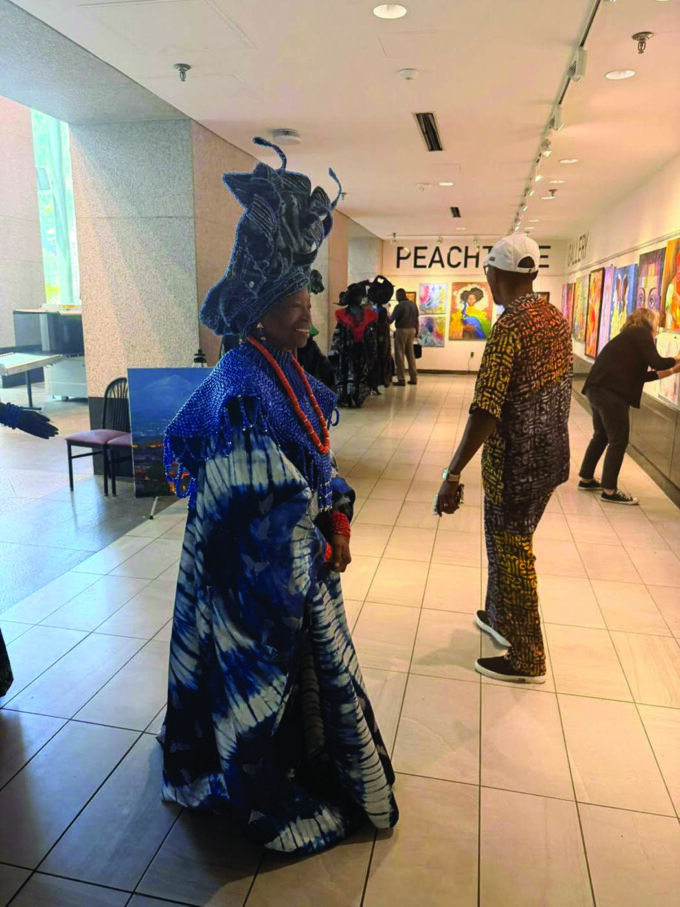
For one art-drenched week in late October, the Institute of Management and Technology Enugu’s International Conference Centre gives itself over to its annual rendezvous. LIMCAF — that irrepressible jamboree officially known as Life in My City Art Festival — once again turns the venue’s echoing recesses and spacious auditorium into a carnival of paint and pulse. What has become tradition now feels more like ritual: a younger generation of artists inhaling the nation’s anxieties and exhaling them as spectacle. The 2025 theme, Can We Breathe?, drifts over the proceedings like smog thick with sermon — an existential gasp rendered in pigment, protest, and the occasional knowing flourish.

Interpretations of the theme, inevitably, come in many shades — earnest and ironic alike. It is the parable of the six blind men of Hindostan all over again — only this time, the elephant is Nigeria, and the men arrive armed with diplomas, degrees, or long studio experience.

Take Segun Victor Owolabi’s “Entanglement: Sad Generation with Happy Faces”, which clinches the $2,000 Elder K.U. Kalu Prize for Young Artist of the Year. His shimmering textile tableaux stitch irony into despair — youth wrapped in bright patterns, angst disguised as aesthetic. This is the post-Instagram generation, filtered and fatigued, rendered thread by thread. If ennui is a textile, Owolabi is its tailor.

Elsewhere, the camera bears witness. Abubakar Mohammed’s photographic diptych “E Fona A’da Na” I and II, winner of the Chinelo Chime Prize, confronts viewers with two seemingly unrelated compositions — two young boys curled in fetal repose on bare stony ground, and a rustic landscape capturing the aftermath of the Mokwa flood. The work seems to trap breath itself mid-flight. Patricia Ikel Bello’s “At the Foot of Her Mercy”, which takes Best Painting/Mixed Media, indicts the justice system through pigment and restraint, while Mba Ukemba’s sculptural “Man” lays the blame squarely at humanity’s doorstep for being the author of its own misfortunes. And then there is Audu Phillip Iko, whose ceramic “Yes We Can and We Will” re-fires Barack Obama’s optimism in the kiln of irony — hope as handcrafted resistance.

If the sound of the times could be rendered in texture, it might look like Ipa Anyaole’s “Voices Unheard”, winner of Best Digital Art/Video. In a cascade of murmurs and playful montage of four shots of the same female face, Anyaole spins silence into substance — a meditation on how absence, too, can be eloquent. Her lens doesn’t just see; it eavesdrops. Meanwhile, Harry Joel Gunduri’s “Hope in the Shadows”, winner for Best Drawing, makes graphite breathe. His figures hover between exhaustion and endurance, sketching faith with the precision of a man teaching a candle to hope.

Among the women who rise to the occasion, Chinenye Eze’s “Life Rut” — which earns her the Most Creative Female Artist award — hints at stagnation born of dogmatism. Her ceramic forms, poised between paralysis and persistence, look as though they are trying to remember how to breathe. Ogbodo Daniel’s “Trap in Radiance”, winner of Best Artist Living with Disability, shimmers with paradox — beauty caught in its own snare, light arguing with confinement. Both artists turn constraint into choreography, proving that fragility, when fired, can be a form of defiance.

Beyond the prizes, LIMCAF’s pulse comes from artists who turn suffocation into style. Babatunde Omotehinse’s “How Much for Breather” prices oxygen like a commodity — a seated, dreadlocked figure tethered to a respirator, wheezing in desperation against the backdrop of modernity’s blasted landscape. Akinsowon James’s “Let It All Make Sense” sighs for the jobless and overqualified, each brushstroke drooping under the weight of dashed ambition. Dada Nifemi Tunde’s “Still I Rise” imagines a woman drowning in headlines yet lit from within — hope flickering like a faulty bulb but refusing to die.

Some offer despair in subtler tones. Stephen Nwofoke Ekenedirichukwu dreams of animals inheriting the moral conscience humans pawned off long ago — a soft apocalypse rendered in allegory. Joseph Aimanesi Steve’s “The Trauma of the Economy” submerges a man — literally — in the quicksand of capitalism. And Babatope Samuel Oladimeji’s “More Than Life Itself” sits in prayer that is less pious than tactical: faith repurposed as survival strategy.

But if rhythm is a religion, Alimi Adekunle Abraham is its quiet prophet. His batiks pulse like soft percussion, each motif a heartbeat refusing to flatline. Adebiyi Michael Temi-Tope (aka Mike Wheeler) goes full anarchist with “Bearers of Chaos”, recasting the suited arsonist as Nigeria’s national mascot — ambition and accelerant in one. 

David Chizoba Nwadike’s “Since 1960”, painted on a battered car door, is part sculpture, part national obituary — rust as realism. Ahmed Michael’s “A Man’s Diary” writes tenderness into vulnerability, while Ifeoluwa Oliver Akinbobola’s “A Whispered Promise” places a child at the crossroads of fatigue and inheritance. Danjuma Sumdi Misak’s “A Beacon of Hope in a World of Conflict” glows faintly, like a hymn sung through cracked lips.

Money, predictably, claims its spotlight in David Imoleayo Alao’s “Breathless Pursuits”, which orchestrates a ballet of exhaustion — figures chasing naira until the air gives out. Ojo John Olawale’s charcoals and Mafeng Davou Pam’s graphite piece “Here We Are” form a quieter chorus of endurance — graphite hymns to survival. And Bilkisu Oyiza Shuaibu’s “Suffocating Dreams” captures a bare-shouldered, cigarette-smoking dreadlocked young woman mid-compromise — ambition dimming like a failing bulb.

By the festival’s close, the audience seems to inhale in relief. The applause that ripples through the auditorium feels like communal exhalation — a nation briefly oxygenated by art. LIMCAF 2025 isn’t merely a competition; it’s a test of endurance disguised as exhibition.

Here are artists who arrive smarting from the nation’s hard truths and leave lighter, their ideas cross-pollinated into small, oxygen-rich rebellions. Their works offer not answers but respirations — proof that creation itself is a way of breathing through collapse. In the end, the question lingers like incense in the auditorium: Can we breathe?

The answer? If the festival’s spirit is any measure, then yes — if only for a moment.


Source link

Share

Leave a comment

Leave a Reply

Your email address will not be published. Required fields are marked *

Related Articles

Nigerian NGO Receives Global Recognition in Fight Against Tuberculosis in Denmark – THISDAYLIVE

Adedayo Akinwale in Abuja A Nigerian youth-led health organisation, Debriche Health Development...

LASU VC, Husband to Receive Top Honours at UI Alumni Awards in Abuja – THISDAYLIVE

The Vice-Chancellor of Lagos State University (LASU), Professor Ibiyemi Olatunji-Bello, and her...

EGO Foundation, Access Holdings Empower 1,570 Women Traders in Asaba With  Financial, Digital Skills – THISDAYLIVE

Funmi Ogundare  EGO Foundation, in partnership with Access Holdings, has empowered 1,570...

At Night of Tributes, Ibori Encourages Awolowo’s Widow to Stay Strong – THISDAYLIVE

Former Delta State Governor, Chief James Ibori, has urged Bola, the widow...