



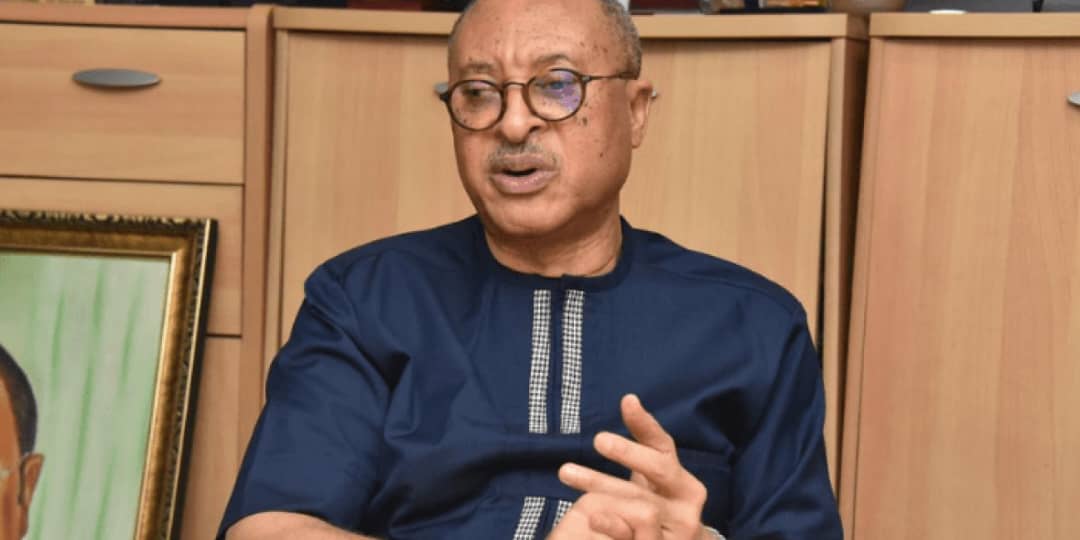
Political economist and former presidential candidate, Prof. Pat Utomi, on Monday warned that Nigeria is sliding towards national collapse, calling for urgent electoral and institutional reforms, including independent probes into the Independent National Electoral Commission and the judiciary.
Utomi issued the warning at a press briefing on the state of the nation and electoral reforms, where he described Nigeria’s political system as “unsound” and incapable of guaranteeing justice, stability and democratic progress.
“Our nation is in deep crisis. The state of our nation is unsound and pushing dangerously to the brink,” he said, urging citizens to “draw a line in the sand” before the country reaches what he called an irreversible breaking point.
He said Nigeria was at a crossroads between “collapse and progress; life and death,” stressing that the choices made by leaders and institutions in the coming months would determine the country’s survival as a democracy.
Utomi unveiled what he described as a seven-point “people’s charter of demands,” warning that failure to act could trigger widespread social unrest.
Chief among the demands is the establishment of a multi-stakeholder commission to review the conduct of the 2023 general elections, which he said were deeply flawed and lacked consequence management.
“The urgent need for a multistakeholder commission to review the 2023 elections cannot be overstated,” he said, insisting that those responsible for electoral malpractice must be held accountable to restore public confidence in the democratic process.
He also called for the creation of a consequence management committee to sanction institutions and individuals found culpable in electoral abuses, arguing that democratic progress depends on strong institutions and accountability.
The professor further urged oversight reviews of the National Assembly’s role in electoral reforms and called on the Attorney General of the Federation to prosecute lawmakers he accused of undermining the legislature’s constitutional role as representatives of the people.
Utomi also demanded the immediate establishment of a State Capture Commission, modelled after South Africa’s Zondo Commission, to investigate alleged hijacking of state institutions by private and political interests.
Raising concerns about the electoral umpire, he proposed the constitution of an international panel to probe INEC’s operations, including its procurement processes, funding sources and mode of appointing commissioners.
“There must be a review of INEC’s operating modes, procurement processes and even the way its membership is constituted,” he said, noting that the commission receives substantial donor funding and should therefore be subjected to international accountability standards.
He also called for an urgent probe into the judiciary’s role in election disputes, warning that allegations of judicial corruption have severely eroded public trust in the courts and the rule of law.
Utomi urged the Nigerian Bar Association to begin delisting judges and lawyers found to have compromised electoral integrity.
“If these demands of the people are not immediately implemented, we have to take it that the powers that be are ready for war with the Nigerian people,” he warned.
While stressing that no one desired Nigeria to descend into chaos like Sudan or Somalia, Utomi cautioned that nations that ignore the grievances of their citizens often face dire consequences.
“The complicit middle are those waiting to be absorbed into the rot or waiting for their turn to do damage,” he said, warning that once popular anger spills into the streets, it may be impossible to distinguish the innocent from the guilty.
On the broader task of national renewal, Utomi called for a reinvigoration of civil society, restoration of civility in public discourse and an end to what he described as the weaponisation of identity and the monetisation of politics.
He urged civil society organisations, ethnic and religious leaders to work together to rebuild trust and de-escalate tensions, warning that hatred of neighbours had become “the most powerful weapon in the hands of political elites.”
“May God help us all as we strive to save Nigeria,” he concluded.
 ‘
‘ ‘
‘Do you want to share a story with us? Do you want to advertise with us? Do you need publicity for a product, service, or event? Contact us on WhatsApp +2348183319097 Email: platformtimes@gmail.com
We are committed to impactful investigative journalism for human interest and social justice. Your donation will help us tell more stories. Kindly donate any amount HERE







Leave a comment