



Timothy Enietan-Matthews
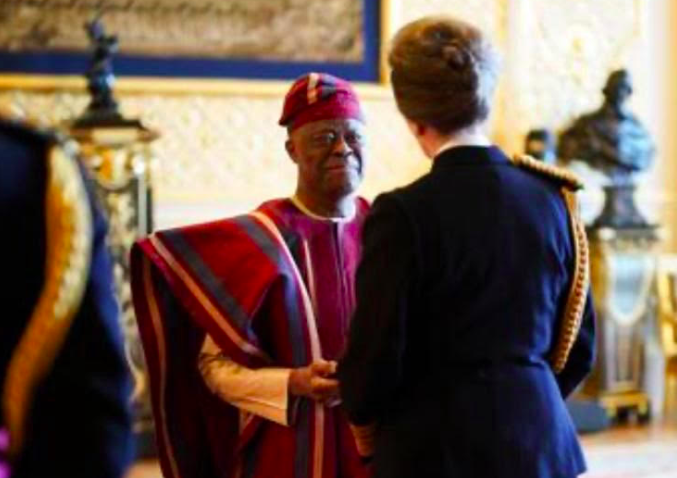
The ceremony at Windsor Castle was rich in pageantry, but its significance ran far deeper than tradition. Acting on behalf of King Charles, Princess Catherine bestowed the honour of Commander of the Royal Victorian Order on Wale Edun, Nigeria’s Minister of Finance and Coordinating Minister of the Economy.
The award, given in recognition of distinguished personal service to the Crown, placed Edun among an exclusive circle of individuals whose work has earned international esteem.
Sharing the moment with other honourees — including Lydia Tischler, a Holocaust survivor and child psychotherapist; Rhys McClenaghan for services to gymnastics; and John Whiston for services to broadcasting — Edun’s investiture carried particular resonance for Nigeria. It signalled not only personal recognition, but a broader global acknowledgement of Nigeria’s renewed seriousness about reform, stability, and economic governance.
Edun’s path to Windsor was shaped by decades of institution-building and international engagement. As a former trustee of the Duke of Edinburgh’s International Award, he has long worked at the intersection of leadership development, public service, and global cooperation. Those same values now define his role at the heart of Nigeria’s economic management.
Since taking office, Edun has overseen a period of consolidation following some of the most far-reaching economic decisions in recent history. Nigeria is gradually emerging from years of macroeconomic strain, with foreign direct investment showing renewed momentum as policy clarity improves. External reserves have strengthened, providing a firmer buffer against global volatility, while inflation — which surged in the aftermath of fuel subsidy removal and exchange-rate unification — has begun to ease, reflecting improving monetary and fiscal coordination.
These shifts have translated into growing international confidence. Abuja’s selection as host city for the 2026 Technical Meeting of the Intergovernmental Group of Twenty-Four (G-24) placed Nigeria at the centre of global discussions on development finance, debt sustainability, and growth across emerging economies. Addressing delegates, Edun underscored that the outcomes of the meeting would shape access to capital, investment flows, and job creation — pillars of Nigeria’s reform and growth agenda.
Global partners have echoed that assessment. The World Bank Group, through its Managing Director of Operations Anna Bjerde, has described Nigeria as a global reference point for “steady, credible reform leadership,” highlighting the government’s resolve to remain consistent despite early challenges. Edun reinforced that message at the Al Ula Conference for Emerging Market Economies in Riyadh, noting that Nigeria’s reforms are yielding results and must now be anchored for long-term resilience.
His national leadership draws heavily from experience at the subnational level. As a commissioner in Lagos State under then-Governor Bola Ahmed Tinubu, Edun was part of the team that reshaped Lagos’ fiscal architecture, expanded revenue generation, and embedded institutional discipline. That Lagos experience — reform-driven, data-focused, and execution-oriented — now informs his approach to managing Africa’s largest economy.
Today, Edun’s priorities are firmly outcome-driven: energy-led growth, digital tools to strengthen revenue assurance, improved fiscal–monetary alignment, and an investment climate that rewards transparency and productivity. Under his watch, Nigeria is steadily repositioning itself as a credible reformer capable of attracting capital and delivering sustainable growth in an uncertain global environment.
In that sense, the honour conferred at Windsor Castle mirrors the trust being rebuilt at home. It reflects a public servant whose credibility resonates internationally, even as he works quietly to stabilise, reform, and restore confidence in Nigeria’s economy. As the country moves from reform to results, Wale Edun stands at the intersection of global recognition and national responsibility — helping to shape a more stable economic future.














Leave a comment