



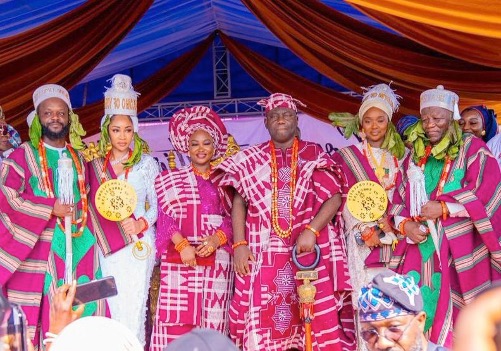
Tradition, pageantry and national symbolism converged in Oyo town recently, as the Alaafin of Oyo, His Imperial Majesty Oba Abimbola Akeem Owoade I, conferred prestigious Yoruba chieftaincy titles, Obaloyin of Yorubaland, and Obaloyin of Yorubaland, respectively on former Zamfara State Governor and serving Senator, Abdul’aziz Abubakar Yari, as well as philanthropist, Seyi Tinubu, Sunday Ehigiator reports
By any measure, Sunday, December 21, 2025, will linger long in the collective memory of Oyo town. From the first beat of the talking drums to the final royal salutations that echoed across the ancient palace grounds, the Alaafin of Oyo’s palace became more than a ceremonial arena; it transformed into a living symbol of Nigeria’s possibilities: unity without uniformity, tradition without exclusion, and leadership anchored in service.
Under the watchful gaze of history and culture, His Imperial Majesty, Oba Abimbola Akeem Owoade I, presided over the installation of two eminent Nigerians as Yoruba chiefs: Barrister Oluwaseyi Tinubu, entrepreneur and philanthropist, who received the revered title of Òkanlòm of Yorubaland, and Distinguished Senator Abdul’aziz Abubakar Yari, former Governor of Zamfara State and current Senator representing Zamfara West, who was installed as Obaloyin of Yorubaland. The double installation, bridging the Southwest and the Northwest, was both deliberate and deeply symbolic.
A Palace Awash with Colours
From early morning, the palace courtyards filled with a kaleidoscope of colours. Yoruba chiefs in flowing aso-oke exchanged pleasantries with northern emirs in richly embroidered robes. Lawmakers, governors, ministers and captains of industry mingled with traditional rulers, scholars and cultural custodians. It was a convergence of Nigeria’s many identities, drawn together by the authority of an ancient throne and a shared reverence for service.
Among the dignitaries present were Senate President Godswill Akpabio; the Minister of Youth, Hon. Ayodele Olawande; Lagos State Governor Babajide Sanwo-Olu; Sokoto State Governor Ahmed Aliyu; Deputy Speaker of the House of Representatives, Benjamin Kalu; former Ogun State Governor, Otunba Gbenga Daniel; former Kano State Governor, Abdullahi Ganduje; and dozens of serving senators. Their presence lent national weight to what might otherwise have been seen as a regional ceremony. Instead, it unfolded as a national moment.
Alaafin’s Message
In his remarks, the Alaafin of Oyo underscored the enduring relevance of traditional institutions in contemporary Nigeria. Chieftaincy titles, he noted, are not mere ornaments; they are covenants of responsibility. They bind the recipient to values of integrity, service, cultural preservation and social harmony.
By conferring titles on leaders from different regions and backgrounds, the Alaafin reaffirmed an ancient Yoruba philosophy: that leadership is measured not by origin but by contribution.
In a country often strained by ethnic and political fault lines, the palace made a quiet yet profound statement: that tradition can be a bridge rather than a wall.
Òkanlòm of Yorubaland
The title Òkanlòm, translated as “beloved child,” carries an emotional and moral weight within Yoruba culture. It signifies trust, affection and expectation.
The holder is seen as a custodian of values, a unifying figure and a protector of cultural heritage.
For Seyi Tinubu, the honour resonated beyond personal recognition. Known for his work in entrepreneurship, youth empowerment and philanthropy, Tinubu has cultivated a profile that blends private-sector innovation with social commitment.
Through initiatives supporting young Nigerians, small businesses and vulnerable communities, he has built a reputation as a bridge-builder between opportunity and aspiration.
As he took his oath and received the insignia of office, observers noted the generational symbolism of the moment: a younger leader being entrusted with an ancient mandate.
In accepting the title, Tinubu pledged to uphold Yoruba values, promote unity and use his platform to support initiatives that uplift communities across Nigeria, regardless of ethnicity or creed.
Obaloyin of Yorubaland
Perhaps the most striking moment of the ceremony came with the installation of Senator Abdul’aziz Yari as Obaloyin of Yorubaland. A Hausa-Fulani statesman receiving a Yoruba chieftaincy title was not unprecedented, but its resonance in the current national climate was unmistakable.
The Obaloyin title carries responsibilities of counsel, cultural advocacy and social welfare. It positions the holder as a friend of the throne and a promoter of Yoruba values beyond the region’s borders.
For Senator Yari, whose political career spans executive leadership as a former governor and legislative influence as a serving senator, the honour was both personal and political.
Accompanied by a delegation of northern senators and leaders, Yari expressed gratitude to the Alaafin and the people of Oyo. He described the title as a call to deeper national service, pledging to act as an ambassador of unity and to strengthen bonds between Nigeria’s regions. His words were met with applause that cut across accents and attire.
Voices of Commendation and Consensus
In a congratulatory remark that captured the mood of the day, the Honourable Minister of Youth, Hon. Ayodele Olawande, praised the Alaafin for recognising leadership rooted in service and integrity. He described the installations as “a celebration of leadership and a strong symbol of unity across our diverse communities.
“These honours speak to a shared dedication to service and cultural heritage that transcends ethnicity and region. In recognising excellence in different paths of leadership, we are reminded that our collective strength as a nation is forged in unity, respect, and shared values.”
His words echoed a broader consensus among attendees: that the ceremony represented not just personal accolades but a reaffirmation of Nigeria’s social contract.
Music, Memory and the Soul of the Ceremony
As tradition demands, the ceremony unfolded with a rich tapestry of rites and performances. Drummers narrated history through rhythm; praise singers invoked ancestral lineages; royal aides moved with choreographed precision. The air vibrated with meaning.
Musical performances by Fuji maestro Saheed Osupa and juju legend King Sunny Ade added contemporary flair to the ancient setting. Their songs, steeped in praise and reflection, provided a soundtrack that bridged generations; much like the ceremony itself.
The juxtaposition of northern delegations and Yoruba pageantry, of modern political figures and ancient rituals, created a visual metaphor for the Nigeria many aspire to see: diverse yet harmonious.
Expectations and Responsibilities
Chieftaincy titles in Yorubaland are not ceremonial endpoints; they are beginnings. The Òkanlòmọ and Obaloyin are expected to engage actively in community development, cultural promotion and conflict resolution. They serve as intermediaries between tradition and modernity, between the palace and the populace.
For Seyi Tinubu, this may translate into expanded cultural and social initiatives that empower youth and preserve heritage. For Senator Yari, it offers a platform to deepen interregional dialogue and advocate policies that reflect inclusivity and mutual respect.
Both men now carry the moral authority of the Alaafin’s endorsement—a powerful reminder that leadership is accountable not only to voters or shareholders but to history and culture.
A Broader National Implication
At a time when Nigeria grapples with questions of identity, cohesion and trust, the Oyo ceremony offered a counter-narrative. It suggested that unity need not erase difference, and that tradition can play an active role in nation-building.
By honouring a Yoruba entrepreneur and a northern statesman side by side, the Alaafin’s palace projected a vision of Nigeria anchored in shared values rather than sectional interests. It was a quiet yet compelling assertion that the nation’s strength lies in its ability to recognise merit wherever it is found.
The installation of Seyi Tinubu as Òkanlòmọ of Yorubaland and Senator Abdul’aziz Yari as Obaloyin of Yorubaland stands as a reminder that leadership, when rooted in service and guided by culture, can transcend boundaries.
It is a testament to the enduring power of traditional institutions to inspire unity, celebrate excellence and chart pathways toward a more cohesive Nigeria. In Oyo, history did not merely repeat itself; it spoke clearly, confidently and with hope.











Leave a comment