



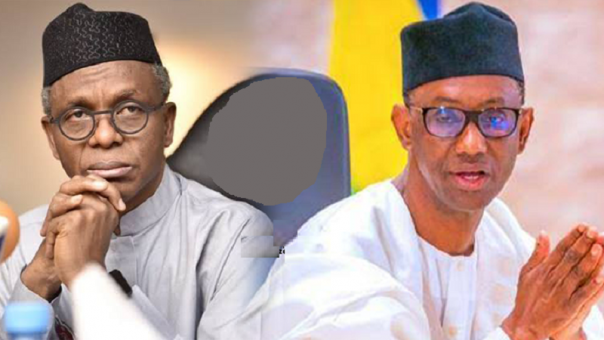
El-Rufai’s obsession with the National Security Adviser is unfortunate, contends MOHAMMED DAHIRU
A former governor of Kaduna State Nasir el-Rufai has given the opposition a voice at a time when it seemed muted. But his gradual descent from interrogating policies to attacking personalities risks diminishing that role.
In a recent interview with DCL Hausa, El-Rufai accused the National Security Adviser (NSA) Nuhu Ribadu of allegedly directing security operatives to arrest political opponents without proper investigation, and interfering in judicial processes — claims that have drawn backlash from civil society groups for being “reckless and unfounded.”
In an interview on Arise Television, Mr El-Rufai said, “someone tapped” Ribadu’s phone, and told him that the NSA allegedly instructed security operatives to effect his arrest.
El-Rufai’s media remarks recently included assertions that the Independent Corrupt Practices Commission (ICPC) and other agencies are being used against him on the directives of Ribadu — effectively alleging political persecution driven by the NSA.
In interviews aired last year on ARISE Television and other platforms, El-Rufai claimed that Ribadu was no longer his friend and suggested the NSA harbours ambitions for the 2031 presidency, and was manipulating security agencies to sideline rivals. Ribadu publicly dismissed these claims, saying he had “never discussed running for president in 2031.”
In previous media appearances, El-Rufai also accused the government — under Ribadu’s national security coordination — of adopting policies that“empower bandits” with allowances and food in the name of non-kinetic strategies — a narrative strongly rejected by the Office of the NSA.
These examples show a pattern of repeated and widely publicised accusations by El-Rufai linking Ribadu to alleged misuse of security agencies, politically motivated actions, and broader governance failures.
The truth is that El-Rufai’s spirit is wounded. The rejection of his ministerial nomination by the Senate, and subsequent dropping of his anointed replacement by Governor Uba Sani, have affected El-Rufai psychologically. Like former governor of Kano State Rabiu Kwankwaso, El-Rufai is wounded politically by his “godson” Governor Uba Sani. Unlike Kwankwaso who was able to have a handful of lawmakers and a couple of commissioners remaining loyally with him, El-Rufai was politically striped bare. Trying to settle scores with Ribadu over the local political misfortunes he had in Kaduna appears like the proverbial donkey rider who ignores the donkey to whip at the pannier.
The administration of Bola Ahmed Tinubu offers no shortage of substantive issues to critique: insecurity, the controversial tax reforms, weak budget implementation, cronyism, cost-of-living crisis, nepotism, etc. These are the key concerns affecting millions of Nigerians, not Nuhu Ribadu.
Yet El-Rufai’s apparent fixation on Ribadu risks narrowing a broad national conversation into a personal duel. Ribadu, whether flawed or not, is not the sum total of Nigeria’s governance challenges.
Opposition politics gains moral authority when it confronts systems, not when it settles scores. If El-Rufai truly wants to shape the national conversation, he must return to the issues not persons. History rarely remembers those who fought personalities, but those who challenged the power.
In Nigeria’s turbulent political arena, disagreements among elites are neither new nor unexpected. What is troubling, however, is the growing pattern of public finger-pointing by former Kaduna State governor, El-Rufai, particularly his repeated accusations against Ribadu.
Political rivalry is one thing, while sustained public vilification is another. Over the past months, El-Rufai has appeared increasingly fixated on Ribadu, portraying him as the architect of his political misfortunes and as a central figure in what he suggests are broader conspiracies within the ruling establishment. The claims are often dramatic, rarely accompanied by verifiable evidence, and almost always delivered in a tone that suggests personal grievance rather than institutional concern.
This pattern raises a fundamental question: why does El-Rufai consistently locate the source of his troubles in Ribadu?
Both men have long careers in public service and share similar reformist reputations dating back to their time in anti-corruption and public sector reform spaces. Ribadu, a former chairman of the Economic and Financial Crimes Commission, built his profile on anti-corruption enforcement. El-Rufai, a former FCT minister and later governor, cultivated an image of blunt leadership.
Yet their trajectories have diverged. Ribadu currently occupies one of the most sensitive security offices in the country, advising the presidency on national security strategy. El-Rufai, on the other hand, has been navigating political headwinds since leaving office in Kaduna. Instead of introspection about shifting alliances or the consequences of his own political style, El-Rufai appears to have chosen a more convenient route of assigning blame to Ribadu.
Dahiru is an Abuja-based journalist.









Leave a comment