



Iyke Bede
With 2025 recording one of the strongest market capitalisation gains in two decades, a 51.2 per cent annual increase that took the NGX from ₦62.76 trillion to ₦99.4 trillion, and inflation easing in late 2025, Nigeria’s macroeconomy showed clear improvement. Yet the effects of these capital gains remain largely invisible at the microeconomic level.
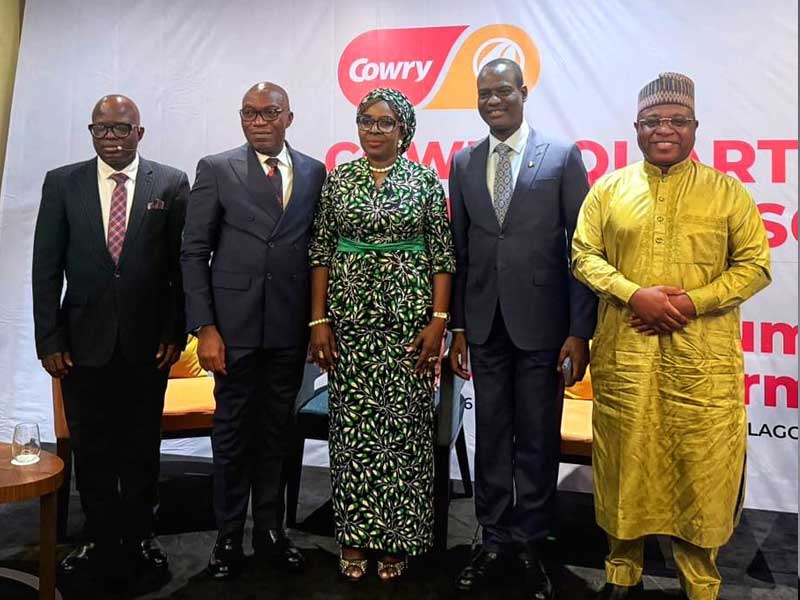
As 2026 unfolds, electoral campaigns for the 2027 elections are beginning, this time under the added dimension of tax reforms. These issues and many more informed discussions at the Cowry Asset Management’s Cowry Quarterly Discourse tagged ‘Nigeria in 2026: Will Politics Trump Economic Reforms?’, and chaired by Chairman, Presidential Committee on Fiscal Policy and Tax Reforms, Taiwo Oyedele; DG, Lagos Chamber of Commerce and Industry, Dr Chinyere Almona; Chairman, Nigerian Exchange Group Plc, Alhaji Umaru Kwairanga; and GMD, Cowry Asset Management Limited, Johnson Chukwu.
Across the board, all panellists agreed on one prediction: the Nigerian economy is on an upward growth trajectory, echoing the projection of an expansion of the gross domestic product (GDP) by 4.3 to 4.5 per cent this year. However, they had their reservations.
Almona insists that Nigeria’s low level of infrastructure continues to stall the economy, especially in a country where the informal sector carries much of the load.
“Nigeria’s infrastructure stock today is about 30 per cent of GDP. The World Bank expects that most emerging economies should be about 60 to 70 per cent. Developed economies should be about 70, 80, and above. But we’re just 30 per cent. That means that businesses will have to self-provide for the things that states should provide. So businesses will have to generate their own power, invest in boreholes, water treatment, waste systems. You have to think about your own security… things that states should actually provide,” she explained.
Regulatory inconsistencies were also highlighted by Almona as factors contributing to the masses not feeling the trickling effect of the improving economy—a sentiment also strongly held by Kwairanga, especially following reforms that led to the unification of FX market windows.
“What matters to us this year is the issue of consistency, policy consistency. Both of the structural changes have already been done. For those, we have already factored a price for most of them. We are deepening our market. A lot of companies are now becoming attractive to be listed on the exchange,” Kwairanga noted.
On the aspect of tax reforms, Oyedele stepped in to quell fears and dispel rumours around taxation. He made it clear that the reforms ensured that the country’s poor do not bear the brunt of indiscriminate taxation, noting that about 96 per cent of income tax was generated from the country’s poor—a stark contrast to South Africa’s tax system, where the top 1.5 per cent of earners contribute 60 per cent of the ₦60 trillion naira equivalent of income taxes.
As oil prices greatly influence Nigeria’s GDP, the current situation with Venezuelan oil hitting the market, despite experts saying the country was uninvestible and requiring years of infrastructure to extract heavy crude, and with US President Donald Trump potentially flooding the market and fuelling speculation of $50 per barrel prompted Oyedele to explain the feasibility of the scenario:
“Global crude oil production is about 102 million barrels a day, and consumption is around 101 million. Add another million, it doesn’t crash anything. Sure, it could cause a short-term shock. The data could support a $50 oil price. I’m not saying it’s impossible. But in reality, I don’t think it will happen.”
Oyedele said the goal was never to keep a gap between macroeconomic performance and what people actually feel. The economy had been in serious decline, and initial reforms caused some volatility, but stability returned. He added that the focus now is on sustainable growth that benefits citizens, and that the impact will translate faster through the new tax reforms.
“Therefore, we are seeing increasing government revenue, but at the same time, household consumption is weakening. The key thing, I think, is how the government can drive an improvement in household consumption. To sustain these reforms, you need to win a share of the people’s support. That will come when people feel their communities are improving, or when they see tangible improvements in their living conditions.
“So I think, looking at what to expect this year, with it being an election year, we are likely to see significant injections into the economy. Some sectors will benefit more, including entertainment, textiles, and fashion design. That flow of funds into households should boost household income, and eventually, that money will circulate through the economy,” Oyedele concluded.














Leave a comment