



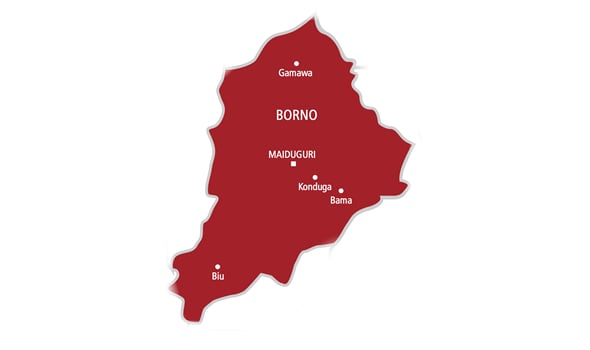

Over one million households displaced by years of insurgency have been resettled in their ancestral homes across parts of Borno State, following sustained stabilisation operations by troops of Operation Hadin Kai.
The Theatre Commander, Operation Hadin Kai, Major General Abdulsalami Abubakar, disclosed this on Wednesday while briefing journalists during a media tour organised by the Defence Headquarters for defence correspondents in Maiduguri.
According to him, the resettlement drive has enabled thousands of families to return to communities previously abandoned due to Boko Haram attacks, restoring livelihoods and socio-economic activities in the area.
General Abubakar listed some of the resettled communities to include Malam Fatori, Kekeno, Mala Jamel, and Yelwa, noting that Malam Fatori alone has witnessed phased resettlement efforts involving over a million households.
He added that Kukawa, once a ghost town at the height of the insurgency, is now bustling with economic activities, while Kekeno has also been successfully resettled.
“Stabilisation operations are basically carried out in the theatre to create the enabling environment for socio-economic activities to return to areas that were abandoned because of the insurgency, so that citizens can return to their ancestral homes to carry out their normal means of livelihood.
“This has been done in several communities in the theatre, including Malam Fatori, where we have phase one, phase two, and phase three resettlement. Over a million households have been resettled in Malam Fatori as we speak.”
The Theatre Commander said the success of the resettlement programme has been strengthened by collaboration with the Borno State Government, stressing that nearly 80 per cent of targeted areas have now been stabilised to support safe civilian return.
“The same applies to Kukawa, which is now a thriving town. If you take a ride into Kukawa, you will see the kind of socioeconomic activities taking place there. Recently, we also resettled Kekeno.
“Stabilisation operations are ongoing in Meirari, about 30 kilometres from Monguno town. This is significant. With support from the Borno State Government, we are almost 80% done, and citizens can return to their normal livelihoods.”
Beyond resettlement, General Abubakar said military operations have led to the re-establishment of critical infrastructure, including the construction of a Forward Operating Base and the repair of the Duji Bridge, which was destroyed by Boko Haram over a decade ago.
Duji, a border community with the only bridge linking Nigeria to the Republic of Niger, was completely deserted during the peak of the insurgency. With the return of troops, the area is gradually being reopened, including plans to restore immigration and customs services abandoned for nearly 10 years.
While highlighting the gains, the Theatre Commander acknowledged that the use of Improvised Explosive Devices (IEDs) remains a major challenge to military operations and civilian movement, particularly on poor roads.
Abubakar explained that terrorists often resort to IEDs when unable to confront troops directly. He noted that poor road conditions between areas such as Gubio and Damasak have provided opportunities for insurgents to plant explosives, endangering civilians and security personnel alike.
“It was highlighted that between Gubio and Damasak, for instance, we’ve had several IED incidents involving commuters, civilians, and even our troops.
“Right now, the main supply route from Gubio to Damasak is being rehabilitated by the theatre. When roads are in poor condition, terrorists can plant IEDs. If all the roads were tarred, we wouldn’t have one incident of IEDs, but the bad conditions give them the leeway to do so.”
He expressed optimism that continued stabilisation efforts would ensure the safe return of more displaced households and consolidate peace across the North-East.
Years of Boko Haram insurgency in Nigeria’s North-East forced millions of residents, particularly in Borno State, to flee their ancestral homes, abandoning communities, farmlands, and critical infrastructure.
The conflict severely disrupted livelihoods and socio-economic activities, leaving many areas deserted and unsafe for civilian return.
In response, the Nigerian military launched sustained counter-insurgency and stabilisation operations under Operation Hadin Kai, aimed at degrading terrorist capabilities, restoring security, and creating conditions for the safe resettlement of displaced households.












Leave a comment