



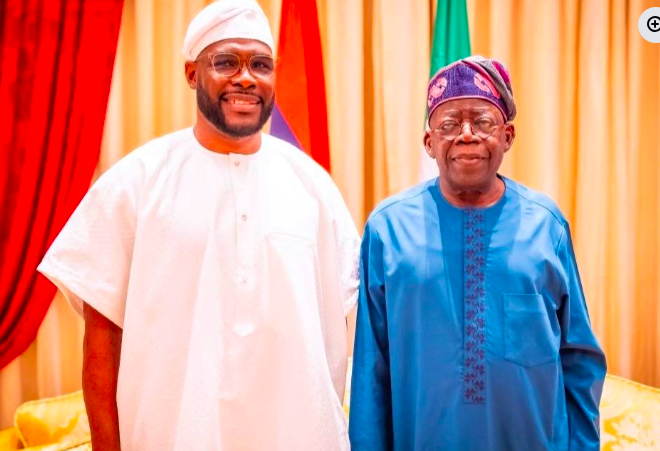
When the president, Bola Tinubu, received Abimbola Onabanjo at his Lagos residence on April 11, 2026, it was officially described as a routine courtesy visit. The discussion focused on national development. On the surface, it looked like a standard meeting between a political leader and a private citizen. But context is king.
You would think that Onabanjo is just a businessman—he is not. He is a prominent prince from Ijebuland and a leading contender for the Awujale throne. That stool is one of the most influential traditional positions in southwestern Nigeria, with real political and social weight.
The Awujale seat has been vacant since the passing of Oba Sikiru Adetona in 2025, and the selection process is still sensitive, with petitions and state involvement slowing decisions. In that environment, access to the President carries its own signal.
For many in Ijebu Ode, this meeting is being read as recognition at the highest level. It does not confirm anything formally, but it places Onabanjo within a circle of relevance that goes beyond local influence. In simple terms, it shows he is being taken seriously.
His profile supports that perception. Often called the “Builder Prince,” Onabanjo has funded road projects and community development efforts in Ijebu Ode. He runs businesses across sectors, including oil and gas and financial services. This mix of local impact and corporate exposure strengthens his case.
There is also a broader political layer. Traditional rulers in Ogun State do not operate in isolation. They shape alliances, influence decisions, and act as stabilising figures. A candidate who can connect both palace and presidency becomes more valuable in that system.
Still, the process is not political in the usual sense. Kingmakers, customs, and legal frameworks determine the final outcome. Even Onabanjo has urged patience, knowing that visibility may open doors, but it does not close the race.














Leave a comment