



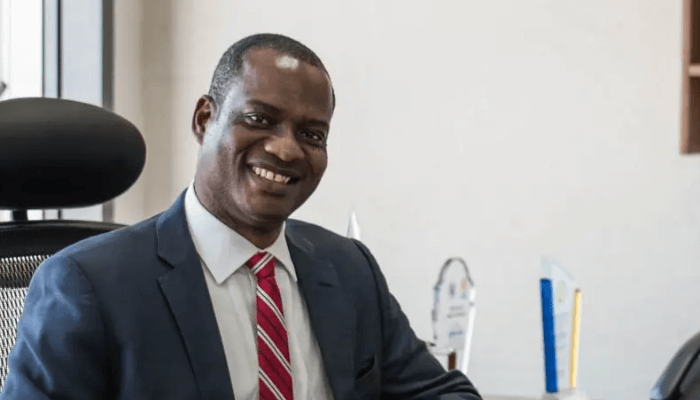
Taiwo Oyedele’s recent elevation to the position of substantive Finance Minister is the icing on the cake for his years of hard work, writes Ndubuisi Francis
Great achievements in life are often defined by hard work, grit, dedication, perseverance, and conscious effort. An enduring success is therefore anchored on personal sacrifice, consistency, hard work, and not overnight luck.
Henry Wadsworth Longfellow fittingly captured this in his famous quote from the poem, “The Ladder of St. Augustine.”
According to him, “The heights by great men reached and kept were not attained by sudden flight. But they, while their companions slept, were toiling upward in the night.”
This does not by any means diminish the fact that an interplay of providence has catapulted a few individuals into greatness.
Just a few days ago, an Associate Professor who prefers to be addressed as Mr. Taiwo Oyedele stepped up a notch higher in his career progression. He has now been saddled with the task of driving Nigeria’s fiscal policy ecosystem.
Precisely on March 16, 2026, he was appointed Minister of State for Finance, and barely a month later (Tuesday, April 21, 2026), he stepped up as the substantive Minister of Finance.
For many of us who read the political barometer intently, following the events of the last few months, Oyedele’s elevation was foretold.
Here is a man who ticks all the right boxes in many respects. He worked himself to the top, and his appointment was not a random pick. Perhaps, for most Nigerians, he wasn’t a household name until he was saddled with the task of overhauling the nation’s Medieval and often loathed tax system.
He is still not a household name for now, and may start ringing a bell when his current portfolio thrusts him into full public glare.
Who is Oyedele, the New Driver of Nigeria’s Fiscal Policy?
Oyedele is an accountant, economist, and investment banker. The almost 51 year–old Oyedele was born on June 18, 1975 in Ikare-Akoko, Ondo State. He attended St. Luke’s Primary School and Babatope Memorial High School, Ikoro Ekiti for his primary and secondary education respectively.
Legend has it that he was almost denied admission into primary school at five because he was small and when put to test as the practice was in those days, his left hand could not touch the right ear when placed across his head. He was accepted only because his twin sister, Kehinde passed the test. He was consistently the best student in his class through primary and secondary schools.
After his secondary education, Oyedele obtained a Higher National Diploma (HND) in Accountancy and Finance from Yaba College of Technology and B.Sc in Applied Accounting at the Oxford Brookes University.
He completed executive education programmes at the London School of Economics, Yale University, Gordon Institute of Business Science and Harvard Kennedy School. Oyedele’s career spans several key roles in both the private and public sectors.
Prior to his appointment in 2023 as the Chairman of the Presidential Committee on Fiscal Policy and Tax Reforms set up by President Bola Tinubu with a broad mandate to carry out critical reforms on Fiscal Governance, Revenue Transformation, and Economic Growth Facilitation, he was the Fiscal Policy Partner and Africa Tax Leader at PwC, where he worked for 22 years.
Over 10 years, he was in top leadership positions, gaining in-depth knowledge and diverse experience ranging from Tax Advisory & Policy Advocacy to Business Strategy Consulting, Leadership Development, and Policy Design and Execution.
He was the Thematic Lead for the Fiscal Policy & Planning Commission, and Chairman of the West Africa Debt Management Roundtable of the Nigerian Economic Summit Group (NESG); Chairman of the Taxation & Fiscal Policy Faculty Board of the Institute of Chartered Accountants of Nigeria (ICAN); member of the Nigerian Taxation Standards Board of the Chartered Institute of Taxation of Nigeria (CITN); and a member of the Ministerial Committee on the Design and Implementation of Nigeria’s National Tax Policy.
Oyedele is also a Fellow of the Nigeria Leadership Initiative, a member of the Global Tax Forum and a former member of the Global Governing Council of the Association of Chartered Certified Accountants (ACCA). He is an Associate Professor at Babcock University and a guest lecturer at the Lagos Business School. With such a rich resume, the cap fits Oyedele. More like a round peg in a round hole.
The Tax Reforms
Key components of the 2025 Tax Reform Acts, which his Presidential Committee midwifed, are the Nigeria Tax Act (NTA), which unified existing tax laws, introduced a progressive personal income tax system (0 per cent to 25 per cent), and updated capital gains tax on digital assets.
There is also the Nigeria Tax Administration Act (NTAA), which establishes a Taxpayer Bill of Rights, mandates digital invoicing, and provides for a new Tax Ombudsman to mediate disputes.
The Nigeria Revenue Service Act (NRSA): restructured the tax authority for better efficiency, while the Joint Revenue Board Act (JRBA) facilitates collaboration between federal and state tax authorities.
These tax laws–four in all–are already in operation, and as nobody can implement them with a human face than him now presiding over the nation’s fiscal space.
Expectations from Nigerians
The talk has been that the current administration’s policy reforms have achieved macroeconomic stability. Commendable. But in its latest Nigeria Development Update (NDU), the World Bank, while applauding the government for restoring macroeconomic stability, cautioned that that macroeconomic stability alone is not sufficient, noting that human capital development is a key channel through which macroeconomic gains can translate into improved living standards and jobs.
It also observed that inflation is still elevated and under increasing pressure, which poses risks to incomes and poverty reduction, highlighting the need to further decelerate inflation and complement stabilisation with investments that expand economic opportunities and jobs.
Poverty remains high, and cost of living continues to soar beyond the reach of most Nigerians. Part of the World Bank’s recommendations is that Nigeria’s fiscal policy should leverage the oil windfall occasioned by the ongoing war in the Middle East to rebuild fiscal buffers and provide targeted support to vulnerable households.
The report noted that while recent bold reforms have strengthened macroeconomic fundamentals, enhancing Nigerians’ productive capabilities will be critical to translating these gains into better living standards and jobs. Nigeria’s economy grew by 4.0 per cent in 2025, the same as in 2024, driven mainly by services such as ICT, financial services, and real estate, with mild expansion in other sectors.
The World Bank report noted that Inflation has eased notably, falling to 15.1 per cent year‑on‑year in February 2026, down from 26.3 per cent a year earlier, supported by tight monetary policy, reduced exchange rate volatility, and improved food supply. But despite these gains, the World Bank stated that household incomes are yet to recover fully as poverty remains high, highlighting the need to lower inflation further and complement stabilisation with investments that expand economic opportunity and jobs.
Nigeria’s debt burden, occasioned by an almost unbridled appetite for borrowing, has remained a cause for concern, even by multilateral agencies. At the present rate of about five per cent of GDP, the concern has been to halt the trajectory. The abysmal implementation of the capital budget is a misnomer and must be checked, while what is perceived as misplacement of priorities and financial profligacy by the government must be addressed. There must be clearly defined fiscal discipline in governance. These and many more are concerns Oyedele is expected to address as Nigeria’s new Minister of Finance and Coordinating Minister of the Economy.
He has the pedigree to make things change for the better only if he sets his eyes on driving life-changing national objectives. The challenges may be arduous, but they’re not insurmountable. He must realise that the election year is fast approaching and comes with a lot of fiscal challenges and headwinds. He must be proactive.









Leave a comment