



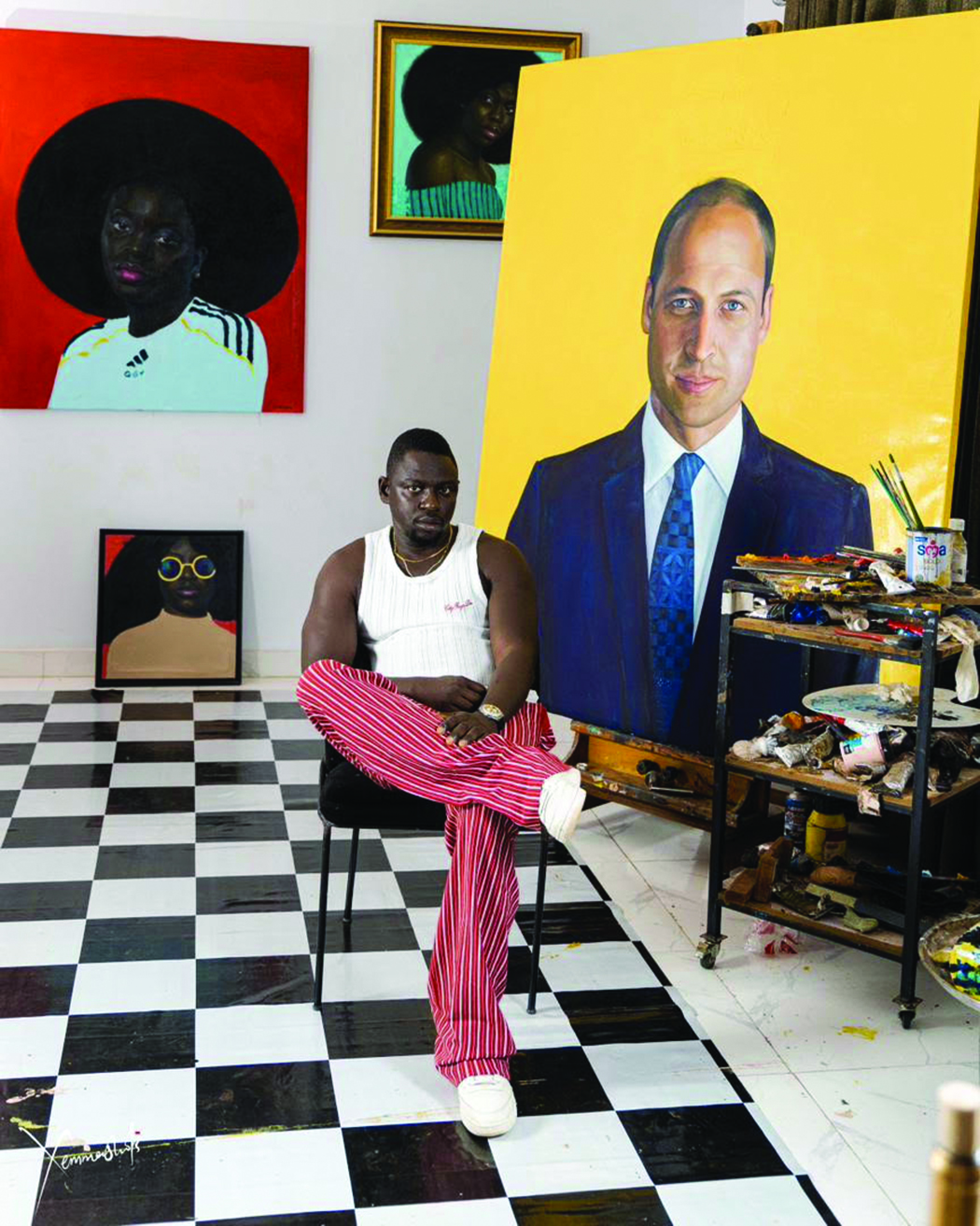
Oluwole Omofemi’s portrait of Prince William trades the stiff solemnity of royal tradition for a vivid, textured fusion of Nigerian aesthetics and British monarchy, prompting curiosity, debate, and praise for its notably flattering take on the future king. Yinka Olatunbosun reports
Commissioned to signal a new chapter for the Prince of Wales, Oluwole Omofemi’s work reframes William through a distinctly Pan-African lens. Set against his signature ochres and deep blues, the figure feels at once recognisable and reimagined. The artist’s bold lines draw attention to a different kind of “crown”—not jewelled, but symbolic: identity, heritage, becoming. It’s a subtle challenge to the viewer: what should a modern monarch look like in a world no longer bound by old borders?
The portrait has drawn significant attention ahead of its appearance on Tatler’s cover, not least for its quiet departure from William’s well-documented balding image. That choice alone has fuelled debate about artistic licence versus realism. Yet Omofemi, known for celebrating Black identity—particularly through the cultural and aesthetic weight of hair—approaches this subject with restraint. The result is less about reinvention than reinterpretation.
There’s a careful balance here. Omofemi blends his pop-art sensibility with traditional oil techniques, softening the rigid distance typical of court portraiture. Light and shadow are used not to elevate, but to humanise. William, in this rendering, is less an icon than a presence—approachable, contemplative, almost within reach.
Having previously painted Queen Elizabeth II for her Platinum Jubilee, Omofemi’s portrait of William feels like a generational bridge. It reflects not only the Prince’s evolving role as heir but also the shifting image of the monarchy itself—less untouchable institution, more scrutinised, global symbol.
For Omofemi, the commission signals something larger than royal approval. It underscores the expanding influence of contemporary Nigerian art on the world stage. Speaking about the process, he emphasised intention over spectacle: “I wasn’t trying to make something overly grand. I wanted it to feel present, calm, and relatable. There’s a quiet energy in the portrait… it’s about showing responsibility in a way that still feels human.”
That quiet energy extends to his use of colour. The recurring yellow tones subtly link this portrait to his earlier royal work, creating continuity across subjects. Even outside his usual focus, Omofemi remains drawn to what he calls the “soul” of the sitter—often anchored in the eyes, which meet the viewer with a steady, unforced intimacy.
His process was meticulous. He scoured images of the Prince online, studying them for something less obvious than likeness—something closer to essence. One reference stood out. From there came sketches, blockings, layers of colour—and interpretation.
“I added a crown,” he explained, “not as something possessed, but as something approaching.”
That idea—inheritance as a state of becoming—runs quietly through the work. A faint rendering of St Edward’s Crown hovers within the composition, less object than suggestion. It carries expectation more than authority, echoing the tension embedded in the title Heir. William is not yet king, but the weight of that future is already present.
Omofemi also weaves in elements of his own heritage. The patterns on the tie, inspired by African textile traditions, are small but deliberate acts of authorship. They shift the portrait from mere representation to dialogue—a meeting point of cultures, histories, and visual languages.
In that sense, this is not just a portrait of Prince William. It’s part of a longer, evolving story. Nigerian artists have been here before: Ben Enwonwu’s 1956 sculpture of Queen Elizabeth II famously “Africanised” royal imagery, while Chinwe Chukwuogo-Roy’s Golden Jubilee portrait offered elegance grounded in precision and dignity. Omofemi follows in that lineage, but pushes it further—into a globalised, postcolonial present where identity is less fixed, more negotiated.
“The timing felt right,” he said. “We’re in a moment where public figures are constantly seen, but not always deeply observed. I wanted to make something that invites people to look again.”
That invitation is perhaps the portrait’s greatest strength. It resists spectacle in favour of reflection. Through layered oils, subtle textures, and restrained symbolism, Omofemi creates a work that feels both contemporary and enduring.
For centuries, royal portraiture functioned as a tool of power—carefully constructed images reinforcing authority. But through a Nigerian lens, the genre becomes something more dynamic: a site of reinterpretation, even quiet resistance. It carries echoes of history while asking new questions about identity, legacy, and ownership.
Omofemi’s portrait doesn’t shout those questions. It lets them linger—somewhere between the seen and the sensed, between inheritance and identity. And in that space, the future king becomes something more interesting than tradition ever allowed: a figure still in the act of becoming.













Leave a comment