



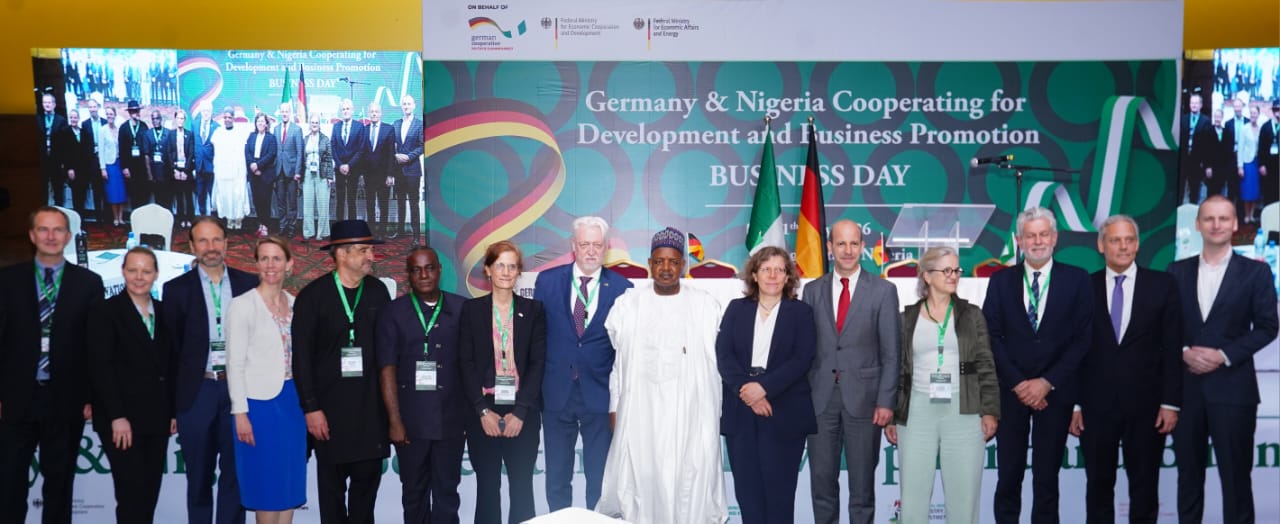
Minister of Budget and Economic Planning, Abubakar Bagudu, has called on German investors to deepen their footprint in Nigeria, insisting that President Bola Tinubu’s economic reforms are steadily reshaping the country into a more stable and attractive investment destination.
Speaking at the Nigeria–Germany Business Day in Lagos, themed “Germany and Nigeria: Cooperating for Development and Business Promotion,” Bagudu said recent policy shifts have created clearer macroeconomic signals, improved fiscal discipline, and expanded opportunities for long-term capital inflows.
“Under President Bola Tinubu’s leadership, decisive measures have been implemented to restore macroeconomic stability, improve fiscal sustainability, strengthen investor confidence, and reposition the economy for long-term growth,” he told participants at the forum hosted by the German Embassy.
He noted that although the reforms have been difficult, they were necessary to correct structural distortions that had constrained productivity and discouraged investment over time.
Key measures such as the removal of fuel subsidies, liberalisation of the foreign exchange market, enhanced revenue mobilisation, and broader structural adjustments, he said, are already beginning to yield measurable results.
According to him, “Nigeria’s revenue performance improved significantly, with total collected revenue rising from about N19.9 trillion in 2023 to over N28 trillion in 2025, exceeding government targets.
“Foreign exchange reserves rose to over US$46 billion in early 2026 — the highest level in almost eight years — helping to stabilise the foreign exchange market and strengthen investor confidence.”
Bagudu added that inflationary pressures, while still present, are beginning to moderate as policy adjustments take hold and supply-side reforms gain traction across key sectors.
He further disclosed that international rating agencies, including Fitch and S&P Global, have revised Nigeria’s outlook to Stable, a development he said reflects growing confidence in the country’s reform direction and fiscal management.
“Nigeria’s capital market also delivered a strong performance in the first quarter of 2026, with the Nigerian Exchange among the better-performing emerging markets globally,” he said, adding, “Importantly, Nigeria remains off the FATF grey list, reinforcing confidence in the country’s financial and regulatory systems.”
The minister urged German businesses to take advantage of Nigeria’s evolving investment climate, describing the country as one of Africa’s most significant long-term growth opportunities.
He highlighted that bilateral trade between Nigeria and Germany increased by nearly 30 per cent to about €3 billion in 2025, making Nigeria Germany’s second-largest trading partner in Sub-Saharan Africa.
He also noted that over 90 German companies are already operating in Nigeria across sectors such as energy, manufacturing, healthcare, logistics, and industrial services, underscoring the depth of existing economic ties.
Bagudu said Nigeria remains committed to achieving a $1 trillion economy by 2030 under its investment-driven National Development Plan (2026–2030), which places the private sector at the centre of growth strategy.
He emphasised priority sectors including renewable energy, agro-processing, manufacturing, digital innovation, and technical education as key drivers of future expansion.
Nigeria’s energy transition agenda, he added, offers significant opportunities for German firms, particularly in renewable infrastructure and clean technology deployment.
He encouraged both sides to move beyond dialogue into execution, urging businesses to translate engagements into investments that will drive industrialisation, job creation, technology transfer, and shared prosperity between Nigeria and Germany.
He said sustained cooperation between both countries would be critical to unlocking innovation and accelerating inclusive growth across Africa’s largest economy going
“We must convert today’s engagements into tomorrow’s tangible prosperity,” he reaffirming commitment to stronger bilateral economic partnership and private sector growth.














Leave a comment