



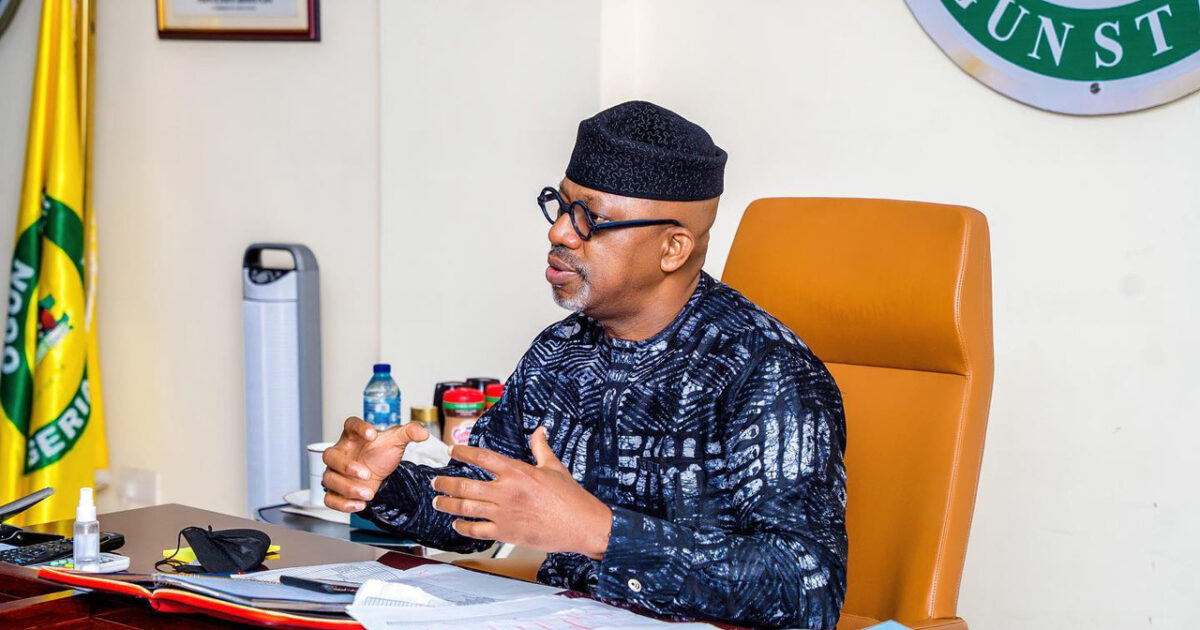

As part of his push to drive industrial transformation in Ogun State, the Governor, Prince Dapo Abiodun has launched a two-pronged strategy to achieve 24-hour electricity supply: building independent power plants and carrying out a comprehensive electricity consumption audit. The goal is to cut industrial costs, eliminate outages, and ensure no community is underserved.
The cornerstone is the Ogun State Light-Up Project. The first phase is a 30-megawatt plant located in Onijanganjangan, near Ewekoro, Abeokuta. During an inspection penultimate week, the Governor confirmed that turbines were being installed and the control room and installed equipment were ready for testing. He described it as the initial phase of a planned 100-megawatt capacity, with 30 megawatts set to provide uninterrupted electricity to Abeokuta, the state capital.
“This is the first phase of the implementation of our Ogun State Light-Up Project,” Abiodun said. “Abeokuta Metropolis will require more than 30 megawatts, but this is the first phase of the planned 100 megawatts power generation capacity.” He added that substantial parts of the city will now enjoy 24-hour uninterrupted power supply, calling it “unprecedented in the history of Ogun State.”
Running parallel is a 4-megawatt gas-fired Independent Power Plant in Oke-Mosan, Abeokuta, which the governor also inspected during the week. While smaller, the Oke-Mosan plant is designed to supply priority government institutions and serve as a testbed for the state’s distribution and metering model. Both the 4MW and 34MW projects are designed for future expansion, with the state targeting 100MW in phase one alone.
The plant is designed as a dual-fired system, capable of running on both gas and diesel for reliability. Abiodun said soft commissioning on diesel will begin in two to three weeks while gas pipelines are completed in three to six weeks. The plant will run primarily on compressed gas, with diesel as backup in case of disruption in supply.
The facility is expected to be commissioned within the next eight weeks. Initially, it will supply government institutions, health facilities, government quarters, police stations, local government offices, and higher institutions, before cascading to private individuals and industries as capacity increases.
Alongside construction, Ogun is moving to fix the demand side of the equation. Abiodun announced plans to carry out a comprehensive electricity consumption audit across the state. “The audit will help government monitor electricity distribution, curb leakages, and tackle energy theft,” he said during the Oke-Mosan inspection. The exercise will map actual consumption against supply, identify illegal connections, and provide data for more accurate load allocation and tariff design.
For years, DisCos have struggled with aggregate technical, commercial, and collection losses above 40 percent in parts of Ogun. By taking control of distribution within state-owned grids, Ogun intends to use smart metering and real-time monitoring to bring losses below 15 percent, in line with best practice for urban grids.
The governor described power as the foundation of industrialisation and economic development. “The Ogun State Light-Up Project is aimed at making the state energy self-sufficient while ensuring no community is underserved,” he said. The audit will ensure that new capacity is matched to real demand and that underserved areas are prioritized in phase two.
For investors and manufacturers, reliable power removes one of the biggest barriers to expansion in Ogun. With stable electricity, factories can scale operations, cut dependence on expensive diesel generators, and improve competitiveness. It also strengthens Ogun’s position as Nigeria’s leading industrial hub and signals to investors that the state is serious about creating a business-friendly environment.
In doing so, Abiodun is leveraging the 2023 Electricity Act, which empowers states to generate, transmit, and distribute electricity independently of the national grid. The law effectively ends the federal monopoly on power and gives subnational governments the legal framework to build localized energy systems tailored to industrial needs.
The Act, signed into law by President Bola Tinubu, decentralizes Nigeria’s power sector for the first time since the 2005 Electric Power Sector Reform Act. It allows states to license mini-grids, regulate intrastate electricity markets, and negotiate directly with gas suppliers. For decades, states were limited to passive roles while the federal government controlled generation, transmission, and tariff policy through NERC and the Transmission Company of Nigeria (TCN).
Abiodun said the state’s decision to enter power generation, transmission, and distribution followed the removal of electricity from the exclusive legislative list by the federal government. “Following the Federal Government’s removal of power generation, distribution, and transmission from the exclusive list, Ogun State has not only passed the necessary laws but has also begun implementing this critical initiative,” he noted.
The Ogun State House of Assembly has passed the law establishing the Ogun State Electricity Regulatory Commission (OGSERC) to oversee all power sector activities in the state and provide oversight for anyone who wants to go into the power business. The commission will regulate tariffs, licensing, and service standards for the state grid and mini-grids.
Similar plants are planned for Sagamu, Ijebu-Ode, and Ota as the Light-Up Project expands. Project Manager Selvin Leo said the Onijanganjangan plant is 90% completed, assuring that with the availability of needed materials, equipment, and commitment from the workers, the job would be completed in record time.
The cost implications for industrial demand are significant. Under the federal-controlled system, manufacturers in Ogun face tariffs set by NERC, erratic supply, and heavy reliance on diesel generators that push energy costs to 30–40% of production expenses. The World Bank’s 2023 Nigeria Development Update estimated that unreliable power costs Nigerian firms about 2 percent of annual sales and forces manufacturers to spend up to 50 percent more on energy than competitors in Ghana and South Africa.
By bypassing the grid, the state’s independent power plants can offer ring-fenced tariffs negotiated directly with industrial clusters in Agbara, Ota, and Sagamu. This removes transmission losses, reduces wheeling charges, and eliminates the cross-subsidy burdens built into the federal tariff structure. Industrial users in Ota currently pay NERC Band A rates of ₦206–₦225/kWh, but still experience 8–12 hours of daily outages, forcing reliance on diesel at ₦1,200–₦1,500 per liter.
The effect on industrial demand is twofold. First, it lowers the effective cost per kWh for manufacturers, making Ogun more competitive than states still dependent on DisCos. Second, it creates predictable supply, allowing factories to scale production and shift from backup generators to grid-equivalent power.
In contrast, the federal system remains constrained by liquidity gaps, gas supply issues, and a centralized dispatch model that cannot prioritize industrial zones. Nigeria generates about 4,500 MW for a population of 220 million, while South Africa generates over 50,000 MW for 60 million people. The result is rationing, load shedding, and a system where industrial users subsidize residential consumers across the country.
If replicated, Ogun’s model shifts power from a cost centre to a competitive advantage, while exposing the inefficiencies of centralized generation. Manufacturers in the state say they could increase output by 25–40 percent if stable power is guaranteed, according to the Manufacturers Association of Nigeria (MAN), Ogun Chapter. The consumption audit will provide the data needed to size future capacity and avoid overbuilding or under-serving key zones.
For households, state-level generation under the Electricity Act 2023 addresses the two main problems with federal-controlled power: cost and reliability.
First, it delivers lower and more predictable tariffs. State projects can ring-fence supply to specific LGAs or housing estates, avoiding the transmission losses and cross-subsidy charges built into the national grid tariff. DisCos can no longer pass on losses from other regions to Ogun consumers. As more gas is procured directly and distribution is managed locally, tariffs can be negotiated closer to the actual cost of service rather than an averaged national rate.
Energy analysts note that localized procurement of gas cuts middlemen costs and reduces exposure to pipeline vandalism in the Niger Delta, a major cause of gas shortages for federal plants. Ogun’s proximity to Lagos and its own gas infrastructure gives it a geographic advantage most inland states lack.
Second, it reduces outages and speeds up response times. When the plant and distribution network are controlled at the state level, faults are resolved locally instead of waiting on Abuja or regional TCN dispatch. For domestic users, this means fewer load-shedding cycles and quicker restoration after faults—critical in peri-urban areas like Mowe, Ibafo, and Sango-Ota, where grid service is currently weakest.
Currently, residents in these areas report 4–6 hours of supply daily on average, according to field surveys by the Ogun Civil Society Forum. The new plant is expected to push that above 20 hours, with priority feeders for residential zones. The consumption audit will help prioritize which feeders are upgraded first.
Third, it reduces reliance on generators. With 24-hour supply, households cut spending on petrol and diesel generators. The average urban household in Ogun spends ₦15k–₦30k monthly on fuel and maintenance. A stable state grid converts that cost into productive spending or savings. Small businesses, from cold rooms to barbershops, stand to gain the most, as energy often accounts for 40–60% of operating costs.
Fourth, it enables targeted expansion to underserved areas. The federal system prioritizes bulk supply to DisCo load centers. A state can direct investment to expand mini-grids and last-mile connections in areas the national grid has ignored, improving energy access for low-income communities. Ogun has already identified 12 rural clusters for phase-two mini-grid projects under the state’s Rural Electrification Board.
The implications extend beyond electricity bills. Reliable power attracts foreign direct investment, reduces inventory costs for manufacturers, and improves the state’s internally generated revenue. Ogun already leads Nigeria in non-oil IGR, collecting ₦240.6 billion in 2024. Stable power could push that higher by expanding the tax base through formalized industrial activity.
It also reduces pressure on the naira. Manufacturers currently import diesel and generator parts to compensate for grid failure, adding to forex demand. A shift to gas-fired, locally managed power reduces that burden.
The newly established Ogun State Electricity Regulatory Commission will be critical to sustaining this. Abiodun stressed that the commission would oversee electricity generation, transmission, and distribution in the state, with a mandate to ensure reliability and affordability. “Our goal is to position Ogun as the preferred investment destination with reliable and affordable 24-hour power supply,” he said.
However, challenges remain. State projects require upfront capital and creditworthy offtakers to be viable. Ogun’s plants are backed by public-private partnerships with a consortium of energy firms, but scaling them to cover the entire state will require further investment. Tariff design must also balance affordability for households with cost recovery for investors.
Regulatory clarity is another factor. While the Electricity Act gives states legal authority, coordination with NERC and TCN is still needed for interstate wheeling and national grid stability. Any friction between state and federal regulators could delay projects.
Ogun is not alone. Lagos, Enugu, and Edo have also begun activating state-level electricity laws passed after the 2023 constitutional amendment. But Ogun’s focus on industrial corridors, its consumption audit, and its existing manufacturing base gives it a first-mover advantage.
“If this works, you’ll see other states follow quickly,” said Dr. Ayo Gbeleyi, an energy economist at the Lagos Business School. “The key is whether Ogun can maintain technical standards, avoid political interference in tariff setting, and ensure transparency in procurement and metering. That’s where most subnational projects fail.”
Abiodun said the administration remains committed to extending the project to Ota, Ijebu-Ode, and Sagamu, calling it “another unprecedented achievement in our administration’s commitment to a brighter and more electrified Ogun State.”
The trade-off is clear. Where executed well, state-level power combined with data-driven distribution shifts domestic consumers from passive recipients of a failing national system to direct beneficiaries of a locally managed one. For Ogun, the bet is that industrial growth, lower household costs, and improved competitiveness will outweigh the financial and regulatory risks.
As Nigeria heads toward the 2027 general elections, energy reform at the state level may become a defining metric for voters. In Ogun, the lights staying on and the bills making sense could be the strongest campaign message of all.
Ogbonnikan is a Senior Special Assistant (SSA) to the Ogun State Governor on Media












Leave a comment