



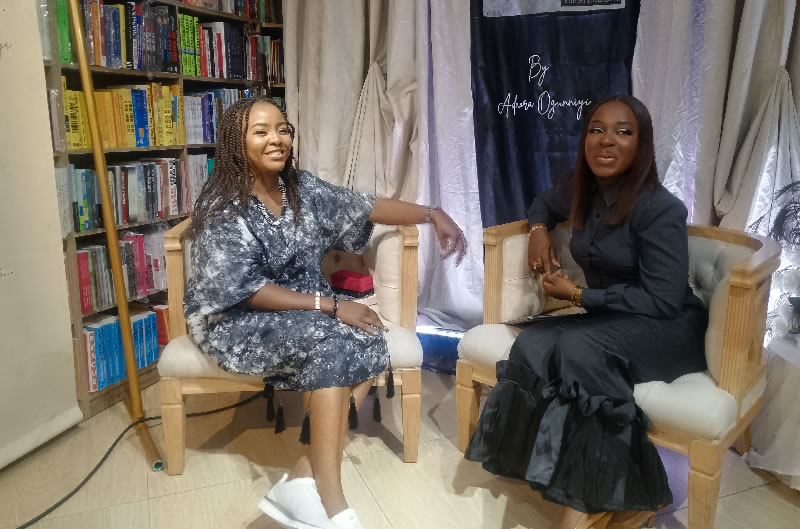

A Nigerian novelist and short story writer, Adaora Ogunniyi, has unveiled her latest work, The Steel Gavel.
This novel explores how the Osu caste system continues to influence marriage decisions in parts of the South-East.
The 334-page book, divided into 20 chapters, was launched on Saturday at the Roving Heights Bookstore, Lagos.
It tells the story of two main characters, Jideofor Williams and Fiyinfunoluwa Taylor, who, in their quest to marry, find themselves up against “a culture famous for stamping its cold verdict on human lives with the force of a steel gavel.”
The Osu caste system is a traditional practice in Igboland that segregates certain individuals and their descendants who are regarded as “slaves of the gods.”
Those labelled Osu face discrimination and social exclusion, including restrictions on marriage and participation in community life.
Ogunniyi noted that although governments dating back to the old Eastern Nigeria legislature announced the abolition of the Osu system, the discriminatory practices persist, especially around marriage.
“Most of the story had to do with them (Jide and Fiyin) fighting hard to be together,” she said.
“It’s interesting because Osu was supposed to have been abolished in 1956 in the then Eastern National Assembly.
“Dr Nnamdi Azikiwe, of blessed memory, said categorically that it is evil and wicked to discriminate against someone – I’m paraphrasing – to call someone unclean because of accidents of the past they had nothing to do with.
“So, most of the story goes around them trying very hard to climb over that obstacle because Osu is so woven into the fabric of society that you would think that now that everybody is educated and forward-thinking, it’s gone. It’s not gone; it is still very much alive, as near as today.”
She described as baffling the reality that stories of love, friendship, and the pursuit of “happily ever after” still collide with such deep-rooted cultural practices in a modern Nigerian society.
“Yes, you can walk with them (Osu), you can be friends with them, you can do everything, be business partners with them, but when it’s time to get married, when they find out, it’s not going to happen.
“Why? Because when you get married to an Osu, not only do you become an Osu, but your entire lineage becomes Osu. So people generally push back,” she said.
Ogunniyi added that her work is inspired by African cultural narratives and the ways people navigate the obstacles they create or inherit.
“My writing is driven by the need to showcase how uniquely the same we all are. So if I write a story about Nigerian culture, my book club members in America can identify with it. I am drawn to African cultural narratives and how they affect people, or how people affect those narratives. That is why my first book, Waves Aligning, was about feminine repression in a pseudo-modern African society,” she said.
“My writing wants to make humanity aware of the structures of society and give them an idea of what could be. I try to showcase narratives we all know and present an alternative ending, an alternative pathway to how life should be.
“It’s important for me to show readers how uniquely the same we are. We are the same, but in different ways. Differences make us better.”
She added that she deliberately ensures her stories end on a hopeful note.
“I desire to shine light amid a depressed world, to give hope through my writings, and that is why I make my stories end well,” she said.
“My stories always end happily because there is a lot of sadness in the world. After I have showcased the troubles of life, I want to give my readers the satisfaction of an elixir of some sort.
“My writing brings hope to people. I’m not going to pretend that there aren’t obstacles in life, but I want you to have some hope. I don’t want people reading my book and then going on to commit suicide.”
Ogunniyi disclosed that it took her four years to complete The Steel Gavel, adding that more novels are on the way.
The unveiling and book-signing event drew literary enthusiasts, authors, friends, associates and family members from Nigeria, the United States and the United Kingdom.
Ogunniyi’s debut novel, published in 2018, tells the story of a young African girl’s struggles and the imbalance in educational opportunities for girls.
Her other works include Six-Feet, a flash fiction published in August 2023; The Mist, also published in August 2023; Missing Pipes, Nuts and Screws, a short story published in May 2024; and My Name Is Adaiba, released in June 2024.














Leave a comment