



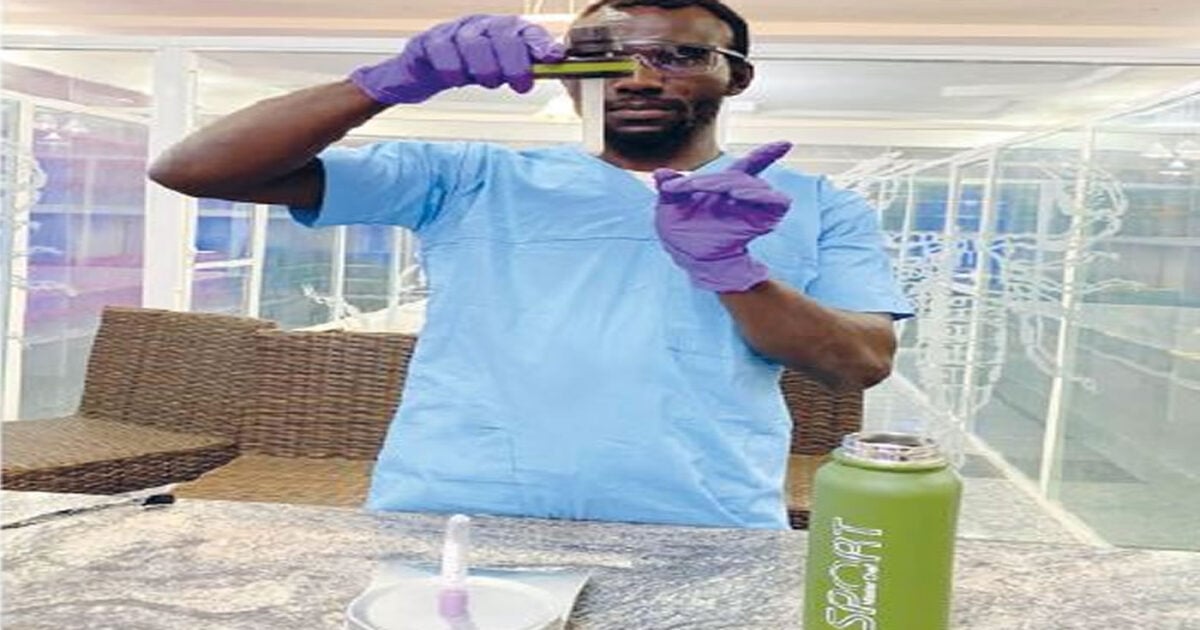
A former corporal in the Nigerian Air Force and Laboratory Operational Manager at Liman Usman Global Ltd, Muhammad Usman, shares with IBRAHIM ADAM how scorpion venom is being transformed from a feared toxin into a high-value scientific resource and how the emerging industry is reshaping agribusiness
What does a visitor encounter upon entering your facility that houses scorpions?
The first thing people notice is the calmness of the scorpions. The environment is quiet, controlled, and highly organised. Thousands of scorpions are housed individually in transparent plastic enclosures, arranged systematically and monitored daily.
The atmosphere is clinical rather than frightening. Contrary to popular belief, this is not a place of danger or chaos. It is a scientific workspace where scorpions are treated as biological resources. Each one carries venom that is among the most valuable liquids in the world.
How would you describe the significance of your job?
What is happening here is the foundation of an emerging biomedical industry. This is not curiosity-driven experimentation. It is a serious scientific and economic venture with implications far beyond this laboratory.
Scorpion venom has enormous global demand, and this facility represents a new export frontier for Nigeria. Beyond revenue generation, it offers opportunities for employment, scientific advancement, and economic diversification.
Why do people call you the scorpion doctor?
I am a retired corporal of the Nigerian Air Force and the Farm Operational Manager at Liman Usman Global Ltd. My professional journey has evolved from national security to agribusiness and biotechnology. The nickname came from people observing my work and familiarity with scorpions.
But I am driven by service, discipline, and solving problems. I was born in May 1991, and I am from the Alukusu community, Katcha Local Government Area of Niger State.
From the Air Force to scorpion venom extraction, what was that journey like?
I joined the Nigerian Air Force in 2013 and served during some of the most demanding periods of Nigeria’s internal security operations. I participated in missions such as Operation Safe Haven, Operation Harbin Kunama, and Operation MESA.
These experiences exposed me to high-risk environments and taught me discipline, patience, and strategic thinking. When I retired in December 2024, no one imagined my next mission would involve scorpions rather than security operations.
I had been doing this work even when I was in active service, but people started noticing me when I resumed full-time.
How did your military background shape this enterprise?
The Nigerian Air Force emphasises unity, professionalism, and efficiency. It is an institution built on structure and accountability. Scorpion farming requires those same values.
Venom extraction, habitat control, animal welfare, and storage protocols demand strict adherence to procedure. Without discipline, this business would fail. My military training prepared me to manage complex systems and long-term projects.
When did the idea of scorpion farming first come to you?
It came during a surprisingly ordinary moment. I was on sentry duty, scrolling through the media, when I saw a report on scorpion farming in Morocco.

The commercial success of that model immediately caught my attention. Rather than dismissing it as unrealistic for Nigeria, I became curious and decided to learn more.
What steps did you take after discovering that model?
I conducted extensive research into scorpion biology, venom composition, extraction techniques, and global market demand. Eventually, I began small-scale practice at home with five to 10 scorpions.
That phase was essential, as it allowed me to understand their behaviour, feeding patterns, habitat requirements, and the practical realities of venom extraction.
How did you balance this research with your military responsibilities at the time?
It was extremely challenging. Over time, it became clear that I could not manage the business alone while still serving actively. The demands of military duty and financial limitations made it unsustainable. That was when I began seeking external support and investors.
How did you approach potential investors for such an unusual venture?
Transparency was critical. I explained the long waiting period, the risks involved, the technical demands, and the long-term rewards. I made it clear that this was not a business for quick profits.
Every venture has advantages and disadvantages, and scorpion farming requires patience and confidence in the science behind it.
Scorpions are widely feared. How accurate is that fear?
Much of it is rooted in misinformation. Scorpions are generally calm creatures and do not attack humans unless they feel threatened.
They sting only when provoked. When people see me handling scorpions or placing them on my body, they are often shocked, but that confidence comes from understanding their behaviour.
Years of observation and practice helped me develop that confidence. Once you understand how scorpions respond to stress, light, temperature, and movement, fear disappears. Knowledge replaces panic, and respecting their nature is key.
How established is scorpion farming in Nigeria today?
It is still extremely rare. This is currently the only fully operational commercial scorpion laboratory in the country. Beyond running the laboratory, I also train and manage individuals who want to enter the industry. Capacity building is essential if this sector is to grow.
What level of capital and expertise does scorpion farming require?
It requires significant capital, technical knowledge, and long-term commitment. Each scorpion costs about N5,000 from forest hunters. We currently house over 10,000 scorpions.
Each transparent enclosure costs N3,000, and we use more than 600 units. Biomedical refrigerators for venom storage can cost up to N6m. This is not a business to rush into.
How do you ensure the survival of scorpions in captivity?
In the wild, scorpions can live up to eight years. In controlled environments, their lifespan may be reduced to around five years due to stress.
To mitigate this, we replicate their natural habitat using tree stems, water, and carefully regulated conditions. Reducing stress improves both survival rates and venom quality.
Why is feeding the major challenge in this business?
Feeding is one of the biggest challenges. Scorpions are fed live prey such as cockroaches, mealworms, and snails, usually once a week.
Mealworms, in particular, are not widely farmed in Nigeria, and scorpions cannot survive on substitutes like black soldier fly larvae. This gap presents a need for complementary businesses.
Does this challenge create new business opportunities?
Yes, it creates new business opportunities. In countries like Dubai, Malaysia, and Pakistan, people earn significant income from mealworm and cockroach farming. I plan to integrate that into this enterprise.
In Nigeria, the most common insect farming is black soldier fly, but it cannot be used for scorpions because it is too small. Scorpions prefer live prey they can strike, kill, and consume naturally.
How is venom extracted without killing the scorpions?
We extract venom from about 1,000 scorpions daily. Scorpions reproduce roughly twice a year, with a gestation period of about six months. However, frequent venom extraction places stress on them and inhibits reproduction.
Therefore, extraction is carefully spaced, usually every seven to 10 days per scorpion, to maintain quality and avoid overmilking.
From 1,000 scorpions, we obtain about nine to 10 millilitres of venom. Venom accumulation is slow, which is why maintaining a large population is essential.
We do not kill scorpions during the extraction process. The method involves using tweezers, tongs, and a low-voltage electrostimulator that causes the scorpion to release its venom without harm.
Are certain scorpion species more valuable than others?
Yes, species matter significantly. Emperor scorpions, for example, are highly valuable because they produce four to five millilitres of venom, compared to species like the deathstalker, which produce far less.
What happens to the venom after extraction?
The venom is stored in airtight containers and preserved in biomedical freezers under strict conditions. Sales are conducted through formal agreements with international pharmaceutical companies and research institutions. We sell only in large quantities, not in small millilitres.
How valuable is scorpion venom in the global market?
The global market for scorpion venom is growing rapidly, with international prices ranging from $7,000 to $9,000 per litre. Scorpion farming is highly lucrative, and the venom has immense medical value.
This is not a product sold casually. Online sources show that a gallon of scorpion venom can cost up to $39m. Its value, especially when converted to naira, is extraordinary.
How long does it take before investors see returns?
This is not a business for immediate profit. Investors may spend up to a year without visible returns, which can feel discouraging.
However, once venom is sold, the results are remarkable. The scale of returns is so large that people may struggle to believe it is legitimate, as earnings are measured in millions of dollars rather than thousands of naira.
Why is scorpion venom important in modern medicine?
Scorpion venom contains complex bioactive compounds. It is used in developing anti-cancer drugs, painkillers, cosmetic products, and treatments for autoimmune diseases.
One key compound, chlorotoxin, has shown the ability to bind specifically to cancer cells, particularly brain tumours, making it valuable for targeted therapies and tumour identification.
What other medical applications are being explored?
Proteins in scorpion venom are being studied for treating rheumatoid arthritis, multiple sclerosis, inflammatory bowel disease, malaria, and chronic pain. Some compounds show promise as non-opioid pain relief agents by modulating the immune system and reducing inflammation. Research is ongoing to expand its applications.
What does this industry mean for Nigeria’s future?
Nigeria has the potential to become a leading exporter in this specialised biomedical market. Scorpion farming can create employment, advance scientific research, and reduce dependence on traditional commodity exports.
With the right policies, regulations, and public awareness, this industry can significantly reposition Nigeria in the global bio economy as the country diversifies away from crude oil.














Leave a comment