



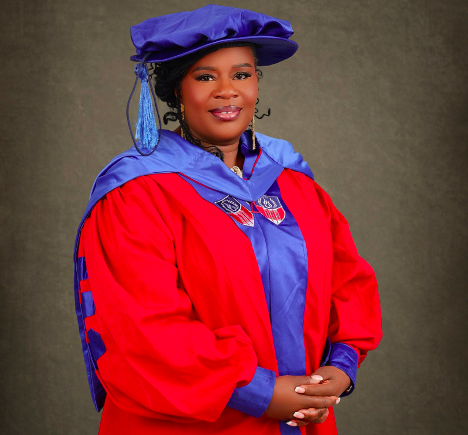
Dr. Yetunde Adeshile embodies a familiar Nigerian arc – one that begins in chaos and returns with clarity. From her early years between Nigeria and the UK to her rise as a project leadership professional, Adeshile political figure, minister, and mentor, her path is impressive. Yet what distinguishes her is the way she threads experience, faith, and public service into something that feels both personal and nationally relevant. Adedayo Adejobi writes
Perhaps, Eko Signature Hotel has perfected the art of warm hospitality. The visually charming marble floors gleam, the air smells faintly of citrus as the staff glide across the lobby with unhurried confidence. It is the kind of place where deals are made, alliances are sealed or tested, and silence gets treated with respect.
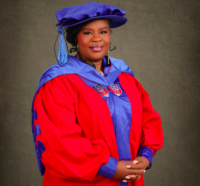
On the fifth floor, in a room overlooking Victoria Island’s modest skyline sits Dr. Yetunde Adeshile. She rises with a warm smile that gives nothing away as I walk in, the sort of smile seasoned politicians cultivate in committee rooms where everyone is slightly annoyed at everyone else. Except she is not here to be a politician. Not yet. She insists on that point with the sincerity of someone who has been asked far too many times whether she plans to run for office.
For now, she prefers to remain a consultant, a pastor, and a builder of people. Still, the room seems full of questions that might one day matter to a country searching for competence in a world that rarely rewards it.
The curtains are open, giving the evening light permission to paint her face with a soft glow. She offers tea instead of coffee. “Coffee invites agitation,” she says with a chuckle. “Tea invites clarity.”
It is a line that tells you everything about her: decisive, slightly humorous, and almost dangerously self-aware.
Adeshile’s story has the kind of plotline that would make an excellent drama if Nigeria’s trusted screenwriters could handle nuance. Born in Nigeria, shipped to boarding school in the UK at eight, shaped by two cultures that often misunderstand one another, she has spent more than thirty years managing complex public and private sector projects for British institutions that prize efficiency as if it were a delicacy.
She became the first black female Conservative councillor in Basildon, then Deputy Mayor. Her late father was the only Christian in a Muslim family, her late mother a magnetic community presence. “Respecting boundaries and different practices are second nature to me,” she says. “It is the coalition of my childhood.”
In Nigeria, this would be considered excellent training for survival. She recently returned to Lagos and Ibadan to host the second edition of her project management and leadership summit. The event bore her fingerprints in every direction. Volunteers moved about with cheerful urgency. Project managers compared notes with painstaking effort. Vendors who had supported the first edition embraced her like a daughter they had watched grow into a formidable person.
Standing before the crowd, she spoke with a mixture of gratitude and mild disbelief. “This summit was born out of passion,” she said. “Last year, when we hosted the first breakfast edition, we realised there was a hunger for something bigger. A hunger for professional development, networking, knowledge sharing, and collaboration among project managers and emerging leaders. Returning this year feels like fulfilling a responsibility to Lagos and Ibadan-my roots.”
It was the kind of remark that does not sound like rhetoric but like a woman reporting for a duty assigned by conscience.
She thanked the volunteers, the partners, the Nigerians in Diaspora Organisation UK, and companies like Rite Foods, Meals Worth, and OysterBuild Project Management. She thanked the participants for being the “real foundations of this summit.”
For years, she has built influence in the United Kingdom. The quiet question now is how she intends to redirect that influence towards Nigeria. Her answer is a careful blend of caution and ambition.
“I have always had a passion to make a positive impact in Nigeria,” she tells me. “But politics in Nigeria is a completely different ball game. One step at a time.”
It is difficult not to hear what was not said. She is not running, but she is watching. Closely.
When I ask how her conservative political experience might translate here, she shakes her head slightly, as if brushing away the idea that she owes ideological loyalty to anyone.
“I believe young people and women can be empowered through the right economic reforms. They must be part of the reform process. Not spectators.”
This echoes themes from her book, ‘The Youth Evolution,’ where she argues that generational change must begin early. Not at 18. Not at 21. At eight. Perhaps even earlier.
“We design mindset training in the UK that starts from age eight. By the time they hit their teens, they already have a sense of purpose. Waiting until adulthood creates greater challenges.”
Her pastoral identity gives her a unique position. She leads a ministry called Ambassadors for Liberty. It is not political, but it encourages Christians to engage with public life.
“For too long, Christians avoided politics,” she says. “I believe God wants us involved.”
The question, of course, is whether this position can function in Nigeria’s complicated religious atmosphere. She looks out the window as if the answer might be hiding somewhere in the traffic.
“I grew up in a home where half my relatives were Muslims. I have lived and served in a UK community that requires constant balancing of beliefs and cultures. Respect is my guiding principle. Boundaries help maintain peace.”
It sounds simple, but simplicity often hides great discipline.
As CEO of RJ Emmanuel in the UK and RJ Emmanuel Project Management Ltd in Nigeria, she is already building a platform that could easily morph into a political foundation. She and her husband plan to work with Nigerian state governments and the federal government to improve efficiency, effectiveness, and sustainability.
“We want to support their work,” she says. “Governments need systems that serve people with transparency.”
When asked about streamlining Nigeria’s bloated bureaucracy, she refuses to perform ideological gymnastics.
“I do not have a blueprint for Nigeria yet,” she says. “But I can recommend salary reviews, role reduction and mergers if that is the direction the country chooses.”
The quiet authority in her tone suggests she already knows what she would do. She is simply withholding details until the nation is ready to hear them.
Her governance philosophy is straightforward. “Adherence to the constitution, rules and processes. Transparency. Accountability. Law enforcement that is no respecter of anyone.”
It is amusing how foreign these ideas sound in a Nigerian context, yet she presents them with the calm of a woman reading a recipe.
When I raise the topic of Nigeria’s security crisis, she responds with three words, spoken slowly as though they contain an entire policy document.
“Honesty. Transparency. Due diligence.”
It is possible that she believes security problems are not overwhelmed by force but by integrity. It is an unfashionable view, yet a logical one.
On the question of welfare reform, she suggests a path that avoids dependency. “Empower people to live independently. Encourage families to support one another. Create collaborations and investments that produce real outcomes.”
It is a philosophy shaped by her Conservative background but softened by pastoral understanding.
Then comes the question everyone wants answered. When does she enter Nigerian politics?
“I do not plan to go into Nigerian politics at the moment,” she says firmly. “I want to support leaders. Not replace them.”
But then she smiles. It is a small smile. The kind politicians wear when they know something you do not.
Should she ever change her mind, her UK network includes influential Conservative figures who could shape investment and policy opportunities for Nigeria. She acknowledges this, but insists she is not building a political bridge. Not at the moment.
For now, she just wants to share her experience with Nigeria. “Project management has shaped every stage of my leadership journey. Everything we learn should shape our future.”










Leave a comment