



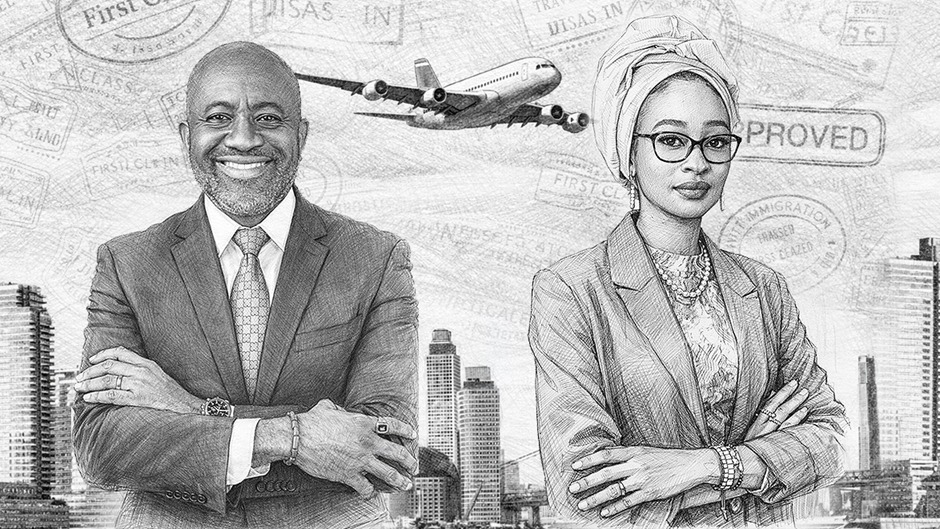
.Why visa walls and broken flight routes are choking AfCFTA, silencing women’s mobility, and costing the continent its most valuable deals.
By Habibah A. Waziri and Oswald Osaretin Guobadia
“Plans are nothing; planning is everything.” It is a clever line, often quoted in boardrooms and strategy retreats. But he was also a man who, almost certainly, never had to travel the continent with a Nigerian passport.
We speak the dialect of a “borderless” digital economy, yet we move across our own continent like unwelcome guests. The paradox is stark: Nigeria is projected to be the world’s third most populous nation by 2050, wielding a cultural soft power that dictates global charts. We are Africa’s largest nominal GDP engine and its venture funding magnet. Yet, we live inside aviation islands, internally disconnected, externally tethered.
Mobility is not a “travel issue”; it is infrastructure revealed in boarding passes. While ASEAN and EU professionals glide through open-air economies, 72% of intra-African travel still requires a visa. Now let’s consider the “Mobility Ratio”: A Singaporean passport holder accesses 4x more destinations bureaucracy-free than a Nigerian. This gap isn’t just an inconvenience, it’s a Domestic-Only Penalty. Our data shows that a pan-African consultant earns 5x more than a domestic-only practitioner. The difference isn’t the CV; it’s the passport.
Not long ago, I had to move between three African countries in five days. On a map, the route looked elegantly simple, a neat triangular loop within the continent. In my inbox, the itinerary told a different story. To make it work without losing entire days to layovers and visa queues, I had to fly into Europe three separate times, exiting the continent just to re-enter it. Lagos to Europe to Africa, then Africa to Europe to Africa. Each connection felt like a commentary. The skies above us were open, but our borders and systems were not.
This friction has a specific victim: The Woman in Leadership. We often attribute the attrition of women at the senior executive level to “culture” or “unpaid care.” While true, we overlook the Infrastructure Filter. When a 48-hour deal-closing trip morphs into a three-week logistical marathon of consular backlogs and opaque rules, organizations default to the “path of least resistance.” They send the person for whom the path is smoother. The result is a persistent erosion of women’s visibility and influence in regional and global spaces. You do not publicly remove women from the table; you quietly make it harder for them to get to the table.
This isn’t just a “women’s issue.” It is an economic leak. If women represent up to 70% of informal cross-border trade but face the highest barriers to formal mobility, we are capping our GDP by design. Inclusion here then becomes a transport protocol, not a HR policy.
And yet this is the same continent that has launched one of the most ambitious economic projects in the world. The African Continental Free Trade Area promises a single market of over a billion people and trillions of dollars in combined GDP. Projections suggest that by 2035, if AfCFTA is fully implemented, income gains could reach hundreds of billions of dollars and millions could be lifted out of poverty. The agreement recognises not just the movement of goods, but also the movement of services, including what trade lawyers call Mode 4, the temporary movement of people to provide services across borders. On paper, we understand that ideas and expertise need legs, not just fibre optic cables.
In reality our behaviour reveals a different fact. Tariffs are discussed, negotiated, and reduced, while non-tariff barriers like visas, fragmented regulations, and underdeveloped aviation routes continue to quietly choke the arteries of intra-African trade. We are, in effect, externally connected but internally disconnected. It is easier for an African founder to meet a European investor in Paris than to meet an African customer in a neighbouring country. It is easier for foreign capital to move freely into African markets than for African professionals to move freely between those same markets. To make it worse, the perception of African travel is still questioned over Europe, a mindset engineering that only occurs when we view ourselves through a warped lens. Much less, working in Africa versus Europe/West. We proudly call ourselves global, but remain strangely constrained at home.
What might a serious solution look like?
It has to be a deliberate reframing of mobility as critical economic infrastructure, as fundamental as ports, power, or digital networks, not another slogan about free movement. It must start from a simple insight: states have legitimate security concerns about migration, but those concerns can be addressed with better tools, not just tighter gates.
Imagine a continental framework where businesspersons and value creators are not treated as strangers at every border, but as known, pre-vetted participants in a shared growth project. They register once, their identities and credentials are verified using modern digital systems, their histories are checked and cross-checked. Immigration authorities across participating states can view this information in advance, make independent decisions, and issue approvals in a structured and predictable way. Once cleared, these travellers carry a recognised digital credential, secure, revocable, but trusted, that allows them to move across a network of African countries with far less friction.
In such a system, the entrepreneur from Lagos could fly to Kigali, then on to Nairobi and Addis Ababa, without re-entering the same bureaucratic maze at each leg. Airlines could design routes that reflect real demand rather than old hub patterns. Time would shift from visa queues to deal rooms and factory floors. Risk would be managed not by blanket suspicion, but by data and cooperation. States would not be asked to surrender sovereignty; they would be invited to exercise it more intelligently, together.
We are not starting from zero. Across the continent, serious attempts are already under way to tackle the mobility question from different angles. AfCFTA has begun technical work on making the movement of trusted businesspersons real. Regional bodies are experimenting with visa-free regimes and common passports. Development partners and international organisations are funding programmes on labour migration, skills mobility, and digital identity. New innovation platforms are investing in African startups, betting on our ability to build globally relevant companies from African soil.
The problem is not a lack of interest. Everyone is working on a piece of the puzzle, but too often in isolation. What is needed now is a ‘Big Tent’, under which continental institutions, national governments, development partners, DFIs, private investors, and the business community sit together and treat mobility as a shared industrial policy challenge, not a side issue for immigration desks. Under that tent, we can align standards, pool resources, and design a system that works in Lagos and Lusaka, in Abuja and Abidjan, not just in pilot reports and slide decks. In essence, it is a lack of convergence.
On March 8, as we honour women who are already leading across politics, business, and civil society, we must also speak for those who never made it onto the plane. Their absence from continental boardrooms, startup hubs, and multilateral negotiations is not a reflection of their capacity; it is a reflection of the systems we have chosen to tolerate. If we are serious about unlocking Africa’s growth, if we truly believe in the promise of AfCFTA, then we must stop grounding our value creators and start building the corridors they deserve.
Plans are nothing; planning is everything. It is time for Africa’s planning to include the simple, radical idea that its people, especially its women in leadership, should be able to move across their own continent with dignity, predictability, and purpose. Only then will our infrastructure finally match our ambitions.
Habibah A. Waziri is a human capital strategist, speaker working at the intersection of people, performance and purpose. Leading BGR consulting which serves as the “operational engine room” building high-trust ecosystems across infrastructure, technology, and policy, with a focus on scalable growth roadmaps for SMEs and multinationals across Africa. As Co-Founder of the HERitage Collective, she is correcting the market failure of female undervaluation, transitioning female leadership into a bankable asset class with proximity to investable capital. A D8 Youth Envoy, Habibah builds the institutional frameworks required to move African agency from structural constraint to global leadership.
Oswald Osaretin Guobadia is a senior policy adviser and digital strategy leader with over 25 years building infrastructure and shaping transformative policy across Africa. In his career on the continent and now as Managing Partner at DigitA, Oswald has guided projects and policy innovations that have created impact in countries across Africa, helping to set the pace for inclusive digital development and entrepreneurial growth. He has led the rollout of innovative platforms, such as the UNDP Africa timbuktoo Policy approach and national innovation and entrepreneurship strategies.










Leave a comment