



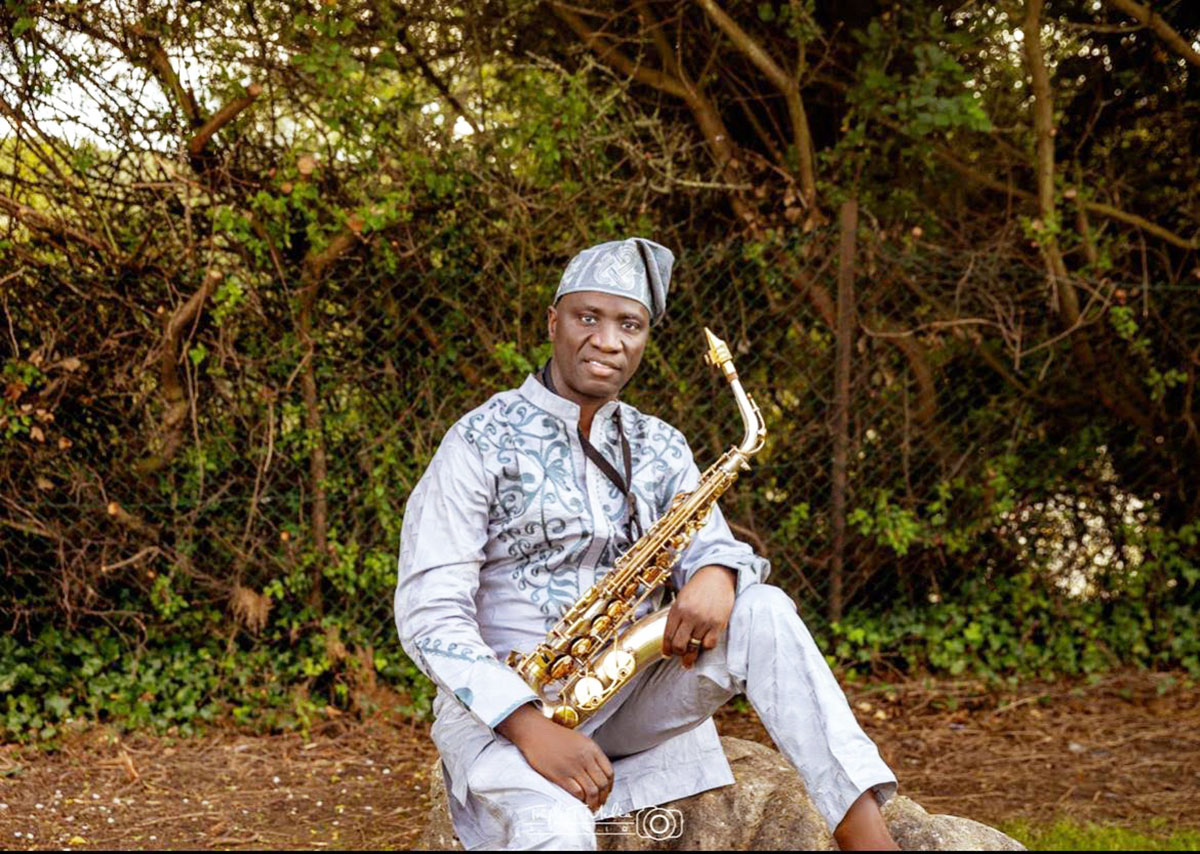
In a sunlit Ikeja studio, Lagos hums softly beyond soundproofed walls. Trumpet gleams, saxophone rests, and Peter Adeshile fondly called ‘Kakaki Jesu’ tunes his instruments with quiet devotion. Here, music, faith, and disciplined creativity converge, shaping a life where gospel sounds, professional rigor, and personal commitment form a harmonious, enduring composition, writes Adedayo Adejobi
In a sunlit studio tucked away in Ikeja, Lagos, the hum of air conditioners blends with the faint metallic shimmer of brass instruments. Microphone stands, cables coiled neatly on the floor, and keyboards lined against the walls frame a space that is simultaneously functional and reverent. This is a small sanctuary of sound. Here, amidst the faint smell of polished wood and the occasional whiff of coffee, Peter Adeshile sits poised, trumpet resting casually on a stand beside him, saxophone slung over his shoulder, and an open notebook of musical scores at hand.
The city’s restless energy pulses faintly through the soundproofed windows, a distant reminder that outside, life rushes by; inside, time is measured by rhythm and silence.
“I have never seen music as something separate from my faith,” he begins, his voice calm but charged with intent, as though every note he has played carries a message beyond the studio walls.
“For me, music is a form of prayer. When I play, I am speaking to God and inviting others into that conversation,” he adds.
The private studio is compact yet warm, adorned with framed images of past performances, handwritten sheets of music pinned on a corkboard, and a small shelf stacked with books on African rhythms, jazz theory, and gospel hymns.
The faint echo of a saxophone’s low tone vibrates off the walls as Adeshile tests his instrument, coaxing a note that hangs in the air before fading into silence.
“Music taught me patience very early,” he recalls, his fingers gently adjusting the valves of the trumpet. “You cannot rush sound. You practise, you repeat, and slowly something beautiful begins to emerge.”
The soft fluorescent light highlights the brass gleam of his trumpet and the lacquered finish of his saxophone, casting reflections that dance like fireflies across the polished wooden floor.
Outside, the honk of cars and the occasional shout of street vendors are muffled by double-glass windows, leaving the room with a stillness that feels sacred. Every object here, from the mixing board in the corner to the worn leather stool he perches on, tells a story of hours spent crafting, perfecting, and listening.
His journey began in Nigeria, where his earliest formal encounters with music came through the Boys Brigade.
The training instilled habits that would follow him into adulthood: patience, repetition, and the quiet satisfaction of gradual improvement. He first learned the drums before moving on to the trumpet, an instrument whose bright, declarative voice suited both his temperament and his faith.
“The trumpet spoke to me immediately,” he says, holding the instrument delicately, as if acknowledging its personality.
“It is an instrument that announces something. It calls attention. I felt it was perfect for proclaiming the Gospel.”
It was this instrument that earned him the nickname “Kakaki,” derived from the Hausa ceremonial trumpet. Over time, the name evolved into “Kakaki Jesu,” a title that fused identity with belief, the trumpet in service of the Gospel.
“Someone once called me Kakaki because of the trumpet,” he recalls, smiling at the memory.
“Later it became Kakaki Jesu. I accepted it because it reminds me that the gift is not really mine, it belongs to God.”
Born in Oyo State and later settling in Britain, Adeshile’s musical development continued within church communities, where the need for committed musicians often turns willing volunteers into seasoned performers. Encouragement from fellow worshippers pushed him towards the saxophone, whose warmer tone complemented the assertiveness of the trumpet.
“I did not plan to become a saxophonist,” he says, lifting the saxophone gently and running his fingers over the keys. “The church needed one, and people encouraged me. That is how ministry works, you grow into the need.”
He tests a few notes, the sound echoing softly against the studio walls. There is a moment of silence as he tilts his head, listening, calibrating the timbre, before continuing.
“I want my music to sound African and spiritual at the same time,” he explains. “Our faith did not remove our culture, it gave it new meaning.”
For Adeshile, music has always been ministry. Raised within a Christian tradition, he came to see gospel not as a career option but as a calling , a means of communication between the sacred and the everyday.
“Gospel music is not a profession you choose lightly,” he says, eyes scanning the studio as though measuring the weight of each word. “It is a responsibility. People listen with their hearts, not just their ears.”
His early recordings included instrumental interpretations of familiar hymns such as Amazing Grace, works that resonated particularly within diaspora congregations seeking continuity in unfamiliar surroundings.
“When Nigerians gather abroad, music becomes memory,” he observes. “A hymn can take you back home in a moment.”
The afternoon sun slants through the venetian blinds, casting stripes across the floor and glinting off the polished brass instruments. The faint scratch of a pencil against paper signals his notation of a new arrangement — a hymn reinterpreted with Afro-highlife syncopation and subtle jazz inflections. Outside, the noise of Lagos traffic persists, but here, within these walls, the city has become a soft, almost imperceptible rhythm, a counterpoint to the deliberate cadence of creation.
The past year has carried that sound far beyond the studio walls. In 2025, Adeshile embarked on an extensive North American tour, performing across major American cities including Atlanta, Chicago, Delaware, California, Houston and Maryland, before moving on to Canada with stops in Toronto, New Brunswick, Ontario and Manitoba. The reception, he says, reaffirmed his belief in music as bridge-building ministry. “2025 was intense and beautiful,” he reflects.
“From Atlanta to Toronto, I saw how hungry people are for music that reminds them of home and of God. Every city felt like a reunion.” With invitations already secured well into the coming year, he adds with quiet gratitude, “My 2026 is even more booked. It tells me that the message is resonating beyond borders.”
This commitment eventually culminated in the album Afro According to the Gospel, a project that captures his artistic philosophy with clarity. Traditional hymns and African rhythms merge into a unified soundscape, affirming his conviction that gospel music must remain culturally rooted even as it reaches toward spiritual universality.
“That album is my testimony in sound,” he says. “It shows that the Gospel can speak in African rhythms without losing its message.”
Adeshile has often argued that music becomes most necessary in times of hardship. When economies falter and uncertainty grows, he believes songs of hope carry renewed meaning.
“When people are struggling, they need encouragement,” he says. “Sometimes a song can do what a long speech cannot. Music reminds them that God is still present, even in uncertainty.”
Yet what distinguishes Adeshile from many artists is the discipline that surrounds his creativity. Before music took centre stage, he worked in banking and other professional environments that sharpened his organisational instincts. Those experiences cultivated a respect for planning and method that continues to shape both his professional and personal life.
“My professional life taught me order,” he says, glancing at a meticulously arranged stack of project folders on a nearby shelf. “Creativity flows better when your life is organised.”
This structured approach extends beyond the rehearsal room. Adeshile belongs to a generation of diaspora Nigerians who maintain professional careers alongside creative pursuits. His involvement in project environments in the United Kingdom reflects a practical philosophy: that artistic expression need not exist in economic uncertainty.
“I believe stability gives you freedom,” he explains. “When your basic needs are secure, you can serve God with a clearer mind.”
It is a dual identity he carries with ease, project professional by day, gospel instrumentalist by calling, each role reinforcing the discipline required by the other.
“I do not see it as two lives,” he says. “It is one life with different responsibilities.”
If music provides the rhythm of his life, family provides its grounding. Adeshile speaks often about the importance of order and partnership within marriage, seeing domestic stability not as an accident but as a shared responsibility.
“Marriage is teamwork,” he says simply. “You build it every day. My wife and I have learned to respect each other’s gifts. She keeps me grounded, I try to inspire her in return.”
Central to this balance is his wife, Yetunde, herself an accomplished project management professional whose organisational skills complement his artistic pursuits.
“My wife is my strongest support,” he says. “Many things people see in my life are possible because she stands with me.”
Together, they present a model of complementary strengths, a quiet collaboration rather than a public performance. Her laughter occasionally rings through the studio as she observes him tuning the saxophone, a reminder that music here is both work and joy.
Within the broader tradition of Nigerian diaspora musicians, Adeshile occupies a distinctive place. His work speaks to immigrant congregations navigating life between continents, communities that seek reassurance in familiar sounds and messages.
“I see myself as a bridge,” he says. “Music connects where distance separates. Every note is meant to remind someone of home and God’s presence.”
Trumpet in hand, saxophone slung across the shoulder, and project plans neatly arranged, Peter Adeshile represents a modern African artist, one who treats life itself as a carefully managed composition.
“I want my life to be in tune,” he says softly. “Not perfect — just in tune. Music teaches you that balance is everything.”
In the Ikeja studio, where sunlight falls in slanted stripes across the instruments, every object, every note, every pause speaks of intentionality, discipline, and devotion. Here, Lagos is distant yet present; the city’s chaos becomes rhythm, and the studio’s quiet becomes sanctuary.















Leave a comment