



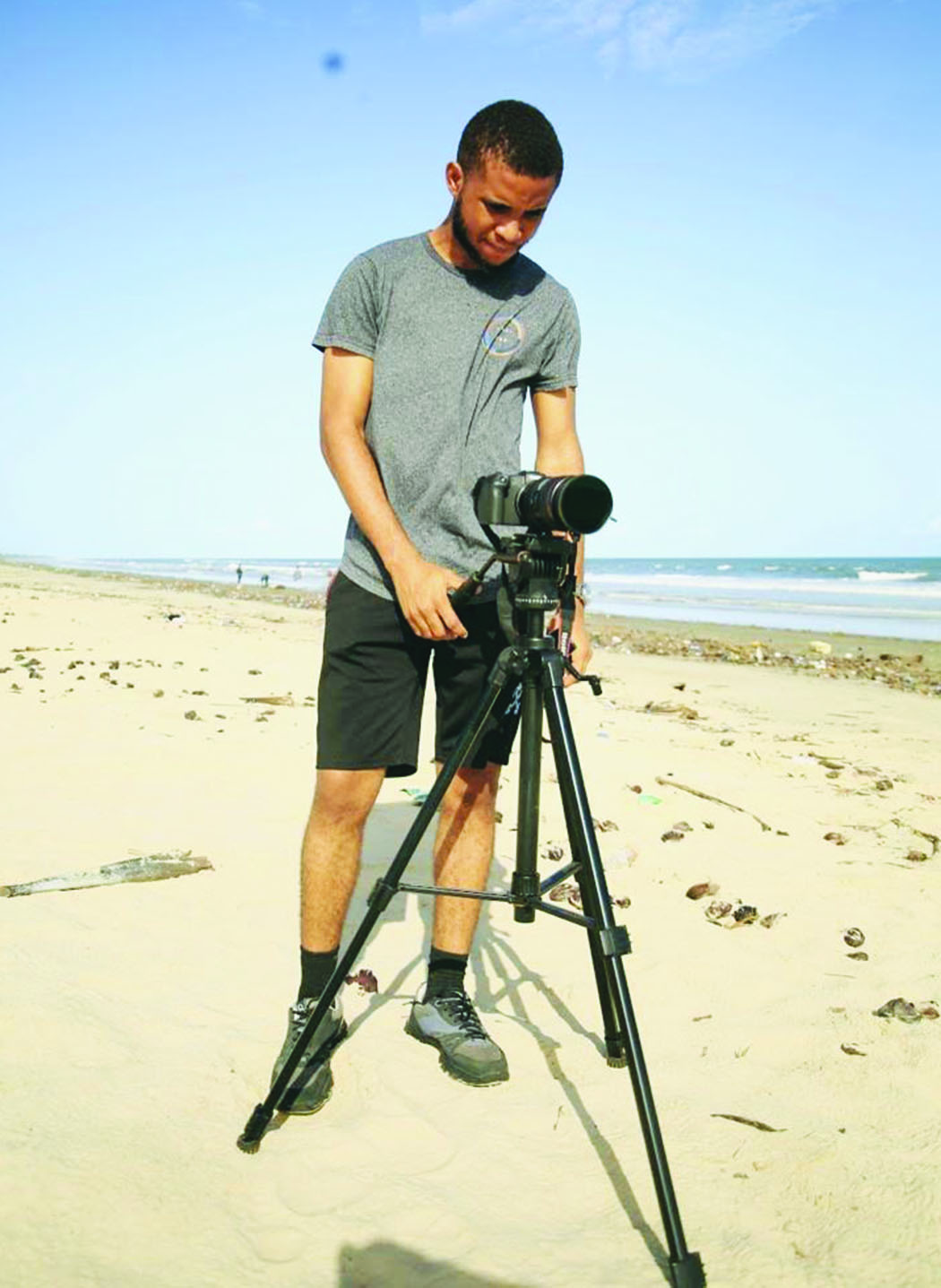
Documentary photographer Chukwudi Nwachukwu’s lens captures the Andoni waterways up close, observing hands, nets, and canoes at work against the quiet, relentless presence of the river. Okechukwu Uwaezuoke writes
First, the blue hush. Then the sepia drift. The Labour of Rivers plunges into a day already in motion, a ritual worn smooth by repetition. Mud clings to bare feet. Light glints off the water, slicing through shadow. Hands move—diligent, purposeful. A fish is lifted from the net, a small, reluctant participant, held just long enough to register in human attention. Even routine carries its own tension: the water stretches, indifferent and vast; the world remains unmoved; and yet life insists on survival.
On survival—this is a word Chukwudi Nwachukwu, a Port Harcourt–based fine art photographer whose practice spans documentary filmmaking, has come to understand as not dependent on abundance, but on the ability to make use of what is within reach. The insight emerged while observing fishermen along the Andoni waterways, where both the environment and the stark simplicity of the tools they rely on held his attention. These men show up each day, working with what they have. In this way, the series deepens its focus on labour, resilience, and steady determination, where effort, rather than circumstance, becomes the defining force.
Raised in Aba, where survival is coded into daily rhythm and hands at work measure life, the 27-year-old learned early that existence is counted in subtle, tangible echoes. Though he shapes every frame, he orchestrates nothing—or hardly does. He simply watches, waiting for M-moments to present themselves. Gesture and light become narrative. Through the lens of the Abia State University mass communication graduate, presence leaves traces.
Take the blue-themed photograph titled “A Locally Made Wooden Canoe”, for instance. Absence evokes presence. The empty canoe rests in mud beneath a deep indigo wash—Nwachukwu’s way of suggesting morning light. Its hull bears the scars of years of service. Poles rise like questions—or prayers—vertical lines stretching between earth and sky. A yellow container sits in the stern, absurd in its brightness, stubbornly human amid stillness. Nwachukwu senses the weight of absence, the echo of labour, the imprint of hands no longer visible. Suspense coils in what is implied—the water remembers, the canoe remembers, and human presence lingers just beyond frame, poised to return.
In “A Locally Made Wooden Canoe,” the river seems to hold its breath. The canoe sits in the mud, its deep blue surface catching the first light of morning. Years of use have left their mark on its hull. Two poles stick upright like questions—or perhaps prayers—pointing between earth and sky. A yellow container perches in the stern, oddly bright against the muted tones of water and mud. Nwachukwu doesn’t stage the scene; he waits, watching for the subtle traces of labour left behind. The canoe holds memory, the river holds memory, and somewhere just beyond the frame, human hands are ready to return.
Another photograph, “A Fisherman Untying His Canoe for Fishing”, continues the narrative, recalling Nwachukwu’s early career when moving image—most notably his documentary work on Burna Boy’s “Whiskey” (2024) and his short film “A Sunday Tragedy” (2026)—was central to his practice. From these projects, he learned the power of cinematic language: how natural light and atmospheric framing could honour his subjects. Today, he carries that ‘documentary soul’ into still photography, preserving overlooked cultural memories and subtle narratives of resilience. This sensibility explains why blue tones, evoking morning light, drape the river once more. A man grips a pole, stance deliberate; the canoe waits behind him. Farther out, another figure wades into the water, dissolving into haze. Preparation meets motion. Control confronts surrender. The yellow container gleams—absurd, stubbornly present. The scene is a study in negotiation: body against element, labour against endurance. Every lean of the pole, every shift of weight, holds suspense—a subtle question of balance, a relentless test of persistence.
Still on insistence, “Fishermen Cast Their Net into the Water” stretches the perspective, turning the river into infinite possibility. Two canoes drift; three figures occupy them. One, alone in the foreground, rows with deliberate precision; the other two hover on a second canoe, poised between action and reflection. The net sinks into the water. The horizon embodies patience; the river remains indifferent. Tension hangs: will the day’s labour suffice? Will the water relent? Here, the smallest movement—the splash of oars, the subtle pull of the net—carries urgency, a quiet signal of human persistence against indifferent forces.
A cut to the sepia-toned photographs signals evening. In “A Fisherman Removes Fishes from His Nets”, a man bends low over the water, fingers freeing a fish that flares almost imperceptibly in fading light. The river stretches, patient. There is no flourish, no triumph—only insistence, repetition, concentration. Each act is negotiation: human versus element, patience versus necessity. Tension is cinematic but restrained; a pulse hangs in the air, as if something might slip away at any second. And yet subtle humour persists: the fish remains a reluctant guest, coaxed into another world.
In “A Fisherman Holding His Paddle Beside the River”, suspense shifts to stillness. One hand rests on his hip, the other grips a long pole; the man stands on trampled mud, grounded in the unrelenting rhythm of the riverbank. The land is rough, unpolished; the sky offers no drama. Yet the figure asserts himself. The pole is more than a tool—it is sceptre, staff, marker of presence. Balance is the story. His gaze meets the camera, deliberate yet unassuming. Something in his posture hints at quiet assurance: he will endure, the river has risen before—and he has remained.
“Fishermen and a Woman Examine the Day’s Catch” tightens the focus. Three figures cluster around a blazing orange bucket, the day’s yield a luminous punctuation against a sepia-gold smear of river and mud. One holds, one inspects, one waits with hands on hips. Every glance, every pause carries weight: the bucket is small, but its contents are proof, argument, survival. The nearby canoe rests, indifferent—a silent partner in the economy of effort. Suspense is internal: will the haul suffice? Will labour have meaning? The answer comes quietly, in the glint of scales, the shuffle of feet, the tilt of heads.
Finally, “Fresh Fish Collected in a Basket After Fishing” slows the beat but tightens tension differently. Two men move along the riverbank in careful relay: one carries the catch inland, the other lingers by the canoe, poised to return. The river lies still; the horizon stretches patient and infinite. Labour is cyclical, continuous, and in its quiet insistence, urgent. Each frame asks the same question: can the day be contained? Will effort yield result?
Across The Labour of Rivers, Nwachukwu’s eye traces rhythm, repetition, resilience. The fishermen return not for glory but because they must. Labour becomes suspense: will the hands succeed? Will the river yield? Morning, reflected in blue, brings cool clarity; evening, in sepia, reflects patience—light itself a character, marking time with careful observation. At the heart of the series is Nwachukwu’s principle: “He who leaves the shore in search of fortune carries only hope with him; he returns fulfilled not by what he finds, but by what the journey makes of him.”













Leave a comment