



Chuu Krydz Ikwuemesi Joecollins Ezepue
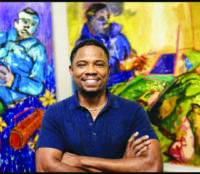
To encounter the paintings of Victoria Oniosun is to confront something increasingly rare in contemporary Nigerian art: a sustained attempt to articulate the emotional and psychological dimensions of womanhood through material exploration rather than narrative excess. In a context where artistic practice is often overshadowed by economic pressures and institutional fragility, Oniosun’s commitment to painting reads as both aesthetic and existential conviction.
Her trajectory reflects a familiar path for many contemporary Nigerian artists who have sought advanced training beyond the country’s borders—not due to a lack of local talent, but because of uneven support structures for sustained studio practice. After earning her BA in Fine Art from Obafemi Awolowo University, Ile-Ife (2022), she proceeded to an MA at the University for the Creative Arts, Canterbury, UK. This movement between Ile-Ife and Canterbury, between local rootedness and global exposure, has significantly shaped her visual language.
At the centre of her practice are questions of identity, femininity, and self-reflection. Yet this is not the polished feminism often packaged for international consumption, nor a romanticised idealisation of African womanhood. Instead, Oniosun’s work engages lived female experience in contemporary Nigeria—where tradition and modernity frequently intersect in tension, negotiation, and transformation. Her paintings occupy the unstable but fertile space where personal memory meets collective experience.
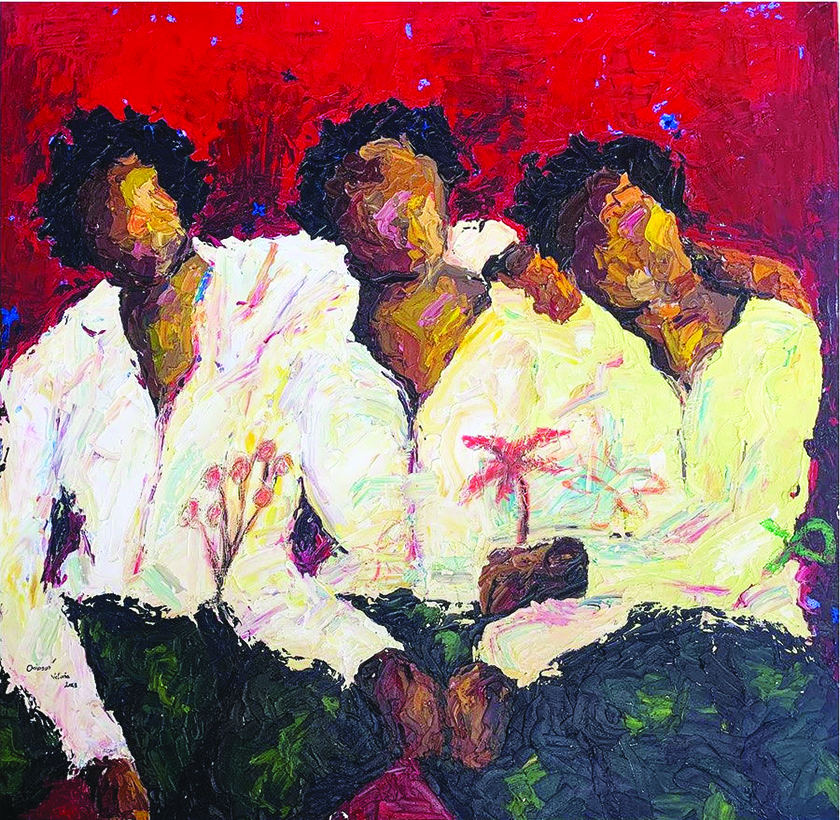
Formally, her work is anchored in texture and abstraction. “I work with textured surfaces and abstracted figures,” she notes. This simplicity of statement belies the rigour of execution. Using palette knife techniques and heavily layered surfaces, she builds paintings that resist smooth resolution. The surface becomes an active site of tension—where emotion, memory, and identity are not illustrated but physically accumulated. As she puts it, her work emerges “from the space between the visible and the felt.”
In works such as Reverie, Winter Blossom, and Self (2025), Oniosun deploys simplified figuration and dense impasto to construct what she describes as “vessels of universal truth rather than singular personalities.” The figures are deliberately indistinct—softened, pared down, and withdrawn from specificity. Yet within their gestures and proximities, they carry quiet narratives of intimacy, solitude, mental states, and shared femininity, without falling into didactic social commentary.
Her approach invites comparison with several artistic lineages. The textured materiality recalls Ablade Glover, though without his urban exuberance. The psychological restraint of her figuration echoes aspects of Ben Enwonwu’s later portraiture. Further afield, there are resonances with Frank Auerbach and Leon Kossoff in the insistence on surface density as emotional register.
Yet Oniosun’s synthesis is distinct in its grounding in contemporary Nigerian female subjectivity.
This focus becomes more distilled in her 2026 series, including A Place to Pause, A Place to Feel, A Place to Heal, and A Place to Be. These works shift towards interiority, functioning almost as contemplative environments. They offer visual pauses—spaces of reflection in a world marked by instability, digital saturation, and social pressure. In this sense, her paintings recover something of art’s older function: as sanctuary, as threshold, as a site of quiet transformation.
Born and raised in Nigeria, Oniosun draws directly from everyday social textures—those often overlooked rhythms of life that shape collective experience. From Lagos traffic and workplace routines to domestic rituals and Sunday gatherings, her work translates lived observation into visual language. In The Sunday Ritual, for instance, she captures the quiet centrality of weekly communal gatherings as both social anchor and spiritual practice.
Her exhibition history reflects a steadily expanding international and local presence: from Latitude of Expression (Mitochondria Gallery, Texas, 2022), to The First Step (African Female Artist Mentorship Programme, Lagos, 2023), to the Hamptons Fine Art Fair (New York, 2024). In 2025, she participated in major platforms including the 1-54 Contemporary African Art Fair (New York), ART X Lagos with Yenwa Gallery, and scope Miami with Dozie Arts, as well as the She-nergy group exhibition at Alliance Française de Lagos.
Across these contexts, her work continues to evolve with clarity of intent. What distinguishes Oniosun is not simply technical fluency, but a refusal of reduction—of womanhood, of identity, of experience. Her paintings insist on complexity without spectacle, intimacy without overstatement.
As her practice develops, Oniosun remains part of a generation of artists expanding the vocabulary of contemporary African painting through material depth and psychological nuance. Her canvases do not merely depict; they accumulate, suggest, and hold. In their silence, they speak with quiet insistence.
• Ikwuemesi is Professor of Painting and African Art History, University of Nigeria, Nsukka.
• Ezepue is a graphic artist and assistant lecturer, University of Nigeria, Nsukka.









Leave a comment