



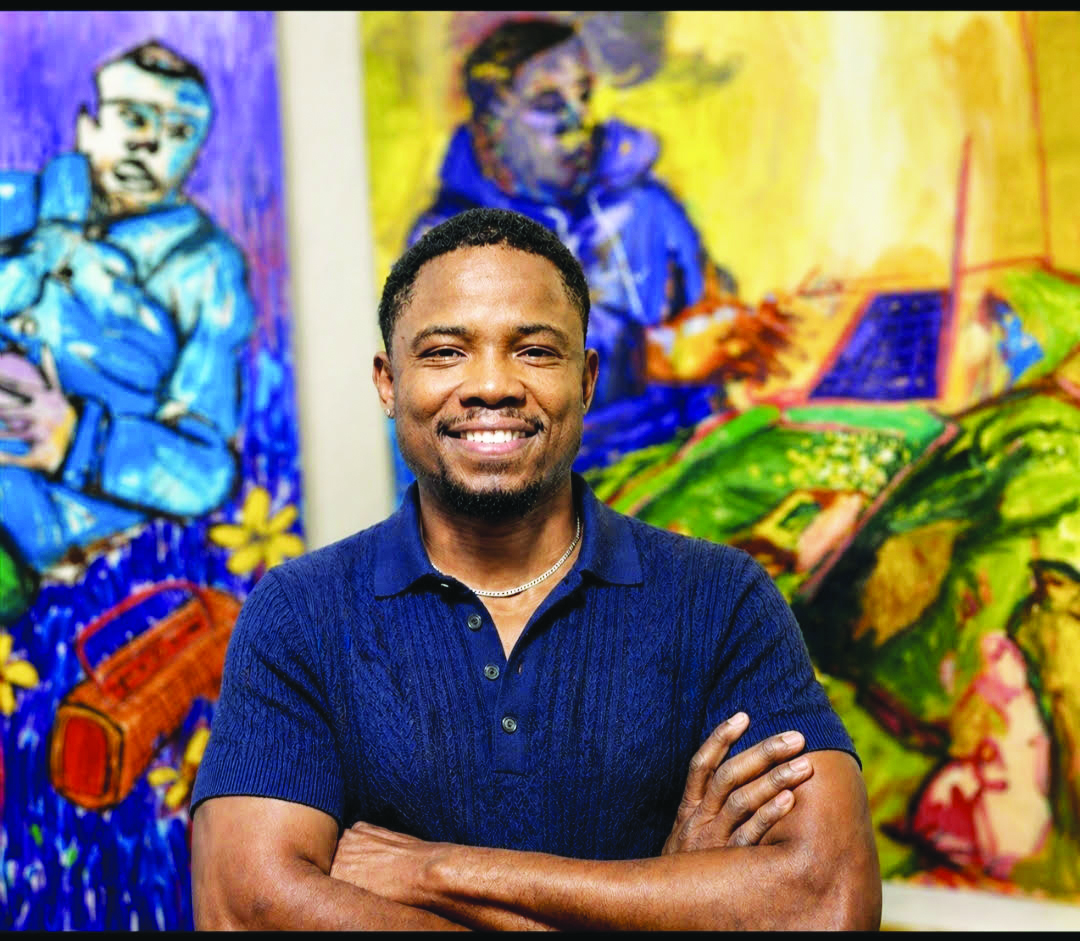
In Oshorenoya David Francis’s work, solitude emerges not as absence but as a charged interior space where identity is steadily formed, unformed, and reformed. Okechukwu Uwaezuoke writes
Surely, Oshorenoya David Francis did not arrive in the UK primed to wax philosophical about solitude as if it were a well-rehearsed script! It began, instead, as a jolt. Nigeria was behind him—its warmth, its human density, its easy, unthinking rhythms—and he found himself in a quieter terrain where silence wasn’t just present but pressed in with palpable force.
“I didn’t immediately see solitude as something productive,” he recalls, with the clarity of hindsight. What he encountered was not the oft-romanticised idea of aloneness but its rawer form: the sudden removal of anchors—people, pace, recognition. In their absence, the days stretched differently. The silence was not empty; it was dense, disorienting, and, at first, entirely unrelenting.
Then the weight of the silence turned inward. Thoughts long held at bay—fears and desires, half-acknowledged, ambient anxieties—began to surface with a subdued, tenacious force. Francis, a Nigerian-born artist now based in the UK after completing an MA in Contemporary Art Practice at De Montfort University, Leicester, came to understand solitude less as a concept than as residue: what remains when distraction falls away. From this inward turn emerges Solitude, Becoming, and the Cartography of Inner Life, his forthcoming solo exhibition curated by Obi Nwaegbe at 1853 Studios in Oldham, Greater Manchester. It is an account rather than a transformation—concerned less with resolution than with what continues to surface when solitude can no longer be evaded.
At some point—almost imperceptibly—solitude sheds part of its threat. It is no longer merely an affliction to be endured but a condition to be entered. Within it, distinctions blur: thought and feeling bleed into one another; breakdown and recovery cease to behave as opposites and begin to register as phases within a single, ongoing cycle. This recalibration underpins the current body of work.
What takes shape is not resolution but a slow crystallisation of intent. The studio, in this sense, becomes less a site of production than a climate to be endured and gradually understood. Francis’ practice reads less as statement than as record: a visual mapping of becoming shaped by displacement, pressure, and reorientation.
If the 2022 solo exhibition Emotional State of Man at Photo Carrefour Gallery in Abuja leaned outwards—figures fraying into their environments, lines straining at their limits—the present works redirect that turbulence inwards. In “Chapters in Atomic Habits”, a reader sits at a table, the scene held in subdued tension. Cadmium red outlines and impasto yellows retain their intensity, but the energy no longer declares itself so loudly; it seethes beneath the surface. The undulating line remains—tracing book, wristwatch, bottle—but now binds rather than disrupts, holding together the quiet symbols of routine into a single psychological field.
Likewise, in “Thy Wish”, a figure rendered in electric blues and greens reclines within a violet expanse, hand resting against the chest as if testing for a pulse. The setting does not settle into calm. Thick contours and heavy strokes prevent the image from settling into ease; yellow flowers and a red speaker interrupt rather than console. Colour operates here as pressure, converting leisure into tension. The body occupies an unstable threshold between rest and vigilance.
Francis has described his practice as a “visual map of becoming,” though these maps remain nebulous. They are composed of thresholds: departure from Nigeria, arrival in the United Kingdom, and the decision to remain after postgraduate study. Around these swirl less visible accumulations—financial strain, emotional collapse, recovery, doubt—that persist as undercurrents rather than resolving into milestones. “Thy Wish” inhabits one such point, where desire and weight coexist without resolution.
In “Diary of a Red Head”, the scene centres on a figure bent over a glowing laptop. The body is constructed from slabs of teal, violet, and ochre; red linework traces bare feet and the edge of a bed. The surrounding blues agitate, while the screen emits a dense yellow-orange heat. A familiar activity—work, study—drifts toward instability. The light functions both as portal and burden. The posture remains folded, private, yet the palette sustains a heightened intensity.
Then enters fantasy, not as escape but as forward pressure—the projection of a self not yet realised but already insistent. The gap between present constraint and imagined possibility is maintained rather than resolved, generating a productive tension. The laptop becomes its locus: a glowing threshold between stillness of body and movement of mind.
Similarly, across the other works—“Hug,” “Thoughts in Blue,” “Thoughts in Green,” “Hell-bent,” “Red Table,” “Lines in Chapters,” “Thinking Cap,” and “A Shoulder to Rest,” among others—the relationship between figure and ground remains fluid. At times the body asserts itself; at others it recedes, absorbed into surrounding colour and gesture. Stability is not the aim. What persists is fluctuation—a continuous in-betweenness that is hard to place.
The material language reinforces this instability. Acrylic, charcoal, pastel are layered, revised, partially erased, and reasserted. Surfaces retain the memory of their own making. Nothing is fully sealed; each work carries traces of reconsideration, of decisions held open.
Despite intensely personal sources—emotional breakdown, recovery—Francis avoids direct transcription. The process begins intuitively, without filtration, but becomes more deliberate in retrospect. What is withheld is as structural as what is shown. Absence operates not as lack but as a means of preserving both emotional integrity and interpretative space. The aim is transmission rather than disclosure: for feeling to register without full exposition.
Nwaegbe’s curatorial approach echoes this sensibility. The exhibition eschews linear progression in favour of recurrence and accumulation. Works are arranged as a field rather than a sequence, encouraging return and association. Meaning does not arrive fully formed; it circulates, gathers, and shifts.
Within the broader field of contemporary figurative painting—particularly amidst the heightened visibility of Black figuration—Francis’ work operates in a quieter mode. The figure is not deployed as emblem or declaration but as site of inquiry, shaped as much by interior states as by external conditions. It withholds the demand for immediacy, for instant legibility.
What emerges is not resolution but duration. A sustained state of becoming. Identity remains provisional, responsive, continuously negotiated. In this openness, solitude is no longer simply absence. It becomes the condition under which something continues to take form—without closure, but also without return.










Leave a comment