



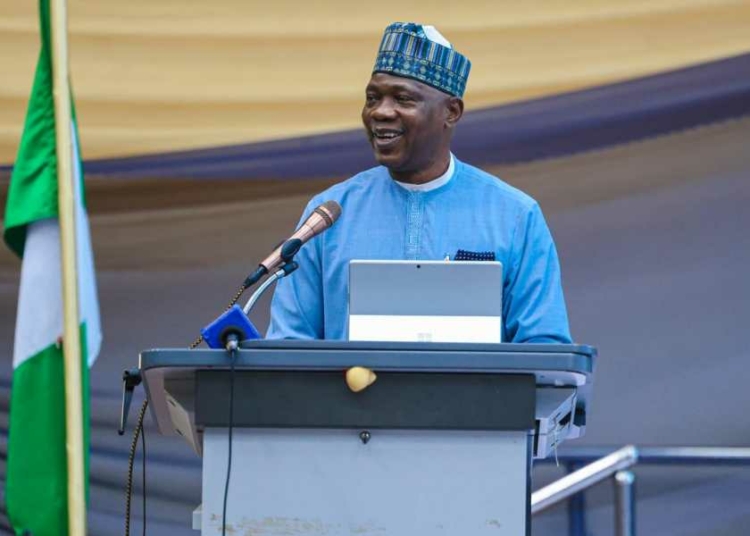
The Comptroller-General of the Nigeria Customs Service, Adewale Adeniyi, has urged a human-centred approach to digital transformation, warning that technology must enhance, not replace, ethical leadership, institutional accountability and public trust in governance systems.
He made the remarks while delivering a keynote address at the 4th Biennial International Conference organised by the Faculty of Communication and Information Sciences at University of Ilorin in collaboration with the Faculty of Philology, RUDN University. The conference, themed “Disruptive Technology: Human and Artificial Intelligence in the Digital Economy,” brought together scholars, policymakers, technology experts and agency heads to examine the evolving impact of AI and digital innovation on governance, trade and development.
Adeniyi noted that while disruptive technologies have already reshaped global systems through e-commerce, digital payments and intelligent automation, societies are now fully operating within disruption rather than merely preparing for it.
“The digital age is, in the end, a human story, and the real test of our generation is not how powerful our machines become, but how wisely our societies choose to use them,” he said.
He cautioned that the real value of artificial intelligence lies in its partnership with human expertise, not in replacing it.
“The partnership, not the rivalry, between human and artificial intelligence is where the real value lies,” he added.
Drawing from reforms within the Nigeria Customs Service, he highlighted the impact of the B’Odogwu Unified Customs Management System, noting that it has significantly improved trade facilitation, cargo clearance and inter-agency coordination. He disclosed that the system generated over N230 billion at the PTML Command within eight months, while compliant cargo clearance time had dropped to under eight hours.
Adeniyi further stressed that technology alone cannot deliver effective governance outcomes without strong institutional culture.
“Technology changes processes; leadership and expertise still deliver the results,” he said.
He also urged stronger collaboration between academia and government agencies, calling on universities to move beyond theory and become active contributors to innovation, policy development and problem-solving in the digital economy.
On the sidelines of the conference, the Customs chief engaged with stakeholders across government, academia and traditional institutions on opportunities for collaboration in digital research, capacity building and innovation-driven governance.
















Leave a comment