



Charles Okigbo
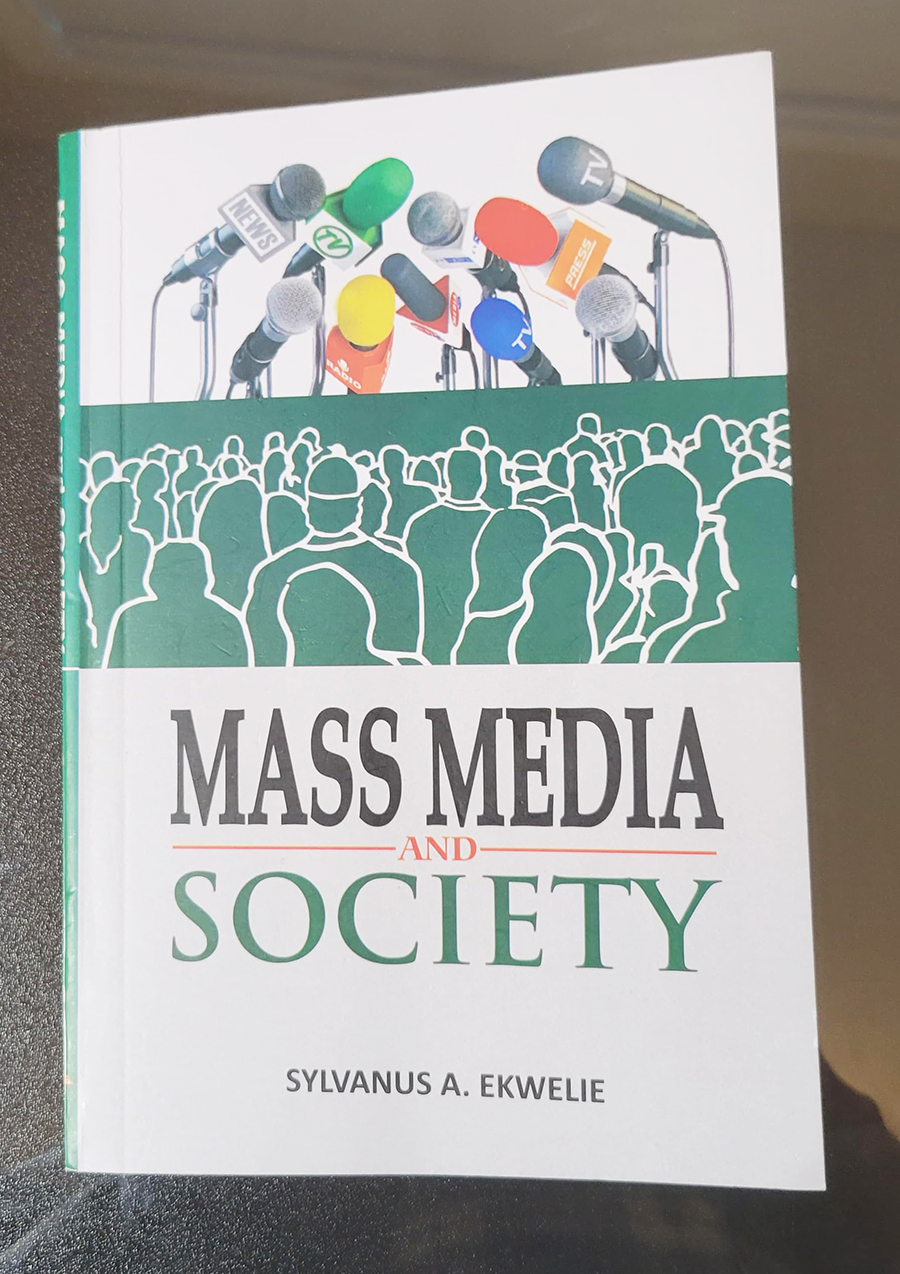
Pofessor Ekwelie’s new book titled Mass Media and Society is an important addition to the growing body of works on mass communication, a field of research and education that owes its origin to American scholars who were concerned about the uses of newspapers and radio in the 1930s. Ekwelie’s book focuses largely on Nigeria but relies heavily on examples from Europe, the United States, and other parts of the world. Although this book is a new addition to mass communication scholarship, it has taken all of 40 years to produce because it started its historic journey as an intended 1985 inaugural lecture at the University of Nigeria, Nsukka, where Ekwelie was destined to be the first professor in the Department of Mass Communication. Like aged wine, this book is a rare and valuable treasure. Three aims guided the writing. According to the author, these are: 1) address some of the curiosities; 2) attempt to answer the all-important question of media effects in society; and 3) to provide a definitive analysis of what the author understands to be the potential contributions of mass communication that would aid young communication scholars and certainly non-communication students to appreciate the place of communication in their lives.
The inaugural lecture would have been given to only the members of the university community in attendance, but in this book, Ekwelie set out to commune with students, teachers, communication scholars, general readers, and indeed an interested mass audience.
In an earlier book, an autobiography titled A Story of Our Times (2018), Ekwelie presented the story of the factors that shaped the destiny of people of his generation and their precarious social environment, where almost everything was in short supply, a few of the only exceptions being diseases and their consequences. This new book focuses on the theme of the mass media as communication messages, channels, and people. This focus provides Ekwelie with a broader and more exciting canvas for painting a picture with more colours than a rainbow. Ekwelie’s storytelling prowess is in full display. There is abundant historical narration of both press and politics, made alive with dramatic details and colourful descriptions. There is also abundant review of research, as well as ample theorising on how the media work in society. Not one to be shy about taking a stand and making it public, Ekwelie’s views and opinions are in full display on nearly every page.
The contents of the book are laid out in six robust chapters that are captioned: 1) Classical functions, 2) Inherent functions, 3) Expectations and reality, 4) The need for corporate practice, 5) A news source, and 6) Press and politics. There is enough substance here for journalism enthusiasts, aspiring public relations practitioners, and government information officers, What stand out mostly from these six chapters are:
•That the classical function of information dissemination includes leadership persuasion and agenda setting.
•The inherent function addresses educative and entertainment roles, as well as empathy and status conferral.
•Under expectation and reality, there are many forms of journalism that include interpretive, straight news, impressionistic reporting, new journalism, investigative reporting, and adversary journalism.
•The need for corporate practice is undergirded by the principle that “communication at its best is a product of efficiency – efficiency in gathering, processing, and supplying information” (p.110).
•The chapter on “A news source” starts with explaining the challenges of succeeding as a press secretary. Preparations and responsibilities make the difference between success and failure in press relations.
•The last chapter is about the press and politics. Here Ekwelie presents a portrait of Nigeria’s government – press relations through our various military and civilian regimes.
•The last section of the book is titled General Comment, and here the author illustrates some of the worst scandals of recent governments, including the reported case of a Rivers State Governor boasting of downing a 40-year-old N10 million Whiskey before the noon hours.
Two remarkable features of this book are its wide ranging coverage of mass communication subjects, and his writing style, which is literary, scientific, serious, and humorous, all at once. There are uncommon facts and figures, wry quotations, dry humour, deprecating comments that balance his natural self-pride with disarming simplicity, and his transparent honesty, as an individual of high ethical character. People who know him, personally know that he cannot pretend. As a teacher he never misses an opportunity to enlighten, even with materials that are outside mass communication.
His former students remark how his lectures on Elements of Journalistic Style could turn into lessons on BBC-like pronunciations or the history of world religions. Emma Esinnah, one of his former students still remembers how Ekwelie taught them that the little finger is called “pinky”, at which some students wondered what that had to do with news reporting. In Ekwelie’s world, journalism and mass communication are about people and culture. There are no boundaries. Other ex-students who would recall Ekwelie’s peculiar “no-holds-barred” teaching styles, either directly from his classes or indirectly from Jackson College folklore, would include Garba Shehu, Emeka Monye, Isah Momoh, Dan Okolo, Ugo Onuoha, Joe-Bel Molokwu, Pat Utomi, Susan Eshett, Emeka Odo, Nduka Onum, Gbenga Adefaye, and many others.
Ekwelie’s well-rounded education shows clearly on every page of his new book. His bachelor’s degree was in journalism, from the Jackson College at UNN, and his master’s was in broadcasting research from the University of Wisconsin, Madison, where he also earned his PhD in journalism history with a dissertation on The Press in Gold Coast Nationalism, 1890 – 1957. Ekwelie graduated top of his class of 1966 at UNN, and won the USAID Merit Scholarship for graduate studies at the University of Wisconsin, where he was preceded by Professor Robert Nwankwo (1970), and they were followed by Professor Onuora Nwuneli (1976), and Dr. Samuel Idemili (1980). Dr. Doyin Aboaba-Abiola, took a master’s at Wisconsin, and moved on to SUNY-Buffalo for her doctorate in 1979. Ekwelie was like an elder brother to the first generation of Nigerian mass communication scholars who studied in the US.
Now in retirement, Professor Ekwelie has time to gloat over his achievements as a super teacher, researcher, counselor, media critic, and media historian. He is above all an ardent storyteller, whose craft seems to get better with age. Mass Media and Society is an artful arrangement of a large number of perspicuous stories, many of which leave us asking for more. He is brutal and merciless in his criticisms of Nigeria and our political leaders. But at the same time, he recognises and adores talented performance. Where this manifests was when he wrote Malam Garba Shehu in the Buhari Government to commend the superior performance of one Amina Mohammed, Nigeria’s representative at the International Climate Change Conference in Paris in 2016, “to convey my congratulations for hearing a Nigerian minister speak impressively in an international forum” (p. 108).
Both Ekwelie’s former students and many mass communication scholars in Nigeria are hoping that this new publication won’t be the last from this erudite scholar, who has strong views on mass communication studies and practice in Nigeria from more than 60 years of firsthand experience as a student, teacher, researcher, and critic. He has been actively involved in the establishment of many mass communication departments in Nigerian universities. He succeeded in this book to untangle some of the curiosities about the media and he showed that mass communication can have determinable effects on some people and institutions. This book adds to the continuing, even if uncoordinated promotion of this subject as a discipline of study and a field of practice. Will this be the last book from Professor Sylvanus Ajana Ekwelie on Nigerian mass communication and society? His many former students and admirers hope not.
• Professor Okigbo is a professor emeritus of strategic communication at North Dakota State University (USA)














Leave a comment