



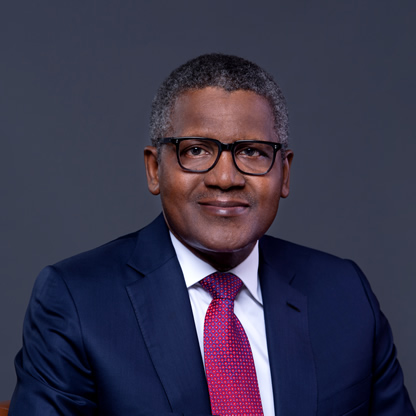
•Says refinery imports 9-10m barrels of crude monthly from US, others
Africa is hemorrhaging an estimated $90 billion annually due to the importation of substandard, environmentally harmful fuels, Aliko Dangote has warned.
The billionaire industrialist and Chairman of Dangote Group, while speaking on the operations of the Dangote Refinery, disclosed that many of the imports are blended to substandard levels that would not be permitted in Europe or North America but dumped in Nigeria.
He added that his facility currently imports between 9 and 10 million barrels of crude oil monthly from the United States and other international suppliers to meet its refining targets.
Dangote, while speaking during the ongoing West African Refined Fuel Conference held in Abuja, organised by the Nigerian Midstream and Downstream Petroleum Regulatory Authority (NMDPRA) and S&P Global Commodity Insights, revealed that, due to the continent’s limited domestic refining capacity, Africa imports over 120 million tonnes of refined petroleum products annually, at a cost of approximately $90 billion.
While appreciating the Management of the Nigerian National Petroleum Company Limited (NNPC), for making some cargoes of Nigerian crude available to us from the start of production to date, he revealed that the company imports between 9-10 million barrels of crude from the United States of America and other countries. He said: “As we speak today, we buy 9 – 10 million barrels of crude monthly from the US and other countries. I must thank NNPC for making some cargoes of Nigerian crude available to us from the start of production to date.”
Dangote further stated that despite producing around 7 million barrels of crude oil per day, Africa only refines about 40% of its 4.3 million barrels daily consumption of refined products domestically. In stark contrast, Europe and Asia refine over 95% of what they consume.
“So, while we produce plenty of crude, we still import over 120 million tonnes of refined petroleum products each year, effectively exporting jobs and importing poverty into our continent. That’s a $90 billion market opportunity being captured by regions with surplus refining capacity. To put this in perspective: only about 15% of African countries have a GDP greater than $90 billion. We are effectively handing over an entire continent’s economic potential to others—year after year,” he said. While reaffirming his belief in the power of free markets and international cooperation, Dangote emphasised that trade must be grounded in economic efficiency and comparative advantage — not at the expense of quality or safety standards. He stressed that, “it defies logic and economic sense for Africa to be exporting raw crude only to re-import refined products—products we are more than capable of producing ourselves, closer to both source and consumption.”
Reflecting on the experience of delivering the world’s largest single-train refinery, Dangote also highlighted a range of challenges faced, including technical, commercial, and contextual hurdles unique to the African landscape.
Africa’s wealthiest man described building refineries such as the Dangote Petroleum Refinery as one of the most capital-intensive and logistically complex industrial facilities ever constructed.
The Dangote refinery project, he said, required clearing 2,735 hectares of land (seven times the size of Victoria Island), of which 70% was swampy, requiring the pumping of 65 million cubic metres of sand to stabilise the site and raise it by 1.5 metres, over 250,000 foundation piles, and millions of metres of piping, cabling, and electrical wiring among others.
“At peak, we had over 67,000 people on-site of which 50,000 are Nigerians, coordinating around the clock across hundreds of disciplines and nationalities. Then, of course, came the COVID-19 pandemic which set us back by two years and brought new levels of complexity, disruption, and risk. But we persevered,” he noted.
The refinery also required the construction of a dedicated seaport, as existing Nigerian ports could not handle the size and volume of equipment required. This included over 2,500 pieces of heavy equipment, 330 cranes, and even the establishment of the world’s largest granite quarry, with a production capacity of 10 million tonnes per year.
“In short, we didn’t just build a refinery—we built an entire industrial ecosystem from scratch,” he said.
Despite the refinery’s technical success, Dangote identified significant commercial challenges, particularly exchange rates which have gone from N156/$ at inception to N1,600/$ at completion, and challenges around crude oil sourcing. Although Nigeria is said to produce about 2 million barrels per day, the refinery has struggled to secure crude at competitive terms.
“Rather than buying crude oil directly from Nigerian producers at competitive terms, we found ourselves having to negotiate with international trading companies, who were buying Nigerian crude and reselling it to us—with hefty premiums, of course.
Logistics and regulatory bottlenecks have also taken a toll. Port and regulatory charges reportedly account for 40% of total freight costs, sometimes costing two-thirds as much as chartering the vessel itself.
“Refiners in India, who purchase crude oil from regions even farther away, enjoy lower freight costs than we do right here in West Africa because they are not saddled with exorbitant port charges,” Dangote said.
He added that, in terms of port charges, it is currently more expensive to load a domestic cargo of petroleum products from the Dangote Refinery, as customers pay both at the point of loading and at the point of discharge. In contrast, when they load from Lomé, which competes with them, they pay only at the point of discharge.
Dangote further criticised the lack of harmonised fuel standards across African nations, which creates artificial barriers for regional trade in refined products.
“The fuel we produce for Nigeria cannot be sold in Cameroon or Ghana or Togo, even though we all drive the same vehicles. This lack of harmonisation benefits no one—except, of course, international traders, who thrive on arbitrage. For local refiners like us, it fragments the market and imposes unnecessary inefficiencies.”
Dangote, stating the challenge with diesel production in Africa, noted, “to give one example, the diesel cloud point for Nigeria is 4 degrees. Without going into the technical details, this means that the diesel should work at a temperature of 4 degrees centigrade. Achieving this comes at a cost to us and limits the types of crude we could process. But how many places in Nigeria experience temperatures of 4 degrees? Other African countries have a more reasonable range of 7 to 12 degrees. This is a low hanging fruit which could be addressed by the regulators.”
He also cited the growing influx of discounted, low-quality fuel originating from Russia — blended with Russian crude under price caps and dumped in African markets.
“And to make matters worse, we are now facing increasing dumping of cheap, often toxic, petroleum products—some of which are blended to substandard levels that would never be allowed in Europe or North America,” he said.
Dangote called on African governments to follow the example of the United States, Canada, and the European Union, which have implemented protective measures for domestic refiners.
Source link Clarior Luxent















Leave a comment