



By Ngozi Nwoke
Policymakers, financiers and hospitality executives gathered in Lagos to argue that culture, one of the continent’s most valuable economic assets, has long been overlooked.
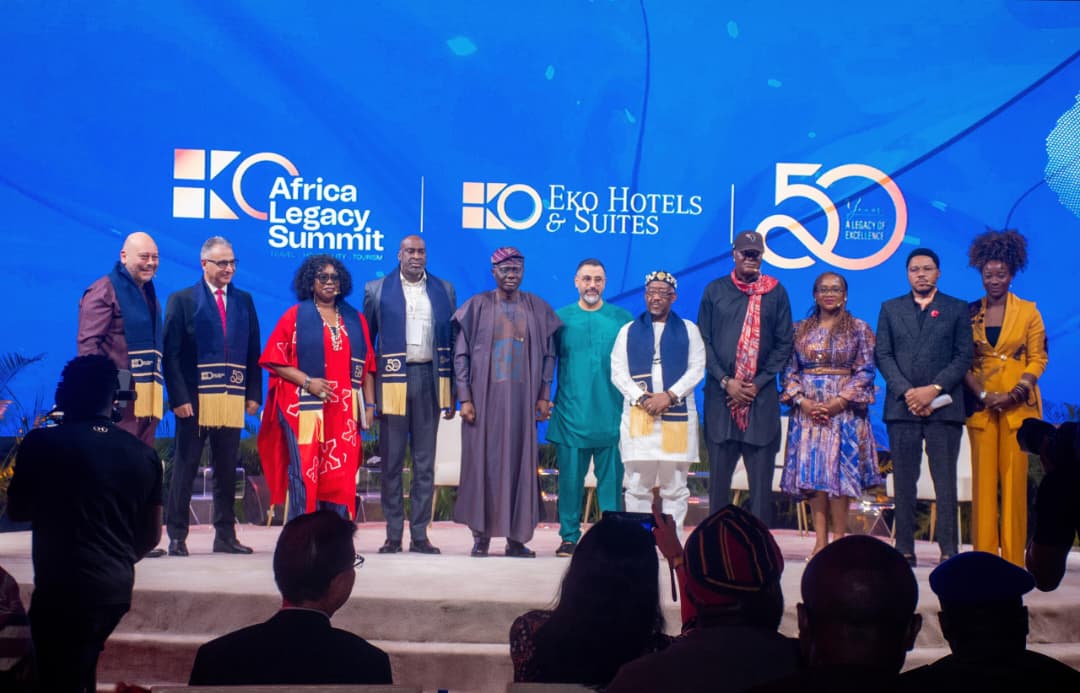
The debate unfolded at the Africa Legacy Summit, convened to commemorate the 50th anniversary of Eko Hotels and Suites, with the theme: ‘Reimagining the Future of Culture in African Hospitality, Tourism and Travel.’
Among the dignitaries present were the Governor of Lagos State, Babajide Sanwo-Olu; renowned Pan-African scholar Patrick Lumumba; the Honorary Consul General for Antigua and Barbuda to Nigeria, Wallace Williams; the Chairman of Air Peace, Allen Onyema; government officials, diplomats, traditional leaders and executives from across industries.
For Lagos State’s Commissioner for Arts, Culture and Tourism, Toke Benson-Awoyinka, the issue is not merely economic but existential. “A people are lost without a well-preserved culture,” she said.
She noted that Lagos State has deliberately positioned itself not only as Nigeria’s commercial nerve centre but also as a cultural destination in its own right. Festivals, heritage monuments, music infrastructure and film investments are all part of a broader strategy to institutionalise culture as economic infrastructure.
“Authorities are also restoring heritage sites, including the Point of No Return, while upgrading theatres into modern cinemas and developing a film village in Epe intended to stimulate both tourism and local economic development,” she said.
Benson acknowledged a persistent weakness: Lagos still lacks a comprehensive system for tracking tourism-generated revenue and its precise contribution to economic output. That gap reflects a broader continental challenge. Africa’s tourism potential is widely discussed, but fragmented infrastructure, inconsistent policy co-ordination and weak data systems continue to obscure the sector’s true scale.
Managing Director of Eko Hotels, Ghassan Faddoul, stressed that the future of African hospitality would not be built by legacy institutions alone, but by young Africans bringing fresh ideas and perspectives. For him, the anniversary was not simply about looking backwards. “As we mark 50 years, this is not only a celebration of the past, but a point of transition,” he said.
Faddoul spoke about sustainability, innovation, environmental responsibility and the need for hospitality businesses to embrace technology and artificial intelligence while remaining rooted in African identity and heritage.
Chairman of Air Peace, Allen Onyema, criticised Nigeria’s dependence on oil while tourism remains underdeveloped. “Tourism is one area that has not been toured in Nigeria. We are so dependent on oil,” Onyema said.
Comparing Nigeria with countries such as Singapore and several Caribbean nations, Onyema said the country had overlooked tourism’s potential to generate jobs, prosperity and international visibility.
He also raised concerns about poor airport infrastructure, weak transit systems and what he described as a culture of undermining indigenous businesses.
Chike Ogeah, Managing Director of Mac-Folly Hospitality, which operates Lagos Marriott Hotel, argued that culture alone cannot sustain a globally competitive tourism industry without effective governance.
“No matter what the private sector does, if the enabling environment is absent, the investment is undermined. Security, aviation connectivity, electricity, and transportation, he argued, remain the foundational requirements for tourism growth. Of these, security is paramount. Tourists will simply not go where they do not feel safe,” he said.
Remarks by Yang Gilbert, Vice President of Amadeus for Central and West Africa, suggested that Africa’s problem is no longer cultural visibility, adding that Nigerian music, film and fashion already command global audiences.
“The challenge is infrastructural fluency. Thirty years ago, Dubai was a relatively modest desert city. Today, it is among the world’s most visited destinations because it systematically reduces friction across the visitor journey through technology, logistics, and operational efficiency.
“Immigration, airport processing, and travel systems were digitised not to replace human interaction but to eliminate the bureaucratic inefficiencies that frustrate travellers before hospitality even begins. Nigeria has the culture. What it lacks is seamless execution,” he suggested.
He cited Rwanda and Benin as African examples of countries that have sharpened and simplified their tourism propositions despite having fewer natural and cultural advantages than Nigeria. The comparison was difficult to ignore.
Karl Hala, Group General Manager of Continental Hotels Nigeria, approached the issue from the perspective of operational execution. Nigeria, he acknowledged candidly, does not always consistently meet international standards of professionalism in hospitality. Yet what the country possesses abundantly — creativity, adaptability and entrepreneurial energy — remains globally competitive. The challenge, he said, is discipline.
“Visitors arrive in a country on the basis of trust,” he noted, arguing that safety, security, service training and operational consistency must become non-negotiable standards.
Mark Darko, Global President of the Africa International Chamber of Commerce and Industry, said the continent’s diversity is not the obstacle many assume it to be.
“Diversity creates unity without requiring uniformity. Agenda 2063, the African Union’s long-term development blueprint, envisions a continent defined by greater integration and shared prosperity. Yet despite decades of Pan-African rhetoric, Africa remains fragmented economically, politically, and psychologically.”
Darko argued that the deeper problem is a trust deficit among Africans themselves, one shaped by colonial history and reinforced through generations of dependence on external institutions and markets.
He noted that long before colonial borders divided the continent, Africans shared remarkably similar communal values, food systems, social traditions and commercial relationships across vast distances. The common thread still exists. What has eroded is confidence in one another.
“That mistrust now affects trade, investment, travel, and diplomacy, often leading African countries and businesses to place greater confidence in foreign partners than in neighbouring African economies. Trust is not declared. It is built.
“The process of rebuilding it must happen through commerce, mobility, and sustained engagement between Africans themselves. Tourism and hospitality, in that sense, become more than industries; they become tools of continental integration,” Darko said.
The message running through the panel was clear: Africa’s tourism future may depend less on copying established global tourism formulas and more on building confidence in its own cultural ecosystem.












Leave a comment