



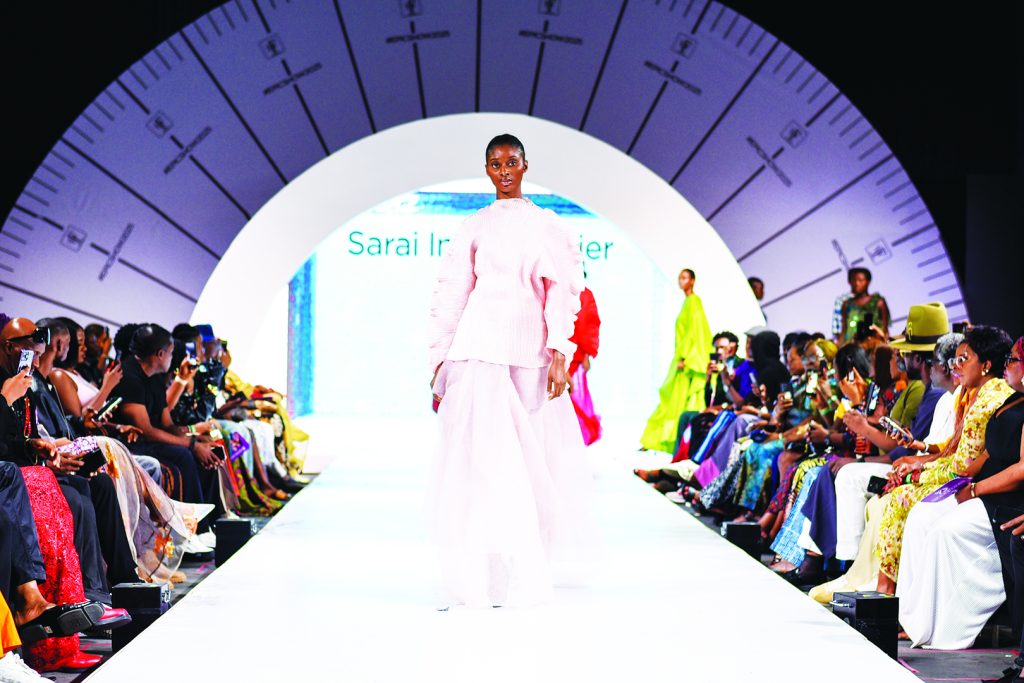
Africa’s most daring new voices in fashion took centre stage at The Epic Show 2025. Organised by Fashions Finest Africa, this stylish spectacle not only showcased bold designs but also tackled the real challenges facing the industry. A highlight of the event was the Design for the Future (D4DF) competition, a pioneering initiative dedicated to spotlighting emerging fashion talents who are redefining the industry through sustainable fashion practices. MARY NNAH takes a closer look at the creativity, innovation, and passion that defined this year’s competition
The fashion industry is undergoing a significant transformation, driven by a growing awareness of the environmental and social impact of clothing production and consumption. As consumers increasingly demand more sustainable and responsible fashion practices, designers are responding with innovative and creative solutions that not only reduce waste and minimise harm but also promote a more conscious approach to fashion.
The Epic Show 2025, a premier fashion event, is at the forefront of this movement, showcasing the latest trends and designs in sustainable fashion that embody the perfect blend of creativity, consciousness, and sustainability.
The show held recently in Lagos was a landmark event that redefined the fashion industry’s approach to sustainability and creativity. One of the event’s most memorable moments was the Design for the Future (D4DF) competition, an initiative launched to spotlight visionary fashion talents at the start of their journey.
This event brought together some of the most talented and forward-thinking designers in the industry, who are pushing the boundaries of fashion while prioritising the well-being of the planet and its inhabitants. From upcycled materials to biodegradable fabrics, the designs showcased at the D4DF demonstrate a deep commitment to sustainability and a passion for creative expression.
The Design for the Future (D4DF) competition was introduced as a platform that celebrates innovation in sustainable fashion, where remarkable designers transformed waste into wearable magic.
The competition featured a diverse range of designers, each with their unique perspective and approach to sustainability. It showcases remarkable designers who transform waste materials into wearable, beautiful pieces, demonstrating that fashion can be bold, attractive, and environmentally conscious.
The competition’s focus on sustainability and creativity was highlighted, and the panel of judges included Sola Oyebade, the Chief Executive Officer of Fashions Finest Africa, Gift Olohije, Founder of Lohije, and Style Infidel, Founder of The Style Indiel Studios. The judges engaged the competitors in a Q&A session, probing them on questions related to sustainability and their design processes.
Koldiezz, the first fashion brand to appear on the runway for the D4DF competition, showcased her afrocentric, streetwear, sustainable brand, which recycles off-cuts and damaged clothes into unique, creative pieces. “We tell stories through discarded clothes that people throw away. We just give them a new life.”
Her brand, Koldiezz, is currently undergoing a rebrand to focus more on sustainability, and this collection, titled “Ndudi” (meaning “life exists” in Igbo), was inspired by an old tree that continued to thrive despite adversity.
Koldiezz explained that the collection’s designs reflect the tree’s resilience and the idea of self-healing. The stitching on one piece symbolises the tree’s ability to mend itself, representing personal empowerment.
When asked about her target audience, Koldiezz identified individuals who appreciate art, craftsmanship, and unique storytelling through fashion, targeting Gen Zs and those who value exclusivity and newness.
The judges praised Koldiezz’s work, with one of the judges, Mr Mahogany, saying, “Your second look is chic… I can find your emotion in this garment.”
However, they advised her to define her target audience more specifically, considering her business model, cost of production, and desired scale.
Koldiezz refined her target audience to individuals aged 18-45 who appreciate limited-edition, storytelling-driven fashion pieces.
The judge’s feedback emphasised the importance of clarity in targeting a specific audience to ensure business success.
The next designer, Comfort Naija was questioned about her target audience and approach to sustainable fashion. She revealed that her fashion brand primarily caters to plus-size women, while sustainable fashion is a personal interest.
“First of all, sustainable fashion is just something that I like doing. But for my fashion brand, my target audience are plus-size women.”
When asked if she plans to incorporate sustainable practices using fabric scraps for her clients, Comfort indicated that it’s something she considers, but hasn’t fully integrated into her brand. She mentioned previous projects where she used unconventional materials like Indomie nylon and cotton paper to create sustainable pieces.
“The first one I did with Indomie nylon. And the second I used cotton paper to make a masterpiece.” Comfort’s response highlighted her exploration of sustainable fashion, but also raised questions about her long-term commitment to incorporating eco-friendly practices into her brand’s core business.
Tomi Ifebogun, another designer, showcased her brand, emphasising its significance and reflection of her identity.
“Tomi Ifebogun is a very important brand, because it is not just a brand, it is also a reflection of who I am as a person.”
She highlighted her brand’s focus on upcycling old clothes into new, sustainable pieces, specifically working with denim. Ifebogun’s collection was inspired by the human body, particularly the evolution and changes of a woman’s body.
This particular dress was inspired by how the human body changes and how it’s not just a vessel, but it keeps evolving, keeps changing, specifically a woman’s body.”
When asked about her brand aesthetics, she described it as evolving, with a leaning towards alternative fashion and a philosophy of thinking outside the box. “My brand aesthetics are still evolving. But I realise that it has been moving more towards the alternative fashion aspect… My brand aesthetics have always been based on thinking outside the box. Not just forms and standards of how clothes are meant to look. But just always thinking outside. How things can be more than what we know already.”
Ifebogun’s approach to fashion emphasises creativity and challenging traditional standards, with a focus on innovation and sustainability.
Designer Aurai The Label showcased her sustainable fashion collection, emphasising the importance of garments telling a story. She explained that her collection combines old and new elements, using biodegradable fabrics and upcycled materials. The female model’s tweed blazer and the male model’s patchwork design were highlighted as examples of sustainable fashion. Aurai also incorporated an old sweater into a piece with sticky notes containing sustainability messages.
When asked about marketing her sustainable garments, Aurai emphasised that her designs don’t necessarily scream “upcycled” and are meant to be stylish and appealing.
However, when questioned by one of the judges, Gift Olohije, Founder of Lohije, about her claim of using biodegradable fabrics, Aurai was asked to provide proof of the components of each fabric. Olohije pointed out that tweed itself is not biodegradable, but the material used to make it could be. Aurai was advised to verify the materials used in her fabrics to support her claims of biodegradability.
Aurai’s approach to sustainability in fashion highlights the importance of conscious choices in material selection and production processes. Her designs aim to promote sustainability through both upcycling and the use of biodegradable fabrics, with a focus on creating garments that are both stylish and environmentally friendly.
Yaomal YDC, another designer, showcased his designs, explaining the materials used for each outfit. She highlighted her use of sustainable materials, stating, “This is Ankara fabric, and this is made from leftover fabrics that could have been scrapped, and I turn them around and give them a new life by making this piece.”
She also used upcycled denim jeans and leftover organza pieces from past collections.
When asked about his target audience, Yaomal replied that she currently targets women but plans to expand to unisex fashion in the future. She confirmed that she sells his designs through social media and a walk-in store.
Yaomal’s approach to sustainability and her business model demonstrate her commitment to reducing waste in fashion while catering to a growing demand for eco-friendly and creative clothing.
Designer Empress Ero Signature shared her creative process, explaining how she utilised dormant fabrics to create unique and elegant pieces. She stated, “I had this dormant fabric in my bag. And I said, What am I supposed to do with it? Then, I got some lace and pieces out of all of them. I decided to create something beautiful, something feminine for a modern girl.” She emphasised her ability to transform unused materials into art, saying, “I can create anything out of anything I see, it mustn’t be with dormant fabrics.”
When questioned by Olohije about the sustainability of using dormant fabrics, Empress explained that she had initially purchased the fabric for a client who later rejected it due to the texture. She had hoped to use it for future clients, but it remained unused. The judge pointed out the potential issue with this approach, noting that if a customer wanted to order a piece in their size, Empress wouldn’t have the fabric available. Empress’s response highlighted her creative flexibility, but the judge’s question raised important considerations for her business model, particularly regarding production and inventory management.
The conversation with Olohije touched on the importance of planning and sustainability in fashion design, emphasising the need for designers to think critically about their materials and production processes.
Designer Estaz showcased her collection, “Back to Our Roots,” and explained the sustainable materials she used, including biodegradable fabrics called Druids. She emphasised the importance of returning to traditional practices in fashion, using materials that can stand the test of time. “This fabric here is called Druids. So, these are basically biodegradable fabrics. I made use of this fabric, basically, because I felt like we need to go back to our roots… to go back to where the problem is from, basically, in past fashion.”
When asked about the originality of her design, Estaz admitted that some ideas were inspired by existing concepts, but she had elevated them through her creative process.
“Some of the ideas that are on my design are basically like combinations… I saw this idea and I felt I could elevate it”, she noted.
She explained how she used wool to hand-braid elements and created oversized hands to make the design her own.
One of the judges, a stylist, Style Infidel acknowledged that inspiration can come from anywhere but emphasised the importance of editing and making ideas one’s own.
“It’s okay to get inspiration from anywhere and everywhere… But you have to learn how to edit. That’s what makes you an original.” The judge noted that while Estaz’s design was stunning, it lacked originality in one of the pieces, having been seen before. “The minute this dress came on, I knew I had seen it somewhere… So, as much as possible, what you have on is stunning… But if I were to look at anything, I’m not impressed. It would depend on the fact that originality isn’t there with one of your pieces.” The judge advised Estaz to learn how to edit and birth her unique ideas from existing concepts.
Designer Emmy Carter discussed the inspiration behind his outfit, choice of materials, and aesthetics. He stated, “I wanted to create pieces that were relatable to something you can see and understand… I have a love for colours, and that was what brought this piece.” Carter’s design fused denim, Aso Oke, and vintage pieces, aiming to create something relatable to different generations while incorporating sustainability.
When asked if he considered his consumers, Carter hesitated, and one of the judges, Mr, Mahogany, pointed out that the design might not be suitable for everyone, particularly those who prefer more modest clothing. Carter explained that he had considered his consumers but also wanted to showcase his creative dexterity. He noted that if the piece were to be resold, it would likely come with a net top inside to cover the back, making it more modest.
Carter revealed that he intentionally designed the piece with an open back to showcase the model’s physique, but he planned to include a net top to provide an alternative option. He stated, “I wanted him to show his back. That’s why I left it this way. But then it would come with a net top. So, the back can as well be visible, but a little bit.” This approach highlights Carter’s consideration for different consumer preferences while still showcasing his creative vision.
Mona Christian, the last designer to showcase his work, caught the judges’ attention with his personal outfit, which was made from repurposed waste materials. According to Mona, “This is the way I could handle sustainable fashion. We seem to underestimate the amount of waste that comes from fashion designers as well as the creation of clothes.”
He explained that he collected discarded fabric scraps from various places, sorting through the waste, and transforming them into a new fabric. “I had to go to various places to sort out waste… I had to put in a lot of just waste and make it into a new fabric.”
Mona emphasised the importance of sustainable fashion and managing waste in the fashion industry, highlighting that designers often underestimate the amount of waste generated during the design process. “I know how much waste comes out from my place all the time. So, I came up with a way that that waste can transform them into something new.” He believes that this approach can help reduce waste and promote sustainability in the fashion industry. “How do we manage waste? How do we make this endangered planet? How do we reduce this waste and make it better?” Mona’s innovative approach highlights the possibilities for creativity and sustainability in fashion.
The winner of the D4DF competition, Koldiezz, received a ₦1 million grant and a closing slot at the grand finale showcase.
The event marked a symbolic investment in Africa’s next generation of creatives, and a step towards shaping the future of the fashion industry.
The Design for the Future competition is a significant initiative that encourages young designers to think creatively about sustainability and fashion.
By providing a platform for emerging talents to showcase their designs and compete with their peers, the competition is helping to shape the future of the fashion industry. With its emphasis on sustainability, innovation, and creativity, the D4DF competition is set to inspire a new generation of fashion designers who are committed to making a positive impact on the environment and society.
As the Chief Executive Officer of Fashions Finest Africa, Sola Oyebade, aka Mr. Mahogany, shared insights on the inspiration behind the Design for the Future (D4DF) competition. “What the Design for the Future is about is that now the world is going through a lot of sustainability. Everywhere you go, people talk about sustainability, emissions, and all those sorts of things. So what we are now trying to do is we have a lot of waste where clothes come in, they are going into landfills, they are not degradable and all that sort of stuff, and it’s affecting us.”
The Epic Show 2025 and the Design for the Future competition are initiatives that are pushing the boundaries of fashion and sustainability, and inspiring a new generation of designers to think creatively about the future of the industry. With its focus on innovation, creativity, and sustainability, the competition is set to make a lasting impact on the fashion industry and to inspire a new wave of designers who are committed to making a positive difference.











Leave a comment