



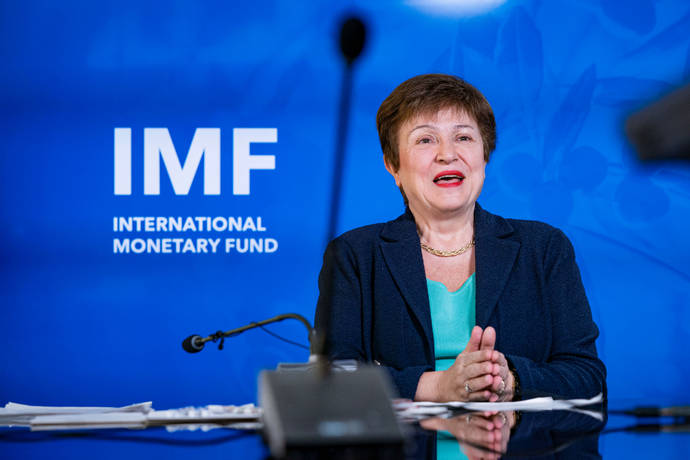
Managing Director of the International Monetary Fund (IMF), Ms. Kristalina Georgieva
•Financing needs projected at $50bn
By Uche Usim
The economic fallout from the Middle East crisis has begun to crop up with the International Monetary Fund already bracing for a spike in emergency financing requests from countries battered by it.
The Managing Director, Kristalina Georgieva, has projected fresh demand of between $20 billion and $50 billion in balance-of-payments support.
Ahead of the 2026 Spring Meetings in Washington, DC, Georgieva made it clear that the Fund is preparing to step in as a global “firefighter,” ready to scale up programmes for vulnerable economies facing surging import bills, volatile capital flows and deepening inflation pressures.
The expected financing needs, she said, would be significantly higher if not for years of improved policymaking across many emerging markets, an acknowledgment that stronger economic fundamentals have bought some countries valuable breathing space.
She noted that the scale of the current shock is formidable, with the nucleus being a sharp disruption to global energy supply.
The conflict has cut daily oil flows by roughly 13 per cent and liquefied natural gas (LNG) by about 20 per cent, sending shockwaves through international markets and reigniting inflation risks just as many economies were stabilising. The Fund noted that oil prices tell the scathing story as benchmark Brent crude oil surged from $72 per barrel before the crisis to as high as $120 at its peak.
Though prices have since moderated, they remain elevated, with countries scrambling, and paying premiums, to secure supplies.
“This is a classic negative supply shock, large, global, and asymmetric,” Georgieva said, emphasising that no economy is spared, but not all are affected equally.
Energy-importing countries are bearing the brunt, particularly those with limited fiscal buffers or weak credit ratings. For them, higher fuel costs are translating directly into rising inflation, currency pressures, and widening external imbalances.
Even energy exporters, despite benefiting from improved terms of trade, are not immune. Higher global prices are feeding into domestic costs, while broader economic uncertainty is dampening investment and growth prospects.
The IMF boss noted that the ripple effects extend far beyond energy as refineries are struggling to maintain operations amid reduced crude flows, triggering shortages of key fuels like diesel and jet fuel.












Leave a comment