



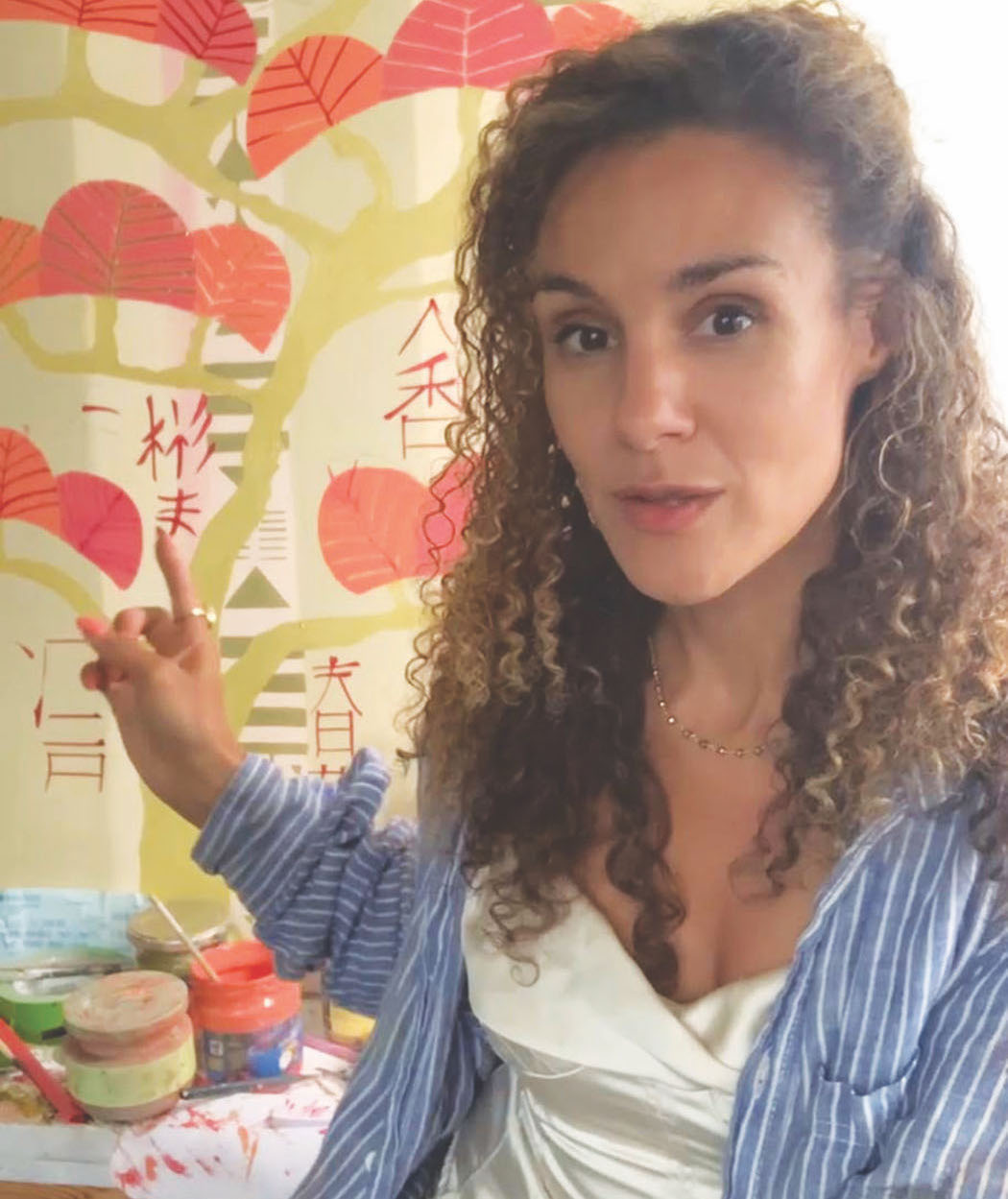
In paintings that privilege feeling over explanation, Sara Jacobs Majekodunmi treats identity not as a problem to be solved but as a quiet, durable presence—rooted in memory, lineage, and an easy refusal to over-explain herself. Okechukwu Uwaezuoke reports
Balance? To Sara Jacobs Majekodunmi, the word seems to prompt a flicker of amusement. Her interviewer might just as well have asked her to explain the mechanics of levitation. “It’s not really something I try to balance on purpose,” she says, matter-of-factly, brushing aside the contemporary itch to over-theorise one’s own inheritance. For her, identity is neither a performance nor a position paper—it simply exists. Nigerian by inheritance, British by formation, and long steeped in an attentive love affair with Japanese fabrics and aesthetics, she sidesteps the modern impulse to treat cultural belonging like a riddle demanding to be solved. In her world, hybridity isn’t something to be managed, declared, or defended. It’s just lived—present, operative, and cheerfully uninterested in applause.
“In Nigerian culture especially,” she explains, “identity isn’t just about one person—it’s about art, creativity, family, community, and shared history.” When she paints from her own experience, broader narratives rise naturally to the surface, without strain or signalling. The personal opens outward; honesty does the connective work. “When something is honest and personal,” she observes, “people from different backgrounds can still connect to it.” It’s a deceptively modest principle in an age obsessed with branding the self into neat, digestible units.
That sense of connection—felt rather than spelt out—runs through her engagement with the past. Nigerian histories, she reminds her interlocutor, have often travelled not by way of books but through voices, gestures, and ritual. “A lot of Nigerian history is passed down through stories, not books,” she notes, and this inheritance deeply informs how she approaches memory. Her paintings are not reconstructions, nor do they aspire to documentary exactitude. They function instead as vessels of feeling, holding on to what history feels like rather than what it dutifully records.
“When I paint,” she continues, “it feels like bringing something back into the present—especially stories that might otherwise be forgotten.” The canvas becomes less an archive than a site of return, a place where the past is allowed to breathe again, briefly pushing back against the slow drift of amnesia. In this, her work aligns naturally with oral tradition itself: fluid, responsive, vulnerable to loss yet stubbornly enduring.
The emotional weight of her paintings is inseparable from this approach. Feeling is not applied as ornament or expressive garnish; it is structural. She paints from proximity rather than analysis—not in rejection of thought, but in refusal to let it take command. Intimacy is allowed to accrue over time, patiently sustained until it simply “feels personal.”
Here, Nigerian cultural instincts—where emotion and spirituality are not marginal but central—are quietly at work. The paintings trust the eloquence of what remains unresolved. Majekodunmi has no interest in full disclosure. “Art can’t show everything about being human,” she acknowledges, “but it can show truth.” Often, that truth lives precisely in what is withheld. “Sometimes what’s left unsaid or unfinished in a painting,” she adds, “is where people really connect.” The incomplete becomes an invitation: a shared space of vulnerability between image and viewer.
Medium, too, carries memory. Majekodunmi’s choice of oil paint is neither incidental nor nostalgic. It was the medium of her grandmother—an artist shaped during a pivotal moment in Nigerian art history—and to work in oil is to remain in dialogue with that lineage. Yet the connection is neither heavy nor imitative. “Working in oil paint makes me feel connected to her,” she says, “but I don’t feel like I have to copy her.”
Legacy, as she understands it, is not a command to repeat but a permission to grow. “In Nigerian culture, legacy is important,” she reflects, “but so is growth.” To honour her grandmother is to work honestly—to follow her own instincts while acknowledging the ground from which she rises. “That connection gives me strength rather than pressure.” It steadies her hand without steering it.
Across her canvases, Nigerian fabrics—often indigo, saturated with historical and symbolic resonance—rub shoulders with Japanese visual sensibilities and other global influences. The encounter feels unforced, almost domestic in its ease. There is no translation exercise underway, no didactic staging of difference. “Art speaks in feeling, not words,” she notes, “so it crosses cultures easily.”
When indigo meets Japanese textile traditions, the effect feels less like juxtaposition than recognition. “I’m not trying to explain one culture to another,” she insists. “I just let them sit together.” It mirrors a contemporary reality in which many lives are lived between cultures, without the luxury—or burden—of singular belonging. “Many people live between cultures today,” she adds, “and my work reflects that.” A single image can hold multiple stories precisely because it leaves room for them.
Her movement between figurative and abstract painting follows the same intuitive logic. There is no hierarchy, no manifesto pinned to the studio wall. “Sometimes a story needs a face and a body,” she explains, “and other times it needs movement and feeling instead.” Figuration allows her to explore presence and identity; abstraction offers a language for emotion and memory—those experiences that resist neat articulation. “I don’t plan it too much. It depends on the painting.” The work decides.
Though her paintings now find homes in collections across the globe, Majekodunmi resists the temptation to paint for posterity. She paints for the present—for what presses, insists, and demands attention now. “I paint for now,” she says, “for what feels important in the moment.” Still, she knows paintings are stubborn things; they outlast their makers. In this, her practice once again echoes storytelling traditions that speak from the present while casting lines into the future. “In Nigerian culture, storytelling is about passing knowledge forward,” she reflects, “and I see painting in the same way.”
Should some future viewer encounter her work decades—or centuries—from now, she hopes they will feel its sincerity. “I hope they feel honesty, emotion, and a clear sense of where I come from.” Not explanation. Not resolution. Just presence.
That sense of origin takes on a particularly intriguing charge in her engagement with the lesser-known histories of the Benin people and their deep, often overlooked connections with Japan. Drawing on oral histories and cultural research, she points to parallels too precise to dismiss as coincidence: documented instances of identical personal names in both Nigerian and Japanese contexts, as well as identical forms of greeting elders—“not just similar,” she stresses, “but the same in form and meaning.”
Add to this shared beliefs in sky deities, parallel warrior traditions, and a long history of bronze-making executed with extraordinary precision in both cultures. “These parallels are too specific to ignore,” Majekodunmi insists. They hint at submerged knowledge systems and cultural memories that unsettle tidy historical boundaries. What if histories are not as geographically sealed as many have been taught? What if cultural memory travels by routes humanity hasn’t yet learned to read?
Her work does not rush to answer such questions. Instead, it insists on making them visible. “If my work helps bring these connections into view and encourages people to question how histories are told and preserved,” she says, “then that feels like a meaningful contribution.”
In the end, Sara Jacobs Majekodunmi’s paintings do not offer conclusions. They offer attention. They ask viewers to sit with complexity, to recognise continuity where they’ve been trained to see separation, and to trust feeling as a legitimate form of knowledge. In doing so, the works function not as answers, but as acts of witnessing—quiet, insistent, and built to last.













Leave a comment