



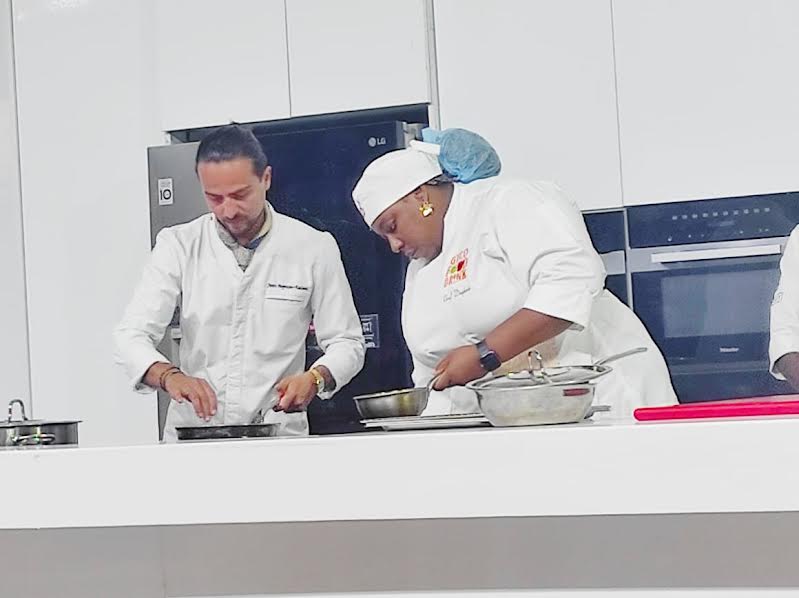
When the GTCO Food and Drink Festival hit full swing in Oniru, one tent went quiet. Inside, French chef Jean-Baptiste Ascione stood over a burner with beef aged in coffee, butter bubbling with toffee, and a crowd waiting for more than a recipe. He gave them a lesson in trust, context, and why “fresh” means something different in Lagos than it does in Paris. Writes Mary Nnah
It was 4:30 p.m. on Sunday, May 3rd, at the GTCO Food and Drink Festival in Oniru, Lagos. The air at Plot 1 Water Corporation Drive hung thick with humidity, smoke, and anticipation.
Outside the tent, the festival was in full roar – vendors shouting about the “baddest, creamiest shawarma,” a radio booth calling for the parents of 10-year-old William George, and a sandwich bar promising “bragging rights” for ₦5,000.
Inside, it was quieter. Hotter. A single burner hissed. And there was Chef Jean-Baptiste Ascione, sleeves rolled up, holding a slab of beef that glistened dark as polished wood.
The chef who had flown in to show Lagos what happens when you age beef in coffee for two days.
“I put the beef in this coffee two days ago,” he said, turning it in his hands like a relic. His voice was soft, French-accented, almost apologetic. “After two days, it’s tender. You can taste the smell of the coffee, and taste the taste of the coffee.”
The crowd leaned in. You could smell it – deep, bitter, and animal. At that moment, the audience stopped watching a masterclass and started witnessing a confession.
Ascione, 32, doesn’t look like the chefs on billboards. No towering toque, no stern scowl. He looks like he cooks with his whole body. He started at 13, not for glamour, but because it felt inevitable.
He trained in Michelin-starred kitchens, La Grande Cascade, Prince de Galles, and Masa, where precision is religion.
In 2015, all of France watched him on Top Chef when his dessert was named best across all seasons.
At 26, he bet on himself and opened Petit Gris in Paris, a farm-to-table restaurant serving “seasonal, honest cuisine” without pretense. Faby followed, a wine bar built around sharing. This June, he opens Le Petit Brochant, his third act.
But on this Sunday in Oniru, he wasn’t a brand. He was a man with a knife, a pan, and a problem: how do you teach trust?
His class was called “Refined Dish Inspired by French Cuisine.” What unfolded was anything but aloof. He started with duxelles. “Mushroom and onion,” he said, dropping both onto the board.
“We are going to cook it directly. We need to cut it into really little pieces. After that, you have a mash of mushrooms. Mushroom bits.”
He held up champignon de Paris and grinned. “Mushroom from Paris. But I’m sure it’s not from Paris.” The tent exhaled. He had permitted them to laugh.
Then came the beef. Two plates, one animal. “One is going to be beef tartare, and the other, I’m going to cook the beef in butter. Because I’m French.” The line got a roar.
Butter foamed in the pan with thyme and, improbably, toffee. “Butter, thyme, and toffee. It’s a French recipe. We don’t want to lose the beef.” The smell was narcotic: smoke, sugar, flesh.
The tartare was different. Intimate. He diced the coffee-aged beef into small, glistening cubes. “Tartare is when you cut it like this. Little pieces. That’s it. If I cut it like this, it’s a carpaccio.” He showed both cuts, fingers moving with muscle memory. “This is a recipe for tartare. But normally, tartare is just a cut.”
Then the room asked the question everyone was thinking: “Does tartare always have to be raw? Fully raw?”
“Normally, it’s raw. Yes. Normally,” Ascione said. “But in Paris, some people ask to have it cooked. But then it’s just a steak.” He paused.
“So how do you keep it safe to eat raw?” He didn’t dodge. “Yeah, it’s safe. We eat a lot of things raw. Fish, meat. That’s true. It’s okay. You just need fresh pieces.”
“How fresh?” someone pressed. “How long after the animal dies can you eat it?” That’s when Ascione’s face changed. The showman dropped. The chef stayed.
“In France, I can have the meat one hour after it arrives at my restaurant,” he said, choosing each word carefully. “So I can’t really answer here. I don’t know if you have it that fresh. It’s very hot outside. In Paris, it rains every day. It’s not the same situation.” He looked up at the tent, at the Lagos heat pressing in. “For me in Paris, I get my meat for tomorrow. It’s at my restaurant. The next day I work with it, and my customers eat it right away. So in two days, you can eat fresh meat at my restaurant. That’s why it’s complicated here. I don’t really know.”
No bravado. No brand-speak. Just a chef from a rainy city telling a humid city the truth: freshness isn’t a recipe. It’s a context. The questions kept coming. Wine. Religion. Alcohol. “Does cooking with alcohol reduce the alcohol content?” “Normally, when you cook with alcohol, you put fire to it,” he said, miming a lighter. “Big flame. In the end, you don’t have alcohol. If you don’t drink alcohol for religious reasons, you can’t really ‘steal’ alcohol. But you’re not going to get drunk.”
He plated both dishes as the light slanted gold through the hall. The tartare wore mustard, smoked cream, parsley oil, and so on. The seared beef glistened under toffee-butter. “This is the first recipe. Yes, it’s complete.”
The crowd wasn’t clapping yet. They were asking for more. “If there’s a place where we can get this information… not everyone is taking notes… We need step by step so we can practice.”
The moderator jumped in: “We will get back to you if you need anything.”
Ascione said his cooking is “shaped by travel, instinct, and a deep respect for product and fire.”
In Oniru, you saw all three. The trip that brought coffee-aged beef to Lagos. The instinct that told him to say “I don’t know” when he didn’t. The fire he kept lighting under pans and assumptions.
Outside, the festival kept spinning. “If you’re a Liverpool fan, approach any vendor for a discount,” the radio host joked. Shawarma Bistro was still “holding it down.” But for more than one hour on Sunday, May 3rd, a hall at the Water Corporation Drive went silent for a Frenchman who believed refined didn’t mean untouchable. It meant honesty. It meant coffee in your beef, toffee in your pan, and admitting that Paris rain and Lagos heat don’t play by the same rules.’
GTCO Food and Drink 2026, themed Promoting Enterprise, ran May 1–3. The enterprise Ascione left behind wasn’t a dish. It was a dare: to cook with fire, to eat with trust, and to say “I don’t know” out loud. In a city that rewards certainty, that might be the most refined thing of all.















Leave a comment