



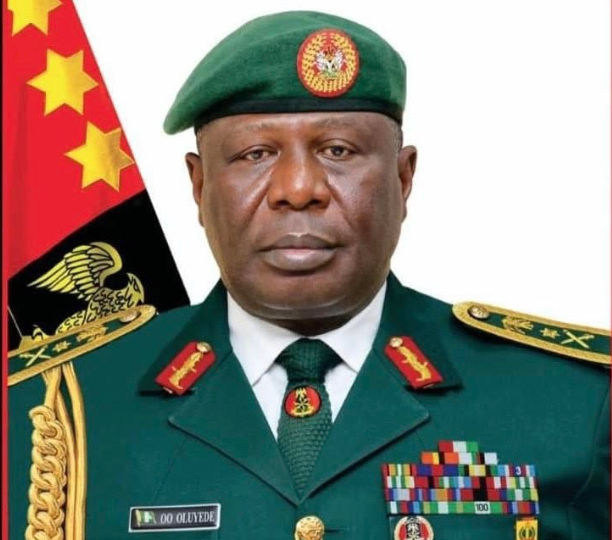
Lieutenant General Olufemi Olatubosun Oluyede, the 24th Chief of Army Staff (COAS), is a seasoned military officer whose career in the Nigerian Army spans over three decades. A member of the 39th Regular Course, he was commissioned as a second lieutenant in 1992 (with effect from 1987) and rose to the rank of Major General by September 2020. Prior to his appointment on December 9, 2024 (after being in acting capacity on September 2024) as COAS, he served as the 56th Commander of the Nigerian Army Infantry Corps in Jaji, Kaduna. Renowned for his operational leadership, Lt. Gen. Oluyede has held key command and staff roles, including deployments in Liberia under ECOMOG, Operation HARMONY IV in Bakassi, and as Commander of the 27 Task Force Brigade under Operation HADIN KAI in the North East. A recipient of numerous honours, including the Corps Medal of Honour, Grand Service Star, and Chief of Army Staff Commendation Award, he is a graduate of the National Institute and holds the ‘Passed Staff Course’ designation. At the recently commemorated 162nd anniversary of the Nigerian Army in Kaduna, the COAS, in an exclusive media chat with executives, addressed wide-ranging questions from the current security situation in theatres of operation to welfare of officers and men, recruitment challenges, and new strategies for tackling insurgency and terrorism. He also spoke on the issue of local intelligence support in the Northeast, strengthening interagency collaboration and partnerships with neighbouring countries, and the army’s expanding role in internal security and emergency response. Most importantly, the COAS reflected on how the Nigerian Army is preparing for the future of warfare particularly in response to shifting internal threats and evolving global security dynamics. Chiemelie Ezeobi writes that his command philosophy anchored on consolidating the transformation of the Nigerian Army into a well-motivated, combat-ready force, capable of effectively discharging its constitutional responsibilities within a joint and multi-agency environment, is already shaping strategic reforms across all operational and administrative levels of the force
Can you give us a sense of the security situation across the operation theatres?
The fact is that we are generally facing challenging security issues, which is why we have threats. That said, it is obvious that our efforts, in collaboration with other security agencies, have helped to meet many of these challenges. We have recorded successes in some theatres, even though there are still challenges in a few others. By and large, things are getting better.
Nigeria has a population of over 220 million, while the U.S. has about 340 million. Yet the U.S. has over 2.1 million military personnel with over 1.2 million active duty officers. According to AI, Nigeria has 135,000 military personnel. With our security challenges, shouldn’t we hire more soldiers quickly to boost numbers on the ground?
For the Nigerian Army, increasing personnel is a priority, and we’ve been recruiting yearly. We bring in about 12,000 across all arms and around 400 officers annually, making about 12,400 recruits per year. This year, we plan to raise that to 14,000. However, this comes with its own challenges. Over 40 per cent of the army currently lacks accommodation. For example, the training depot in Zaria was built for about 500 personnel, later upgraded for 1,000. Now, over 6,000 recruits are being trained there—an overstretched capacity. We’re addressing this by establishing a new depot in Oshogbo. Going forward, new recruits will be split between Zaria and Oshogbo. We also plan to open another depot in the South for better training quality.
I know the Army has been trying to raise recruitment awareness in the Southeast. How successful has that been? What are the numbers like?
We’ve been trying, particularly in the Southeast. But the population there is generally very industrious and business-oriented. Many prefer pursuing financial ventures. That’s the honest reality. Interestingly, we see more women enrolling from the Southeast than men. We’re continuing our awareness campaigns, but it remains a challenge.
What new approach are you bringing to the fight against insurgency and terrorism, especially as we mark 15 years of this battle since 2009? Also, there’s talk of bringing back private military contractors. Is this true?
I’m glad you raised the importance of collective effort in fighting insurgency. Security is everyone’s business. In the Northeast, for example, the insurgents are from the local communities. These communities often provide logistical support. Until they decide to stop supporting the insurgents, progress will be limited. Regarding private military contractors, it’s not a new concept. Major powers like Russia and the U.S. have used them. We’re considering bringing in some elements to support operations. It’s a decision that is being considered carefully.
What progress has been made in winning the hearts and minds of locals in the Northeast to support intelligence sharing and military operations?
It could be better (…sic). When I commanded the 7th Task Force Brigade as a Brigadier General, we could get real-time intelligence. But now, the insurgency has evolved into a war economy. People are profiting from the conflict—operating warehouses and illicit markets. The criminals have become smarter and more discreet. Still, the intelligence community is working hard. We’re also bringing in enablers to enhance our intelligence-gathering capabilities.
How have you improved interagency collaboration and cooperation with international partners, especially our neighbours in the West African region?
Interagency collaboration is robust. We receive timely intelligence from the DSS, Police, and other agencies. Internationally, we work closely with partners. For instance, in Mallam Fatori near the Chad border, the Nigerian Air Force supports operations when needed because threats there could affect parts of Niger. Even when some partners lack an air force, we share intelligence and collaborate effectively.
Beyond your external defence role, what role has the Army played in internal security and emergency responses?
The Army has rapid response units across all formations to support emergencies. For example, during the last major flooding in Nigeria, our personnel were deployed massively to evacuate and support affected communities. There’s an established structure for this within the Army.
In the Northeast, the enemy is now using drones and armour-piercing weapons. What have you done differently to achieve some stability in areas like Baga?
Warfare means you win some, you lose some. Losses disturb us too. But to stabilise the area, I restructured the command system and replaced most of the commanders. We improved soldiers’ welfare, including increasing their feeding allowance from ₦1,500 to ₦3,000 daily. We injected more combat enablers and installed surveillance cameras to boost situational awareness. We also initiated more proactive operations to regain freedom of action. As for a certain notorious bandit in the Northwest, efforts are ongoing. Some of his key commanders have been taken out. It’s a matter of time before we get him too.
What strategy is the Army using to engage the media, especially traditional media, to counter misinformation and shape narratives positively?
I believe security is everyone’s business. So, the media should naturally be on the side of national security. We expect media stakeholders to support us and promote the right narratives. It’s a shared responsibility, not necessarily something that requires formal engagement all the time. Just a sense of patriotic duty.
We have seen security improvements in the South East and appreciate your men’s efforts. But beyond equipment, human capacity matters, what are you doing to improve the welfare of your men?
Thank you for the kind words. For us, the best form of welfare for a soldier is training. No soldier can be effective without it. That’s why we are restructuring our training system and depots. We’re also upgrading our training infrastructure, getting better instructors, and partnering international training bodies. Beyond training, we’ve initiated several welfare schemes for soldiers, and I always tell them—my greatest concern is ensuring they are well-trained and well-catered for.
What kinds of income or allowances accrue to soldiers, especially those with special roles or training?
Today, I’d like to talk about income accruable to soldiers. For example, special forces personnel receive special allowances. If you undergo a language course, you’re also entitled to a different kind of allowance. Instructors are also paid a separate allowance. When you aggregate all of these, you’ll find that a well-engaged soldier is significantly motivated in terms of remuneration. We also have an affordable housing scheme where soldiers can get accommodation for as low as ₦7.5 to ₦8.5 million. We develop these housing units by allocating land and bringing in partners to make construction as affordable as possible. Our aim is for soldiers to own their own homes even before retirement. Additionally, we run a zero-interest loan scheme. Soldiers can access these loans but we also discourage taking them unnecessarily unless there’s a clear need. These schemes are part of our broader welfare efforts to ensure that morale remains high.
Since you invoked the theme “Army Towards a Better Society,” how is the Nigerian Army preparing for the future of warfare, especially with today’s shifting security dynamics more internal than external and evolving global threats?
Thank you very much for that thoughtful question. You’re right to use the word evolve. The challenges we had in December are not the same as what we’re facing now. We are actively preparing for the future. Our training programmes are being restructured to be forward-looking. We’re integrating modern warfare techniques, including technology and innovation. We’re also investing in Research and Development (R&D) to ensure that we’re not just reactive, but proactive. The Nigerian Army is adapting, and we’re determined to remain a relevant and capable force, both now and into the future.









Leave a comment