



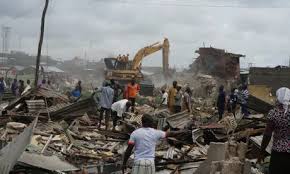
Beyond the noise of misleading narratives, the true intent behind the proposed demolition in Makoko, Lagos, reveals a story that has been largely overlooked, writes Oluwaseyi Adedotun.
First, this is a developing, highly topical issue—one deeply rooted in human interest. It is therefore unsurprising that the mere mention of the Makoko demolition stirs strong emotions, even when the facts suggest a more complex reality.
In recent days, public discourse around the Makoko community in Lagos State has been reignited across both traditional and new media. Much of the narrative has cast the Lagos State Government in a negative light, portraying its actions as a calculated “land grabbing” agenda driven by self-interest rather than the broader public good.
This concern was brought to the fore and adorned some sculpted options during a programme aired on national television, where one of the residents, a septuagenarian, was accompanied by some NGO representatives.
That portrayal, while emotionally compelling, one must say, risks distorting a far more complex reality.
However, considering the inciteful effect that was subtly packaged in the position and tone of the discussion, it is therefore necessary to set the record straight and address the growing wave of narratives that, intentionally or otherwise, misrepresent both the intent and substance of government policy.
At the centre of this conversation is a broader and more delicate issue: the role of activism in shaping public perception. Civil society engagement is vital in any democracy, particularly when it comes to protecting vulnerable communities.
However, activism must be exercised with a sense of responsibility that matches its influence, walking with caution and mindful of the nuances of the environmental reality.
Thus, when advocacy evolves into agitation that dismisses nuance, amplifies distrust and frames every state intervention as predatory, it begins to do a disservice to the very people it claims to defend, and more importantly its brand, albeit with fleeting glory.
In environments as sensitive as Makoko, such narratives can inflame tensions, harden positions and complicate efforts geared at constructive engagement.
Observably, there is an increasing tendency among certain actors to reduce complex urban policy decisions into shallow and oversimplified binaries of “the people versus the government.”
This framing may generate attention and even sympathy, but it certainly obscures the difficult truths that the public ought not to shy away from
Lagos is not a static entity; it is one of Africa’s fastest-growing urban centres, and its sustainability depends on deliberate planning, regulation and, at times, difficult transitions fused into hard choices.
To suggest that every attempt at restructuring informal settlements is an act of dispossession is to ignore both historical precedents and present-day realities.
Makoko itself is a product of decades of organic growth outside formal urban planning frameworks. What started as a modest fishing settlement has evolved into a densely populated waterfront community, defined as much by its resilience as by its infrastructure deficiencies.
Beneath the iconic imagery of stilt houses and canoes lies a precarious living environment marked by overcrowding, high crime rate, poor sanitation, environmental degradation and heightened vulnerability to fire outbreaks and flooding.
These are not theoretical concerns; they are lived experiences that pose real and immediate risks.
The Lagos State Government’s engagement with Makoko must be understood within the context of its broader ambition to position Lagos as a 21st-century megacity capable of supporting its rapidly expanding population.
Urban renewal, in this regard, is not about aesthetics or elite preference; it is about safety, functionality, and the long-term viability of the city, without consciously leaving any of its part behind.
Settlements like Makoko, built without regard to structural integrity, approval of any sort, environmental impact, or access to essential services cannot be sustained indefinitely without consequences.
Relocation, therefore, emerges not as an arbitrary policy choice but as part of a continuum of urban management strategies aimed at improving living conditions and reducing systemic risks.
Sadly, the proposal to move residents to areas such as Agbowa has been met with resistance, particularly on the grounds that Makoko’s inhabitants, many of whom are fishermen, require proximity to water for their livelihoods. This concern is legitimate, but it is not insurmountable.
Agbowa and its surrounding areas exist within a broader coastal and riverine ecosystem, and with proper planning, infrastructure can be developed to support fishing and related economic activities.
The question is not whether alternatives exist, but whether there is sufficient willingness to explore and refine them collaboratively.
It is also important to note that Lagos is not without precedent in managing such transitions.
The relocation of sawmill operators from Oko Baba stands as a case in point. Initially met with scepticism and resistance, the exercise ultimately resulted in the allocation of structured workspaces and improved living conditions for affected individuals.
While no relocation process is without its challenges, the Oko Baba experience demonstrates that, when properly executed, such initiatives can yield tangible benefits for both the people and the city at large.
Equally instructive are redevelopment efforts in other parts of the state, including areas within Agboyi-Ketu, where interventions by the Ministry of Physical Planning and Urban Development have transformed previously disorganised settlements into more regulated and habitable environments.
These examples underscore a consistent policy direction: the gradual replacement of hazardous, unplanned communities with safer, more sustainable alternatives.
To insist, as some have done, particularly non-governmental organisations that seem to be profiting from the mess and pretending to be fighting for the people, that Makoko must remain untouched in its current form is to romanticise a condition that is, in reality, fraught with risk and fraud combined.
Agreeably, preservation of culture and livelihood is important, but it must be balanced against the imperative of ensuring safety, dignity and access to basic services.
No responsible government can ignore the warning signs inherent in settlements that lack the most fundamental basic infrastructure. None of this absolves the state of its responsibility to act with transparency, empathy, and inclusivity.
Engagement with affected communities must be genuine and relocation plans must be accompanied by clear guarantees regarding housing, livelihoods and social services. Trust is not demanded; it is built through consistent and demonstrable action.
However, it is equally incumbent on those who occupy the advocacy space to ensure that their interventions are guided by facts rather than sentiment and by long-term outcomes rather than immediate optics.
Activism needs to be reminded that public discourse must rise above the temptation to assign motives without evidence or to weaponise the anxieties of vulnerable populations for selfish agendas.
The Makoko debate is, ultimately, a reflection of the growing pains of a city in transition. It is a test of Lagos’ ability to balance compassion with pragmatism, and of society’s capacity to engage in honest, constructive dialogue.
Misleading impressions, no matter how well presented, do little to advance this cause. What is required, particularly of activism, instead, is a shared commitment to truth, responsibility and the collective good.
In clarifying the issues surrounding Makoko, the goal is not to silence dissent but to ensure that it is informed, measured, and aligned with the realities on the ground.
Only then can Lagos move forward in a manner that truly serves all its residents, both present and future.















Leave a comment