



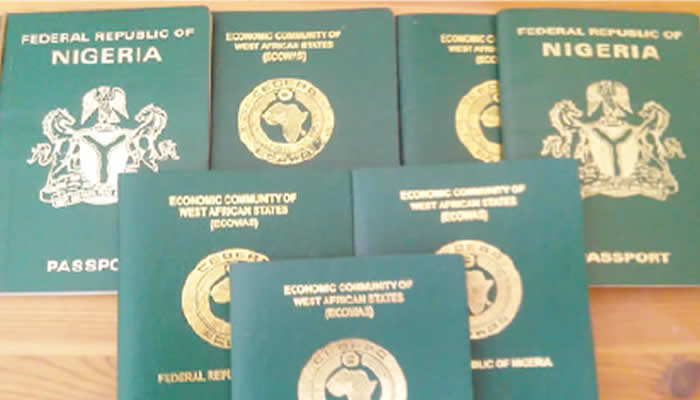

The Nigerian passport climbed six places on the Henley Passport Index since President Bola Tinubu assumed office in May 2023, rising from a global rank of 95 in January 2024 to 89 in the latest April 2026 edition.
However, the actual number of countries Nigerian passport holders can visit without a visa has fallen by two destinations.
This is as Ethiopia, Zambia, Zimbabwe, Lesotho, Somalia, Mauritania and São Tomé and Príncipe, among others, have moved Nigeria to the “visa required” category in recent years.
According to the April 2026 edition of the Henley Passport Index, Nigeria’s visa-free destinations stand at 44, down from 46 in January 2025 and 45 in January 2024.
The data, drawn from three successive annual editions of the index obtained by The PUNCH, shows that while Nigeria climbed six places in the overall global ranking from 95th in January 2024 to 89th in April 2026, the actual number of countries accessible to its passport holders without a prior visa shrank by two destinations over the same period.
According to the data, several countries ranked below Nigeria in prior editions have also fallen further in the intervening period, raising Nigeria’s position without necessarily requiring any improvement in the country’s passport strength.
The Henley Passport Index, now in its 21st year, ranks 199 passports globally using exclusive data from the International Air Transport Association.
In that time, the Nigerian passport fell 27 places from 62nd in 2006 to 89th in 2026.
A detailed comparison of the 46 destinations from January 2025 against the 44 accessible to Nigerian passport holders as of April 2026, verified against the Henley country-specific destination document obtained by our correspondent, revealed that while Nigeria gained access to nine new destinations including Fiji, Micronesia, Mozambique, Rwanda, Togo, Samoa, Palau Islands, Niue and Montserrat between 2025 and 2026, it simultaneously lost access to seven countries over the years.
The most well-documented is Ethiopia, which scrapped visa-on-arrival for Nigerian citizens in October 2022, requiring Nigerians to obtain visas from the Ethiopian embassy in Abuja before travelling.
The change came barely two weeks after Ethiopian Airlines emerged as a core investor in the Nigerian national carrier project.
Ethiopia, which had been one of the most accessible destinations on the African continent for Nigerian travellers, is now effectively inaccessible by any route.
Meanwhile, the Zambian government mandates that all West African passport holders must obtain visas.
Zimbabwe, which previously offered Nigerians a visa-on-arrival, now requires a prior visa application.
Lesotho, Mauritania, São Tomé and Príncipe and Somalia have each similarly moved to a prior-visa requirement for Nigerians.
The changes were highlighted in crossed-out entries against each of the countries concerned in the 2026 destination list for Nigeria.
None of the countries involved cited formal bilateral disputes with Nigeria, and the changes were administrative.
Visa-free Pacific island nations of Fiji, Samoa, Niue, Palau, Micronesia and Montserrat currently operate open-door or minimal-visa-requirement policies that apply broadly to developing nations.
Among West African countries, Nigeria sits near the bottom of the 2026 ranking, as Ghana ranked 67th globally with a visa-free score of 67, 23 destinations more than Nigeria.
The Gambia, a country of less than 2.5 million people, ranked 66th with 68 visa-free destinations.
Senegal ranked 77th with 56 destinations, Burkina Faso and Côte d’Ivoire at 77th and 78th respectively with 56 and 55 destinations, and Guinea-Bissau at 83rd with 50 destinations.
Across the continent, South Africa maintained its lead as the strongest passport. Ranked 46th globally, its holders can travel to 100 destinations visa-free.
Botswana followed at rank 56 with 81 destinations, ahead of Namibia with 74 destinations, Morocco with 71 destinations, Kenya with 69 and Ghana with 67 destinations.
Globally, Singapore holds the world’s most powerful passport with a visa-free score of 192, edging ahead of Japan and South Korea, which share the second position at 187 alongside the United Arab Emirates.
Sweden, with 186 destinations, is ranked third, while Belgium, Denmark, Finland, France, Germany, Ireland, Italy, Luxembourg, the Netherlands, Norway, Spain and Switzerland jointly occupy fourth position with 185 visa free destinations.
The index put Austria, Greece, Malta and Portugal at fifth position with 184 destinations.
Meanwhile, Afghanistan holds the world’s weakest passport as its holders can access only 23 of 227 assessed destinations without a prior visa.
The rest include Syria with 26 destinations, Iraq with 29 destinations, Pakistan and Yemen (31 destinations, rank 98), Somalia (32, rank 97), Nepal and North Korea (35, rank 96) and Bangladesh (36, rank 95).
Libya, with 39 destinations and Eritrea, with 38, occupy ranks 93 and 94, respectively.
In an earlier interview with our correspondent, Research Director, Centre for China Studies, Abuja, Charles Onunaiju, argued that the dwindling visa-free access Nigerians enjoy globally reflects the country’s internal challenges.
“We have a challenge. Since Nigeria is becoming inhospitable, especially for young people with no opportunities, there is desperation to go abroad. Almost all embassies now enforce regulations on Nigerians that they don’t impose on other nationals.
“People feel that almost every Nigerian wants to leave here. That’s partly true because the nation has mishandled the potential in it. Our leaders have not harnessed the vast human resources available to us.
“If we want to earn respect from outside, we must begin from home. If we want the world to take us seriously, we must get our acts together,” Onunaiju said.
An ex-official of Nigeria’s passport issuing agency, the Nigeria Immigration Service, said visa-free mobility primarily reflects bilateral agreements between countries and within regional blocs.
The official who spoke on condition of anonymity said, “Henley’s ranking is based on passport admissibility, and that is largely a function of mutual understanding and reciprocity among countries, which does not necessarily reflect the true strength of a passport. A good example is the European Union and the ECOWAS.
“While we appreciate their work, the NIS is more concerned with deepening its passport technology to meet the standards of the ICAO. The goal is to ensure that our passport complies with ICAO guidelines.”















Leave a comment