



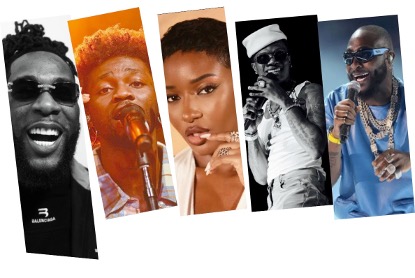
As the 68th Grammys take place tonight in Los Angeles, USA, Nigerians are once again rooting for their own — Burna Boy, Wizkid, Ayra Starr, Omah Lay and Davido — to return home with music’s most coveted trophy. Vanessa Obioha traces Nigeria’s long, winding journey to the world’s biggest music stage.
Before the 2020s, when Afrobeats wasn’t yet a global force, the Grammy Awards felt like a distant dream for Nigerian musicians. Young or old, underground or famous, many aspired to add the golden gramophone to their trophy shelves. Nominations were almost treated like a win in some cases.
For years, Femi Kuti appeared closest to breaking through the Grammys’ wall of fame, earning multiple nominations in the Best World Music category before it was later renamed Best Global Music Album. Still, while the British band Sade which has as lead singer, the Nigerian-born British artist Sade Adu — won Best New Artist in 1986 — and percussionist Sikiru Adepoju, who won in 2009 with the Global Drum Project, had tasted Grammy success, the moment felt removed from Nigeria’s contemporary music scene.
That perception shifted decisively in 2021.
Wizkid and Burna Boy finally brought home the Grammy glory that their generation longed for. Wizkid’s win came through his collaborative effort with American superstar Beyoncé on ‘Brown Skin Girl,’ while Burna Boy claimed Best Global Music Album for ‘Twice As Tall.’
Burna Boy’s victory, in particular, altered the landscape. The self-styled African Giant had done what many Nigerians thought was impossible: win a Grammy in a most competitive category for Africans. He broke the ‘Angelique Kidjo jinx.’ For him and his contemporaries, the win ignited a renewed sense of possibility. The competition intensified. Nigerian artists began submitting stronger, more deliberate bodies of work for Grammy consideration, year after year. It was only a matter of time before the Grammys began considering a dedicated category for emerging African sounds.
In 2023, the Recording Academy introduced Best African Music Performance, a category that was designed to recognise emerging sounds from the continent, including Afrobeats, Amapiano, highlife and other African genres. The category made its debut at the 2024 Grammy Awards. While debates continue over labels and definitions, the category marked a significant institutional acknowledgement of Africa’s growing influence on global music.
Tems emerged as the first Nigerian to win in that category last year for her song ‘Love Me Jeje.’ She also stands out as one of the few Nigerians with multiple Grammy wins, having earlier claimed Best Melodic Rap Performance in 2023 for her feature on Future’s ‘Wait for You.’
The Grammy Effect
For many artists, winning a Grammy represents the pinnacle of a lifelong dream. Since the first Grammy Awards were held in 1959, the ceremony has grown into a global reference point for excellence, recognition and validation in music. Originally conceived to reward technical and artistic merit, the Grammys initially focused on genres such as pop, jazz and classical music. Over time, the awards evolved. By its tenth year, the Grammys had become more than an industry gathering, embracing new sounds and surprising winners. The Beatles’ historic win for ‘Sgt. Pepper’s Lonely Hearts Club Band’ marked the first time a rock album claimed Album of the Year. The awards also honoured an eclectic mix of winners. From Republican Illinois senator Everett M. Dirksen, who won Spoken Word of the Year, to horror film legend Boris Karloff, who received Best Recording for Children.
It was this expanding scope that prompted entertainer Andy Williams — later the host of the first live Grammy telecast — to famously describe the awards as “the Oscar, the Emmy, the Tony of the recording industry.”
In subsequent years, the Recording Academy added new categories to reflect shifting musical realities: reggae in 1985, rap in 1989, and Best World Music Album in 1992, which recognised music from outside the Western mainstream. By 1997, Latin music had grown so significantly that it necessitated a separate platform, the Latin Grammy Awards for works recorded in Spanish or Portuguese from around the world.
In a similar spirit, Nigeria’s Minister of Art, Culture, Tourism and Creative Economy, Hannatu Musawa, floated the idea of hosting an African-centred Grammy-style award in Nigeria. The proposal, however, faced resistance from industry stakeholders who feared it might dilute existing African award platforms and undermine homegrown institutions.
While the Grammys are widely perceived as the highest international music honour, they have not been without controversy. Critics have long accused the awards of gender imbalance, racial exclusion and excessive commercialism. In 1991, the late Irish singer Sinéad O’Connor famously boycotted the ceremony, citing its extreme commercialism. Others have criticised the Grammys for conservatism and for failing to adequately reward innovation.
In response, the Recording Academy made a few changes by creating initiatives such as the Black Music Collective, dedicated to the inclusion, recognition and advancements of Black music and its creators and professionals within the Recording Academy and music industry at-large and Women in the Mix.
Despite these criticisms, the Grammys’ symbolic power remains undeniable, particularly in Nigeria, where international validation still carries enormous weight. Thus, an artist’s greatness is often measured not only by creative output, but also by sold-out global tours and Grammy wins.
There are, of course, other respected international awards including the MOBO Awards, and the MTV Video Music Awards. Even in Nigeria, the Headies was once dubbed the Grammys of Nigeria. Meanwhile, the All Africa Music Awards continues to gain momentum as a continental platform for African music creatives.
Still, for many Nigerian artists, the Grammys represent the ultimate benchmark, a chance to join music’s most exclusive club.
Afrobeat’s Impact
Nigeria’s Grammy story is incomplete without Afrobeat, the revolutionary sound pioneered by the late music legend Fela Anikulapo-Kuti. Fierce, defiant and politically charged, Fela’s music was not just ingenious; it was confrontational, speaking truth to power while laying the sonic foundation for what would later evolve into modern Afrobeats. His influence travelled far beyond Nigeria’s borders, and even farther in death.
Last night in the United States, Fela became the first African to receive a Grammy Lifetime Achievement Award, with the Recording Academy recognising his enduring contribution to global music and his role in shaping the DNA of contemporary Nigerian sound.
Decades after his passing, his legacy remains a reference point for generations of artists who continue to draw inspiration from his work. From Wizkid, whose ‘Ojuelegba’ carries echoes of Afrobeat’s reflective storytelling, to the growing global imprint of Burna Boy, Fela’s sonic fingerprints are unmistakable. Of course, artists like Innocent “2Baba” Idibia and D’banj also played key roles in popularising Afrobeats in its formative years. Yet, in today’s global conversation, Burna Boy has emerged as the genre’s most visible standard-bearer.
Even with just one Grammy win, Burna Boy stands as the most Grammy-nominated Nigerian artist, with over 10 nominations since 2020. In 2024, he made history as the first Nigerian artist to perform on the Grammys’ main televised stage, delivering a medley that featured appearances from Brandy and 21 Savage.
Earlier, in 2021, he performed at the Grammy Premiere Ceremony following his ‘Twice As Tall’ win. Due to pandemic-era restrictions, the performance was staged from Lagos at the then National Arts Theatre. Burna Boy has since become the poster figure for Nigeria’s Grammy aspirations; proof that African artists can compete, and win, on music’s biggest stage without compromising their identity.
The 2026 Contenders
As the 68th Grammy Awards unfold tonight in Los Angeles, Nigerians are once again hopeful. Burna Boy enters the ceremony with two nominations: No Sign of Weakness for Best Global Music Album and ‘Love’ for Best African Music Performance.
Davido and Omah Lay are also nominated for Best African Music Performance with ‘With You,’ while Ayra Starr and Wizkid earn nods in the same category for their duet ‘Gimme Dat.’
Win or lose, the moment itself reflects how far Nigerian music has travelled from distant nominations to sustained global presence. What was once an elusive dream has become a recurring reality that is cementing Nigeria’s place in the Grammy Award












Leave a comment