



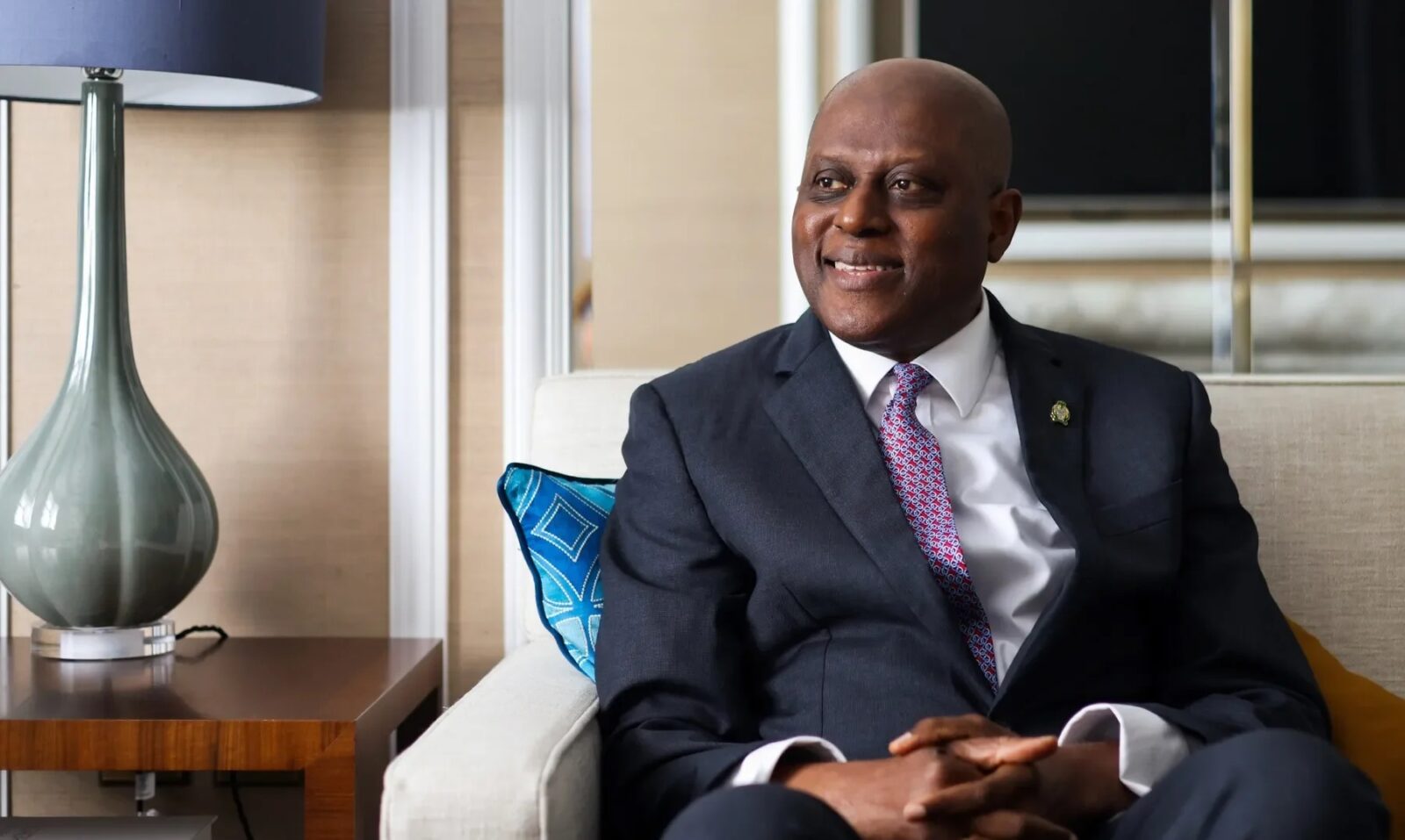
From Adanna Nnamani, Abuja
As global headwinds torment financial markets, the Central Bank of Nigeria (CBN) Governor, Mr. Yemi Cardoso, has asked anxious Nigerians and the international community not to lose sleep as the nation’s economic ship is headed in the right direction and insulated from global tempest.
He gave the assurance while responding to journalists’ questions on the sidelines of the last Monetary Police Committee briefing in Abuja on Tuesday.
Beyond stabilising the financial system, he noted that the apex bank was working to structurally reduce inflation to single digit, shield the economy from global shocks and ensure the banking sector remains resilient as recapitalization progresses.
Recently, the IMF concluded its Article IV consultation in Nigeria, where it commended both the fiscal and the monetary side of the economy for some of its reforms in the last two years. We’d like to know what your assessment of that is, and then if you have recommendations as well.
First, I think it may be important to say something about why Article IV of the IMF is important.
Article IV is important because the IMF is considered a credible institution. And whatever the IMF says, what it comes out with, potential investors are interested. Many take a cue from that in making their decisions.
And by the way, let me not restrict you to the IMF alone. Are there other institutions that, on a regular basis, perhaps not as rigorously and in-depth as the IMF would do? conduct similar assessments. For example, you hear regularly of the rating agencies.
The last one that did something in Nigeria, to the best of my knowledge, is Moody’s. And they really had stayed away from looking at Nigeria for a while. So they recently did their review, and very happily, they gave us an update in line with what others have been doing.
Again, to re-emphasize, these are the things that potential investors take a cue from. They’re very important to them. Now, I would say that the findings of these institutions are really not dissimilar.
There is a feeling that the Nigerian authorities have taken bold, transformative measures to help reposition the macroeconomic fundamentals of the country. There’s a general feeling that they have moved, and you mentioned the monetary side in particular, towards the discontinuation of the monetisation of fiscal deficits.
The foreign exchange market is working a lot better and more smoothly, which has encouraged inflows. Of course, reference is constantly made to the fact that Nigeria has moved away from the very difficult situation where there were subsidies, on both the fuel side and the exchange rate. And all these measures, painful though they may be, have resulted in stability in the FX market.
There is positivity with our trade surplus, and it has restored investor confidence. So I think across the board, the policies we have embarked on are bringing results. Inflation is gradually coming under greater control. And very importantly, Nigerians are having greater confidence in their own currency.
Just yesterday, someone showed me a chat with his travel agent. He was owing some money and the agent said, “Please, I know you normally pay me in dollars, but I’m happy to take it in naira.” That speaks volumes.
The differences between the parallel market and official rate, you can all see them yourselves. Some banks now allow naira card use abroad. These reforms are transformational and they’re here to stay. They are not short-term.
And as more vigilance, transparency, and trust is rebuilt, I am confident that we will continue to see positive signals, as the IMF and others are also acknowledging.
On recommendations, yes, there are. We must build more resilience, buffers for future uncertainties. Also, we must stay the course and not start what we cannot finish. And I’ve said this before: we will not reverse course.
The necessary collaboration will continue to reduce uncertainties because no one wants to invest where there’s risk of loss. Consistency and trust in policy are key, for both foreign investors and Nigerians.
Given that year-on-year headline inflation eased marginally from 22.97 percent to 22.22 per cent in June, but month-on-month inflation accelerated from 1.53 percent to 1.68 percent, how is the Central Bank recalibrating its monetary policy tools to ensure inflation reduction is not just statistical but structurally sustained?
First, let me say that at the Central Bank, we recognize our policy toolkit is working, so inflation is falling. However, our goal remains single‑digit inflation. So even though it’s improving, we are still determined to reach that target.
We must also understand where we’re coming from. The context matters. We’re emerging from a period of enormous money supply, huge injections from ways and means and other interventions. These were unprecedented and still linger in the system. They don’t disappear overnight. That’s one challenge we must confront.
Our response is a very tight monetary stance. We have no choice, it comes at a cost, but it must be done.
If we are to hit single-digit inflation, we must continue using every tool, MPR, CRR, and ensuring the FX market works efficiently.
There are also positive developments helping us. Nigeria is now meeting its OPEC quota, and there is greater transparency in NNPC earnings. I saw on TV today that their monthly profits are being published publicly, that’s encouraging.
We’re also ensuring close coordination between monetary and fiscal policy. I recently addressed NNPC’s first retreat, where useful discussions underscored the importance of collaboration going forward.
We will continue to use our tools, MPR, CRR, FX management, and manage inflation expectations transparently so everyone understands where we’re headed.
We are determined to deploy every available tool to bring inflation down to single digits
With the IMF warning about a potential crisis in China, shrinking fiscal space, and structural factors like food supply shocks and high energy costs driving inflation, how is the Central Bank positioning itself to mitigate these external shocks?
External shocks are a real concern, oil price volatility, geopolitical issues, global inflation—and they are beyond anyone’s control. But Nigeria is taking deliberate steps to insulate itself.
We’ve increased domestic oil production, aided by improved security. That has helped stabilise the economy.
We’ve diversified our reserve base, with stronger diaspora remittances. We introduced the non‑resident BVN, enabling Nigerians abroad to open accounts remotely. This is boosting inflows and transparency.
Our foreign reserves have exceeded $40 billion, providing a solid buffer. Even amid recent emerging market turmoil, Nigeria’s financial system remained stable and our currency firm. That resilience is no accident, it reflects intentional reforms.
The numbers will continue to speak for themselves.
Following recent PMI reports showing a rise in input costs, there are concerns about inflationary pressures. Can you clarify the Central Bank’s position on this?
The PMI reflects the sentiments and expectations of business across the sectors, from industry to service to agriculture. It does not by any means represent the views of the central bank. However, what we see is the fact that, yes, there has been an increase in input, which some may feel could result in an increase in inflation.
That would be conventional thinking, isn’t it? However, in this particular case, what we find has happened is that the increase in input has been absorbed by the manufacturers themselves, by the actors themselves. Rather than passing it on to the consumers, they’ve absorbed it themselves. Now, what does this mean? That’s a good thing.
It’s good for competition. It shows that there’s the possibility of constraining margins and also keeping inflation in check. So, from our perspective, I think that is a good thing, and it’s one that we believe will encourage competition and customer retention.
With the recapitalisation deadline now about eight months away and considering temporary regulatory forbearances from the COVID-19 pandemic, could you provide an update on the status of the exercise? How would you assess the strength of the financial institutions under your watch?
We are pleased with the progress. Eight banks have already surpassed the minimum required capital. One even raised significant funding on the London Stock Exchange, that is a clear signal of international investor confidence.
We have also provided regulatory forbearances, in line with global Basel guidelines, to allow banks to build buffers. These include restrictions on dividend payments and provisioning flexibility.
Today, the banking sector’s Capital Adequacy Ratio is around 13 per cent. Non-Performing Loans are at about 5 per cent. That’s well within healthy thresholds.
So, yes, I can confidently say the system is strong, resilient, and fit for purpose. But we won’t rest. The recapitalisation effort continues, and we are fully committed to ensuring the stability of the financial system.
Last week, the CBN issued a call for research proposals under its Knowledge Assimilation Programme. Could you share the thinking behind this initiative and what the Bank hopes to achieve with it?
You know, I have always felt that the Central Bank has fallen a little bit behind in terms of some of the things it should be doing. Beyond the Naira, the Kobo, the dollars and cents that everyone spends so much time discussing, people go to bed at night worrying about the exchange rate and wake up in the morning concerned about reserve levels, you would be forgiven for thinking that is all the Central Bank does.
But I want to assure you that the Central Bank is much more than that.
Within the Bank, we have had considerable discussions on how to strengthen our thought leadership because we believe we have very capable people here, and we should push them forward to lead conversations on several critical issues. In fact, even on matters that fall outside our direct control, we should still be talking about them.
The idea is not to keep everything internal but to carry people along as we move forward, so we get a broad cross-section of perspectives. This will help strengthen the capacity of a central bank like ours, which is fundamental to the Nigerian economy.
It’s not just about what we publish externally. We are also improving the channels we have internally for debate, capacity building, and encouraging people to challenge ideas and contribute to policy discussions.
As we progress, this will extend to other areas. For example, the relationship between the payments ecosystem, fintechs, and the banking sector. Some of these players are doing extremely well, and we need to have conversations on how to support them better.
We are also mindful of the role the Central Bank should play as a leading institution in the subregion. So the list goes on.
My answer is: watch this space.You will be hearing a lot more from us at the Central Bank. We are moving away from the traditional way the Central Bank has been perceived in recent years. People will no longer need to know anyone at the Central Bank to get their legitimate business done.
We are already moving in that direction. We tell many customers who come here unnecessarily to go back to their banks because there is no need for them to be here. There’s nothing for them to sort out here anymore.
But for those who want to have debates, raise policy discussions, and challenge ideas, you’ll see a lot more of that happening at the Central Bank. That is for sure.
Source link Fast Avkastèr















Leave a comment