



•NNPC remits N2.88trn in Q1, posts N276bn March profit
From Adanna Nnamani, Abuja
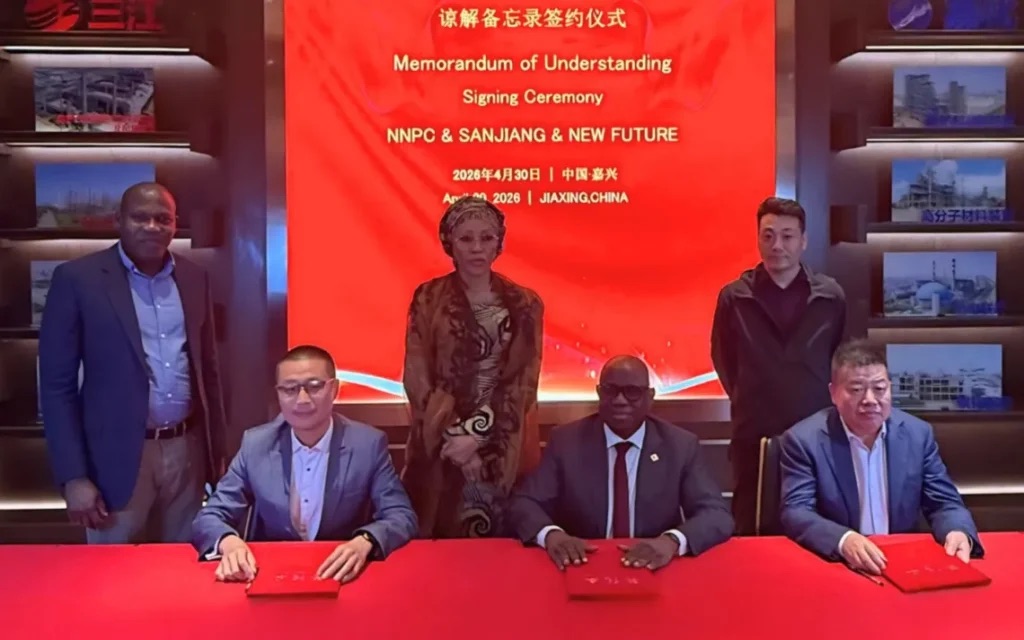
The Nigerian National Petroleum Company Limited (NNPC Ltd) has signed a Memorandum of Understanding (MoU) with two Chinese firms, Sanjiang Chemical Company Limited and Xingcheng (Fuzhou) Industrial Park Operation and Management Co. Ltd, to advance the restart, rehabilitation and expansion of the Warri and Port Harcourt refineries.
The agreement, signed in Jiaxing City, China on Thursday, April 30, 2026, follows more than six months of technical and management-level engagements aimed at unlocking new investment pathways for Nigeria’s refining and downstream petroleum sector.
NNPC said the partnership is expected to explore a potential Technical Equity Partnership (TEP) framework that would support the completion of outstanding works at both refineries, while also enhancing operational efficiency and long-term profitability. Speaking after the signing, the Group Chief Executive Officer of NNPC Ltd, Engr. Bashir Bayo Ojulari, described the MoU as a major milestone in ongoing efforts to restore Nigeria’s refining capacity and attract strategic technical partners.
He noted that the collaboration reflects a shared commitment to developing gas-based industrial hubs and expanding petrochemical capacity around co-located energy infrastructure.
“All parties recognise the mutually beneficial opportunities for developing refineries and harnessing gas and downstream petrochemical value chains,” he said, adding that the initiative would position both facilities for cleaner, more efficient and globally competitive operations.
The proposed collaboration also envisions upgrading refinery systems to higher performance standards, while integrating industrial park models to maximise value creation.
According to NNPC, the MoU sets the stage for further discussions, with any final agreement subject to due approvals and due diligence processes.
Chief Corporate Communications Officer of NNPC Ltd, Andy Odeh, reaffirmed that the partnership reflects the company’s broader strategy to reposition Nigeria’s downstream sector through strategic global alliances and investment-driven reforms.
Meanwhile, the corporation has remitted N2.88 trillion to the federation between January and March 2026, as it recorded a profit after tax of N276 billion in March, driven largely by stronger gas production.
The figures were disclosed in the company’s latest monthly report released on Monday, which noted that all production, sales and financial data remain provisional and subject to reconciliation with relevant stakeholders.
According to the report, revenue for March stood at N2.774 trillion, reflecting the scale of the national oil company’s operations and its continued role as a major fiscal anchor for the country.
Gas production rose to 7,731 million standard cubic feet per day (mmscf/d) in March, up from 7,458 mmscf/d recorded in February, which shows a steady upward trajectory since late 2025. Gas sales also increased to 5,059 mmscf/d from 4,893 mmscf/d in the preceding month, indicating stronger demand and improved distribution.
Crude oil and condensate production posted a modest increase to 1.56 million barrels per day (mmbopd) in March, compared to 1.51 mmbopd in February, suggesting a gradual recovery in output. However, crude oil and condensate sales declined to 17.27 million barrels in March from 23.08 million barrels in February, pointing to possible logistical or export constraints during the period despite improved production levels.
Providing context for the gains, the company said production improved following the early completion of turnaround maintenance on the OML 118 Bonga asset, delivered 12 days ahead of schedule.
The report, however, noted that performance was partly impacted by operational disruptions, including a leak on the Trans Forcados Pipeline, which led to outages across several assets between February 20 and March 25.
Despite these challenges, the company’s financial and operational performance highlights its continued importance to the nation’s economy, as it remains a dominant player across the upstream, midstream and downstream segments, with its statutory remittances forming a significant share of government revenue.
The company had earlier reported a profit after tax of N5.4 trillion on revenue of N45.1 trillion for the full year ended 2024. It also remitted N12.117 trillion to the Federal Government between January and October 2025, reinforcing its position as a key revenue driver for the federation.
A debt relief approved by Bola Tinubu in December 2025 also saw the clearance of $1.42 billion and N5.57 trillion from the company’s obligations to the Federation Account, further strengthening its financial standing.










Leave a comment